
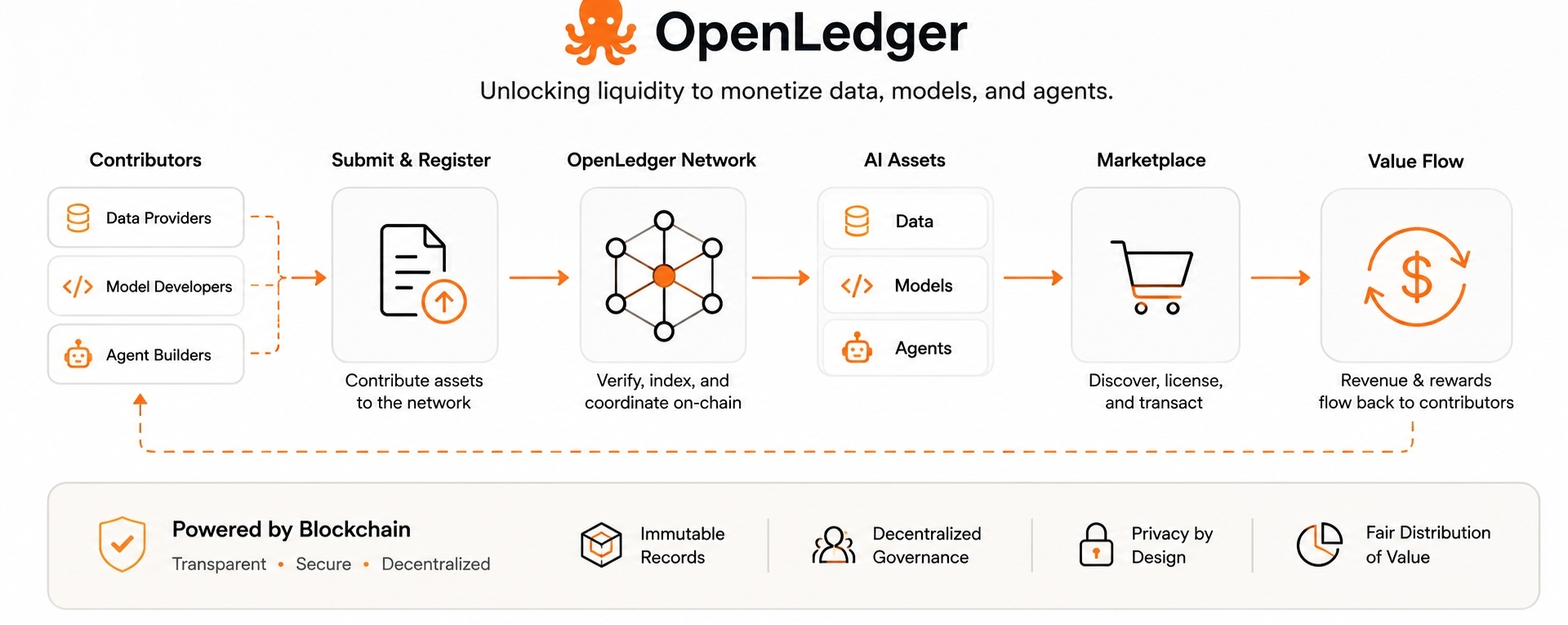
I keep coming back to OpenLedger for reasons that honestly have nothing to do with hype.
Most projects disappear from my mind a few days after I read about them. The narratives are usually predictable now. Bigger ecosystem. Faster chain. Better AI. More scalability. More adoption. Crypto has learned how to package ambition extremely well. Sometimes too well. Everything starts sounding finished before it has even been tested properly.
But OpenLedger does not sit in my mind like a finished system. It feels unfinished in a way that keeps bothering me.
Not broken. Just unresolved.
And maybe that’s because the problem it is trying to approach is bigger than infrastructure itself.
The internet quietly trained people to stop thinking about ownership a long time ago. We upload, search, type, scroll, react, and feed systems every day without really questioning where the value flows afterward. Most people accepted that trade years ago because convenience felt worth it. Free platforms became normal. Data extraction became invisible. Nobody really stopped to ask what happens when the thing being extracted is no longer just consumer behavior, but intelligence itself.
Now AI arrives and suddenly data is not just background material anymore. It becomes the fuel behind models, agents, automation systems, prediction engines, recommendation layers, and digital behavior itself. The value of information changes completely once machines start learning from it continuously.
That shift feels important to me.
And I think OpenLedger understands that tension better than people realize.
Not because it has all the answers, but because it seems focused on something uncomfortable most systems still avoid directly. Who actually benefits when intelligence becomes infrastructure?
That question sounds simple at first, but the deeper I think about it, the messier it becomes.
Because systems built around AI almost naturally drift toward concentration over time. Better models attract more usage. More usage creates more data. More data improves the models again. Stronger infrastructure attracts stronger developers. Eventually the network effect starts feeding itself.
And crypto likes to believe tokenization automatically solves that problem.
I’m not fully convinced it does.
Sometimes decentralization in crypto feels more cosmetic than structural. The interfaces look open. Governance exists on paper. Participation is technically available to everyone. But real influence slowly accumulates around smaller circles anyway. Usually the people with better infrastructure, deeper resources, stronger coordination, or simply more time.
I keep wondering whether OpenLedger could slowly drift into the same pattern if it ever becomes deeply integrated into real AI activity.
Not immediately. That’s what makes these systems difficult to judge.
Centralization rarely arrives like an attack. Most of the time it arrives disguised as optimization.
The most reliable operators become dominant because users trust consistency. Larger contributors gain leverage because they can produce better outputs. Governance participation slowly shrinks because normal users stop caring enough to stay involved. Over time the network can still look decentralized publicly while important decisions quietly narrow into smaller groups behind the scenes.
Honestly, that feels less like corruption and more like human behavior.
People usually choose convenience before principles once systems become useful enough.
And AI makes that risk even stronger because most users will never fully understand the infrastructure underneath the products they interact with daily. If the tools work smoothly, people stop questioning the layers beneath them. They stop asking who controls access, who influences incentives, who benefits most from the economic structure, or how power is slowly shifting internally.
That’s the part I cannot stop thinking about with OpenLedger.
Because if the project succeeds, the pressure on its incentive structure becomes much heavier than it looks right now.
The idea of monetizing data sounds fair in theory. Contributors create value, so contributors should capture value. Simple enough. But markets change behavior the moment incentives become financialized.
What kind of data gets rewarded under pressure?
Does quality stay important, or does the system slowly optimize toward engagement, visibility, and output volume instead? Do contributors remain authentic once synthetic behavior becomes profitable? What happens when AI agents themselves begin generating economic activity inside the same network they are helping train?
At that point, the system stops being purely human-driven.
And honestly, I do not think anyone fully understands what those feedback loops eventually look like.
Maybe they become healthy. Maybe decentralized ownership creates stronger alignment than traditional platforms ever managed. Maybe OpenLedger becomes one of the rare systems where contribution and value remain connected over time instead of separating completely.
Or maybe the same old internet patterns quietly return again in a different form. Extraction hidden behind participation. Coordination hidden behind openness. Influence hidden behind governance processes most people eventually stop paying attention to.
I think that uncertainty is why the project stays in my mind.
Not because I’m convinced it wins.
Actually the opposite.
It stays in my mind because I cannot cleanly resolve the contradictions inside it.
Part of me thinks systems like this might become necessary once AI becomes deeply integrated into everyday digital life. Another part of me thinks every infrastructure layer eventually faces the same gravity pulling power toward concentration once real dependency forms around it.
And maybe the real test for OpenLedger will not happen during growth phases at all.
Growth hides weaknesses.
Communities stay optimistic while incentives are expanding. Governance feels active while attention is high. Everyone believes in decentralization more easily before difficult tradeoffs appear.
The real pressure probably arrives later.
When participation slows down. When incentives become less attractive. When coordination becomes harder. When users stop caring about ideals and start caring mostly about efficiency, reliability, and convenience.
That is usually the moment where systems reveal what they actually are underneath.
And I still cannot tell whether OpenLedger would resist that pressure… or slowly adapt to it the same way almost every large system eventually does.