
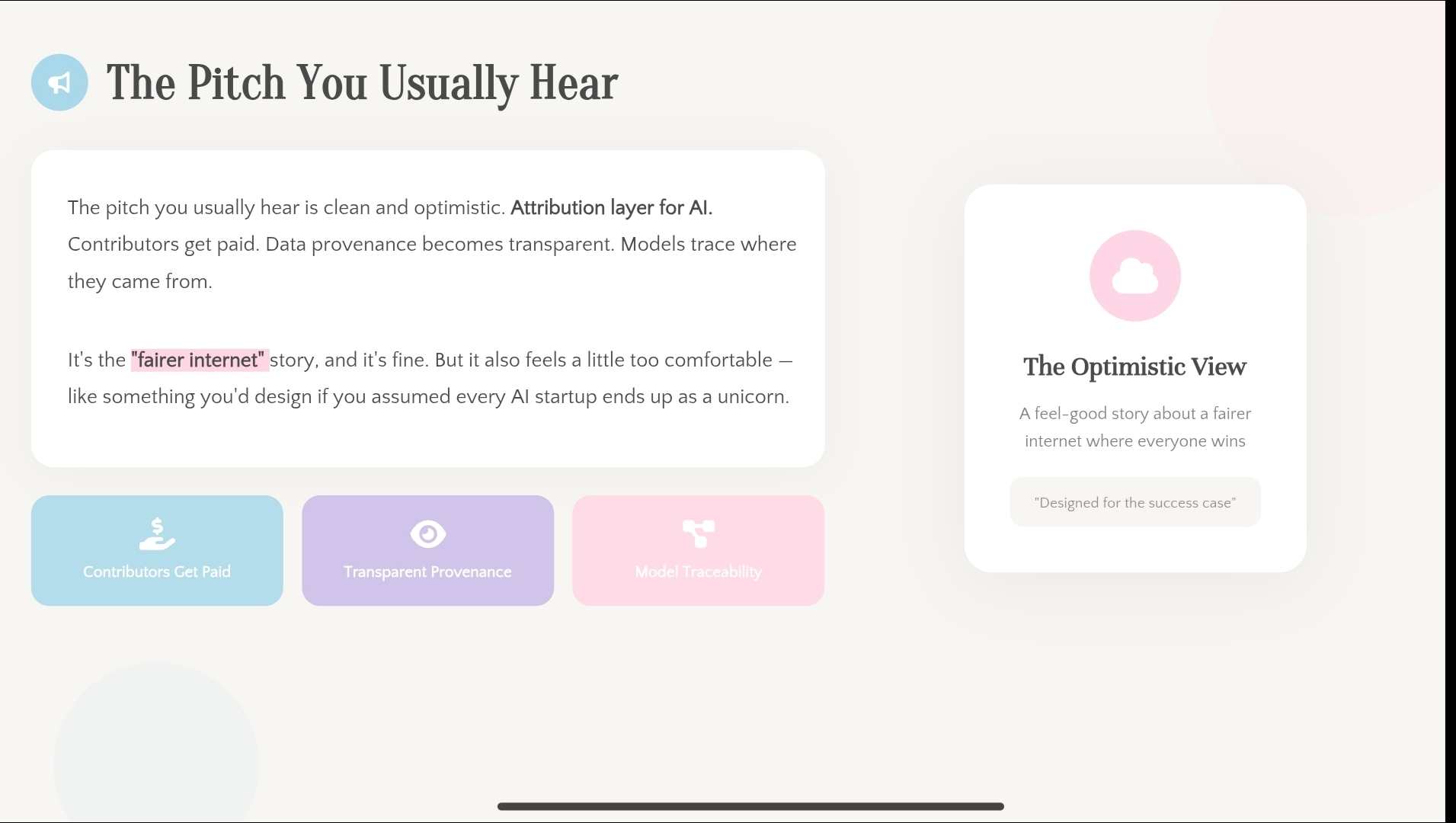
I’ve been watching the OpenLedger narrative for a while, and honestly? I think most people are reading it backwards.The pitch you usually hear is clean and optimistic. Attribution layer for AI. Contributors get paid. Data provenance becomes transparent. Models trace where they came from. It’s the “fairer internet” story, and it’s fine. But it also feels a little too comfortable — like something you’d design if you assumed every AI startup ends up as a unicorn.
Here’s the thing though. Most don’t.
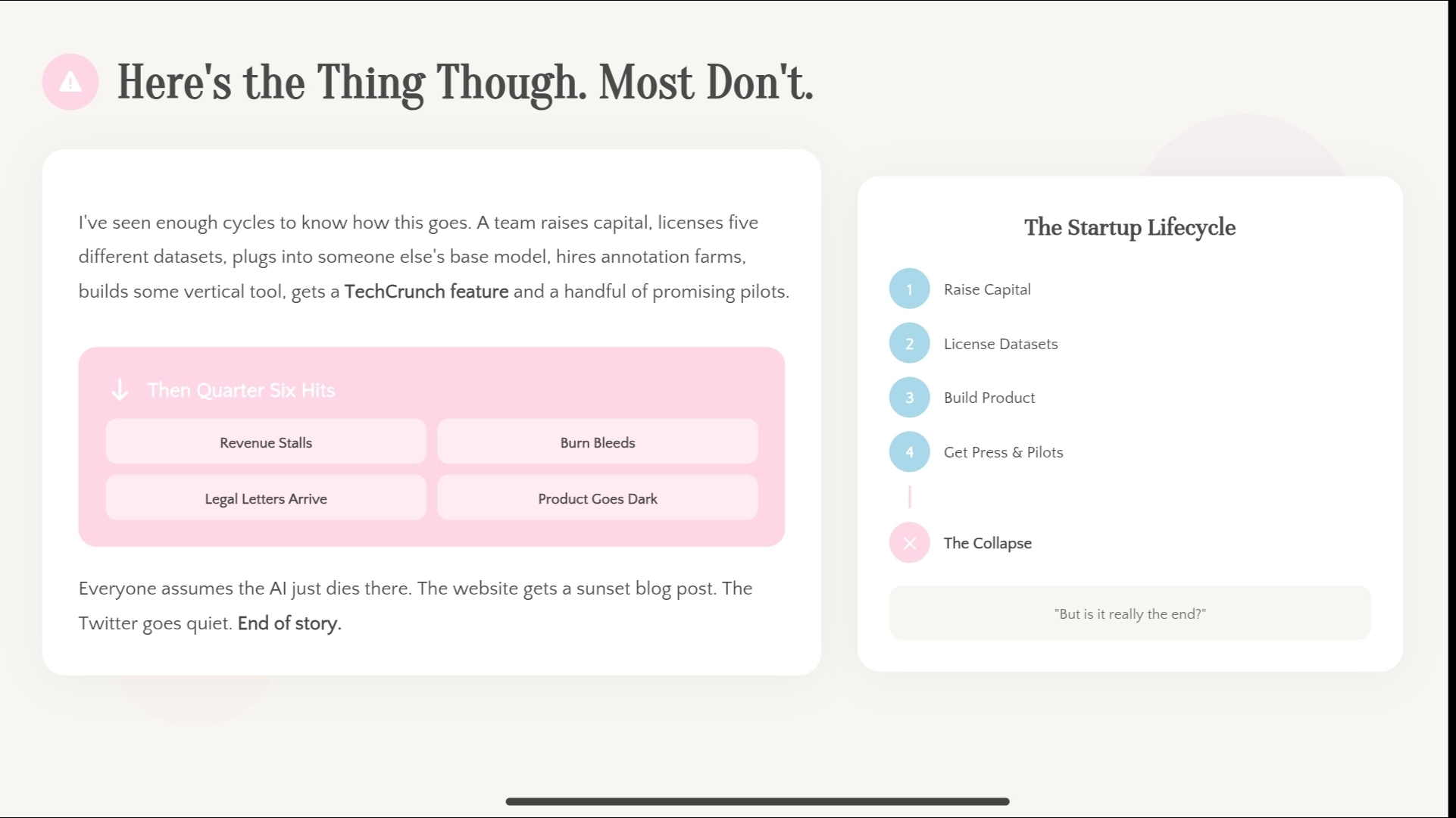
I’ve seen enough cycles to know how this goes. A team raises capital, licenses five different datasets, plugs into someone else’s base model, hires annotation farms, builds some vertical tool, gets a TechCrunch feature and a handful of promising pilots. Then quarter six hits. Revenue stalls. Burn is bleeding. Legal letters start showing up. The product goes dark. Everyone assumes the AI just dies there. The website gets a sunset blog post. The Twitter goes quiet. End of story.
But is it?
Because when that company shutters, the economic mess doesn’t vanish with the Slack workspace. Someone licensed that health data. Someone fine-tuned that model. Someone provided the annotation labor. There were contracts, promises, implied dependencies — and now there’s no revenue to settle anything. That’s when the vague handshakes and “we’ll figure it out later” agreements turn into actual disputes.And that’s the moment I keep coming back to when I look at OpenLedger.Not the success case. The failure case.
The Mess Nobody Talks About
Picture a medical AI startup. They built a diagnostic assistant. They’re using licensed clinical datasets, a third-party architecture, proprietary fine-tuning weights, external annotators, maybe a live retrieval layer pulling from hospital systems. Totally normal setup.Now the company folds. Ordinary, boring failure.Who gets paid from whatever’s left? What if a data provider says the model was commercially dependent on their contribution way more than disclosed? What if a regulator shows up asking for provenance documentation? What if distressed asset buyers need to know exactly what ownership exposure they’re inheriting?
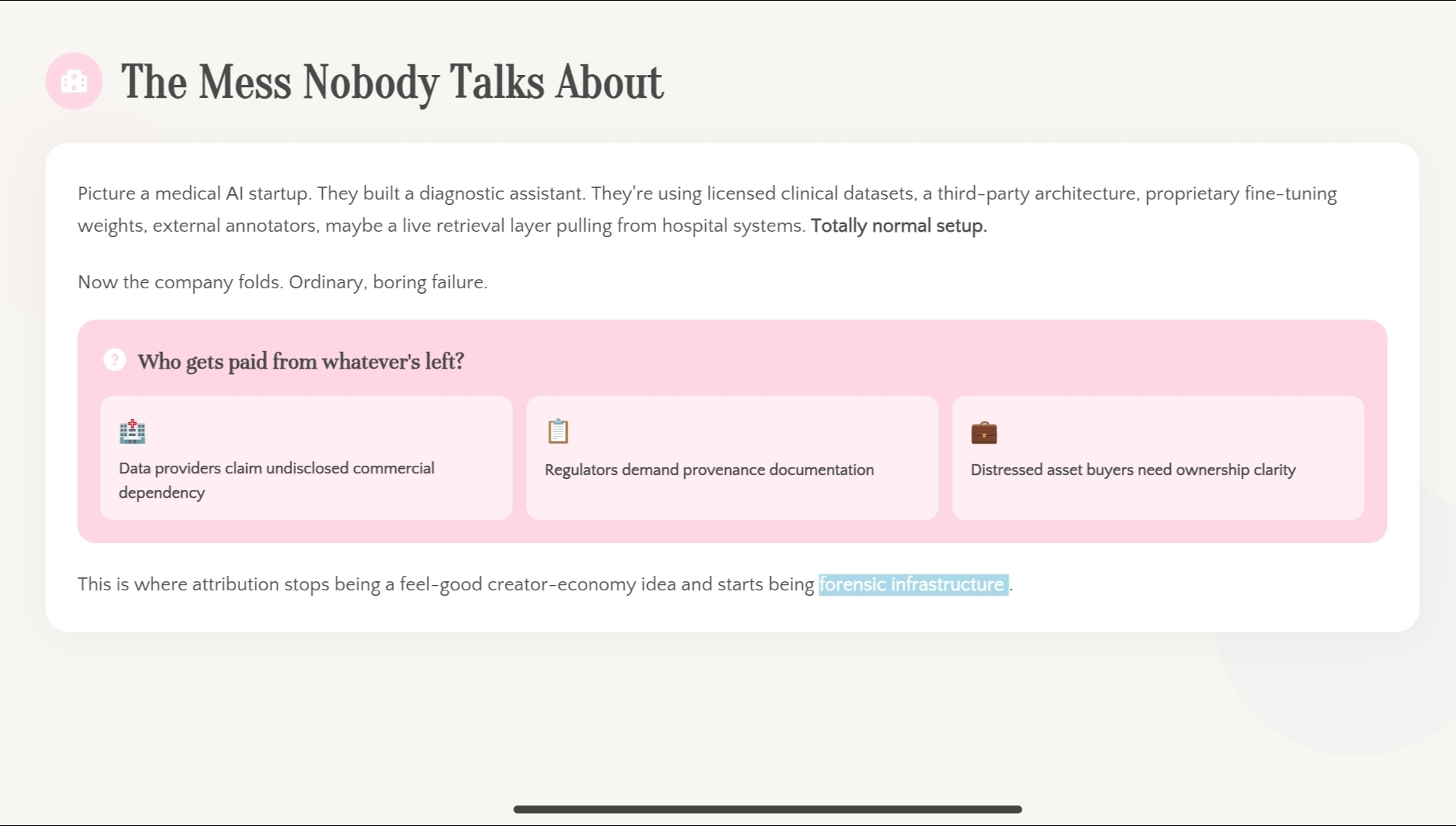
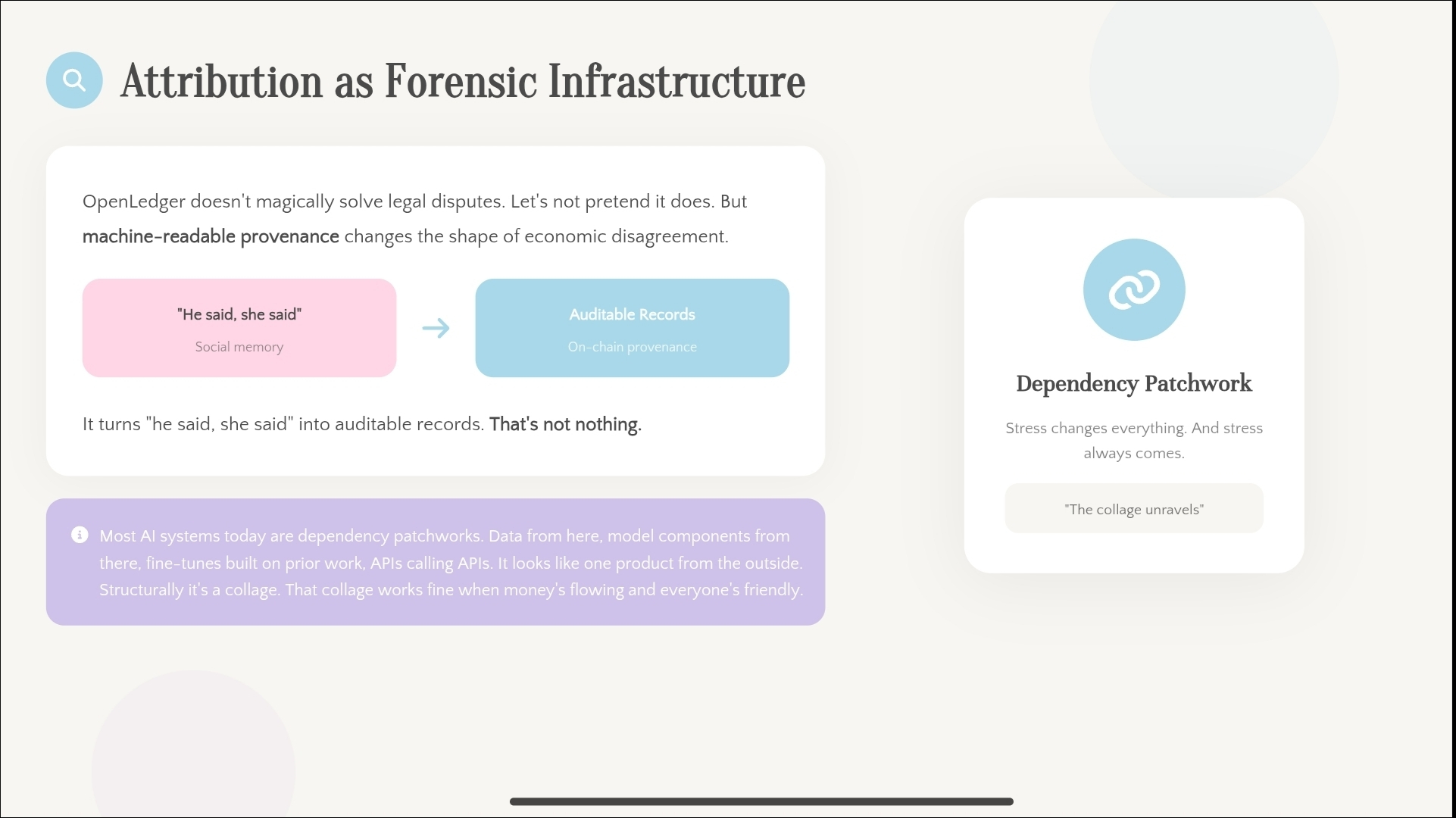
This is where attribution stops being a feel-good creator-economy idea and starts being forensic infrastructure.OpenLedger doesn’t magically solve legal disputes. Let’s not pretend it does. But machine-readable provenance changes the shape of economic disagreement. It turns “he said, she said” into auditable records. That’s not nothing.Most AI systems today are dependency patchworks. Data from here, model components from there, fine-tunes built on prior work, APIs calling APIs. It looks like one product from the outside. Structurally it’s a collage. That collage works fine when money’s flowing and everyone’s friendly.Stress changes everything. And stress always comes.
Crypto Should Know This Already
We’ve lived this. DeFi treasuries. Validator economics. Governance expectations that seemed obvious until the treasury drained and suddenly nobody agreed on what “community ownership” meant. AI won’t be different just because the landing pages are prettier.What OpenLedger seems to be building — conceptually, at least — is infrastructure where contribution history becomes economically legible instead of socially remembered.
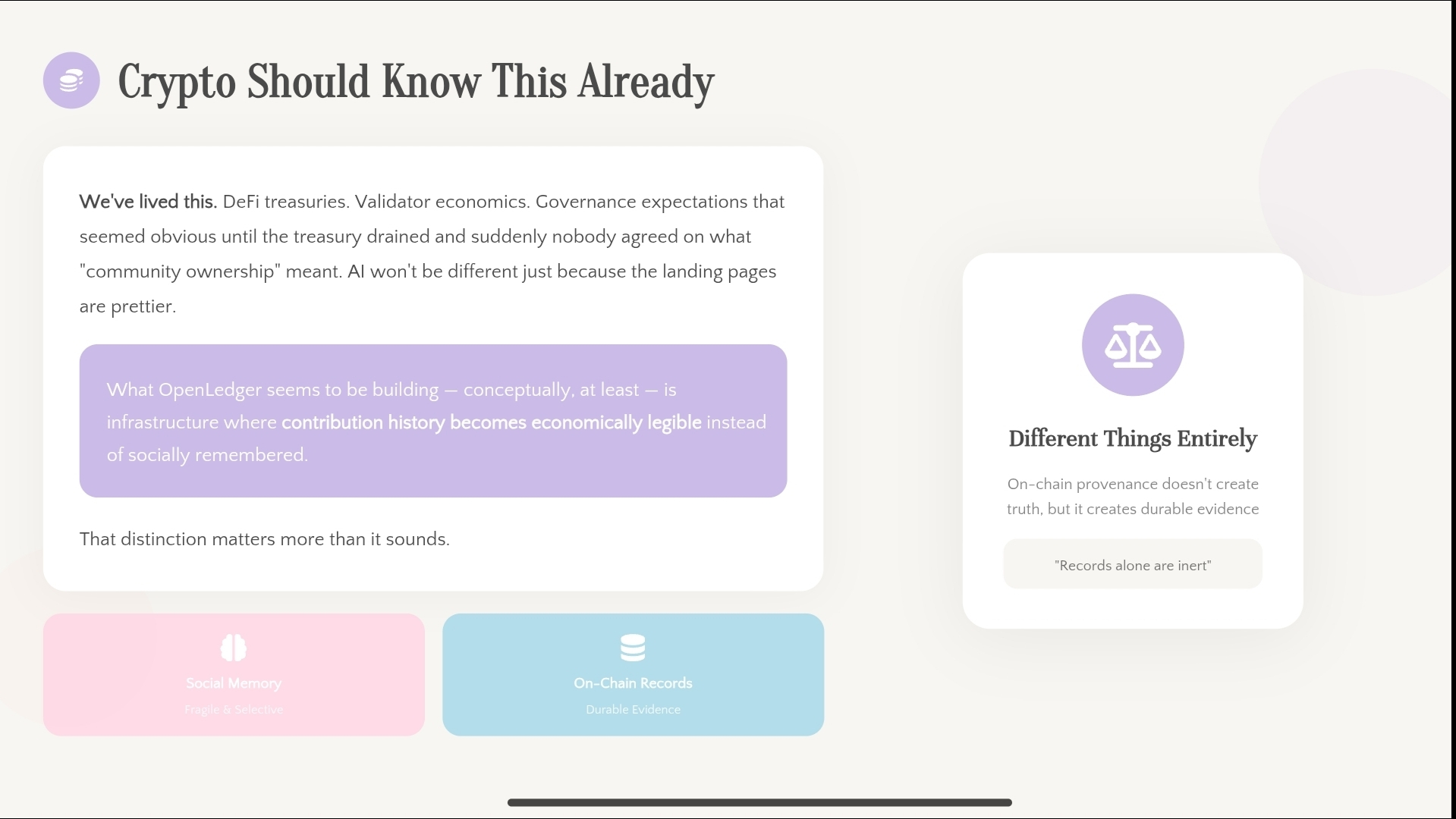
That distinction matters more than it sounds.
Social memory is fragile. Documentation gets selective. Teams dissolve. Cloud accounts get deleted. People conveniently re-read contracts when the outcome changes. On-chain provenance doesn’t create truth, but it creates durable evidence. Different thing entirely.Of course, records alone are inert. “Put it on-chain” isn’t “problem solved.” Crypto people forget this constantly.If $OPEN ends up as just a utility token for routing activity, the thesis gets thinner. Interesting, sure, but limited.
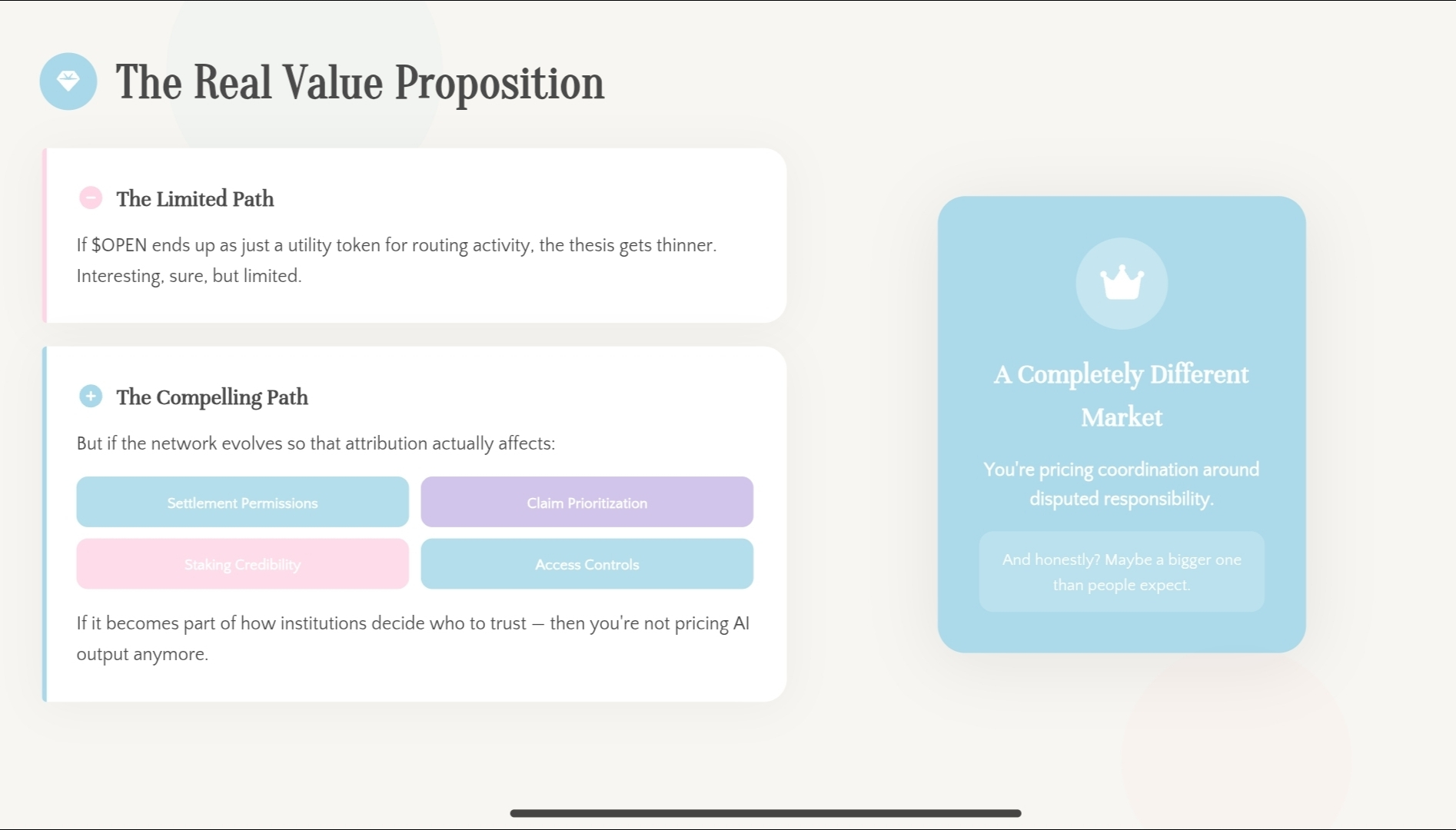
But if the network evolves so that attribution actually affects settlement permissions, claim prioritization, staking credibility, access controls — if it becomes part of how institutions decide who to trust — then you’re not pricing AI output anymore.You’re pricing coordination around disputed responsibility.That’s a completely different market. And honestly? Maybe a bigger one than people expect.The Boring Problem Enterprise Actually Cares AboutRetail narratives keep missing this. Everyone’s obsessed with agent hype and autonomous economies. Meanwhile, enterprise procurement teams are sitting there asking one question: what’s our exposure?They’re not scared of AI being dumb. They’re scared of hidden liability. Data contamination they didn’t catch. Ownership chains that look clear until they don’t. Compliance surprises that show up six months post-deployment.
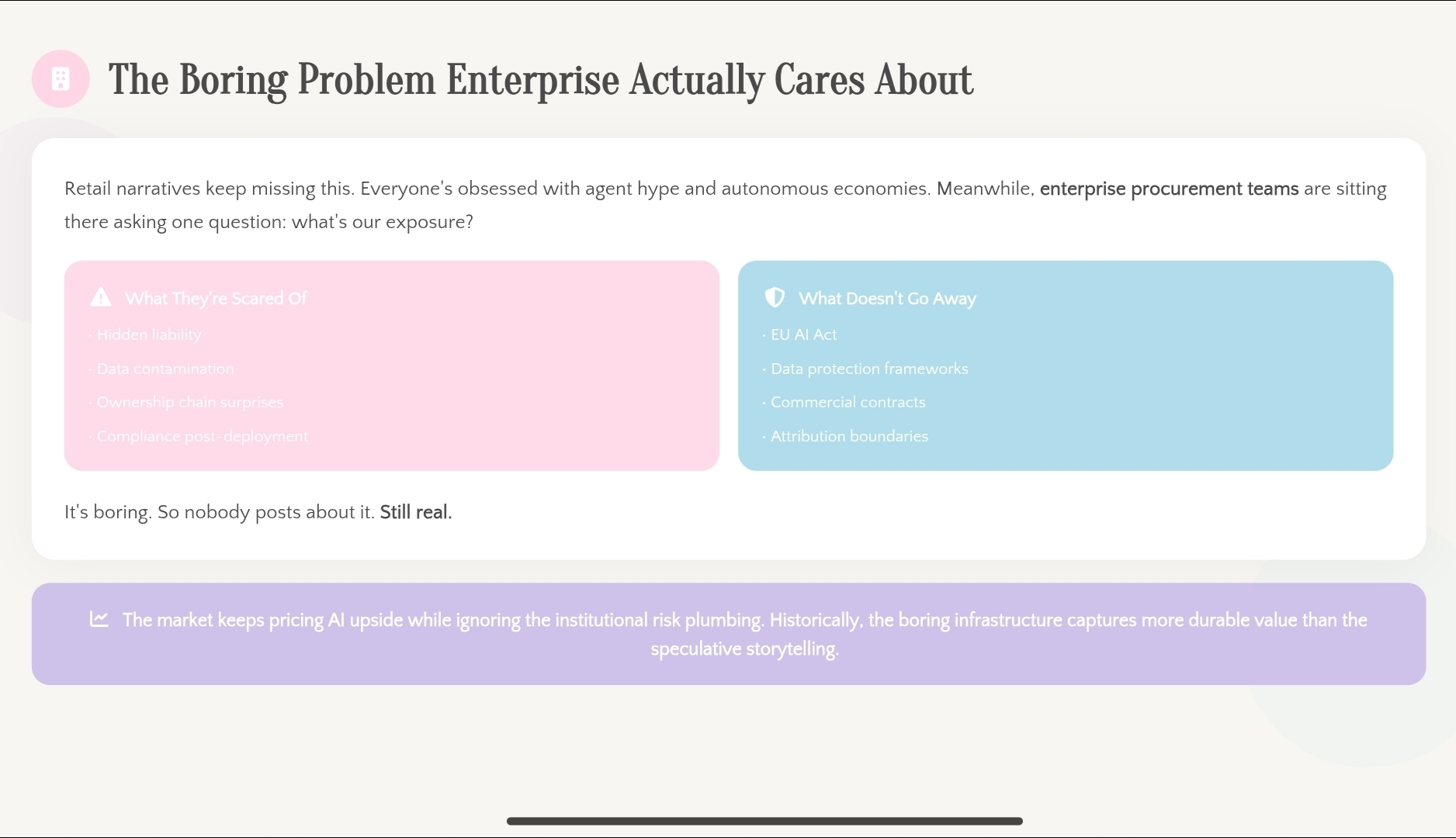
It’s boring. So nobody posts about it. Still real.
The EU AI Act isn’t going away. Data protection frameworks don’t evaporate because the model got smarter. Commercial contracts still care about attribution boundaries even when the technical stack makes them blurry.The market keeps pricing AI upside while ignoring the institutional risk plumbing. Which is weird, because historically the boring infrastructure captures more durable value than the speculative storytelling.The Honest Problems None of this is clean, though. Attribution itself is messy as hell.How much did one dataset actually matter? Was a contributor economically material, or just technically adjacent? If a model touched ten thousand micro-inputs, does everyone get a recurring claim forever? That path gets absurd fast. You can’t build functioning markets where every microscopic contribution becomes permanent financial overhead. The admin weight alone would crush coordination.
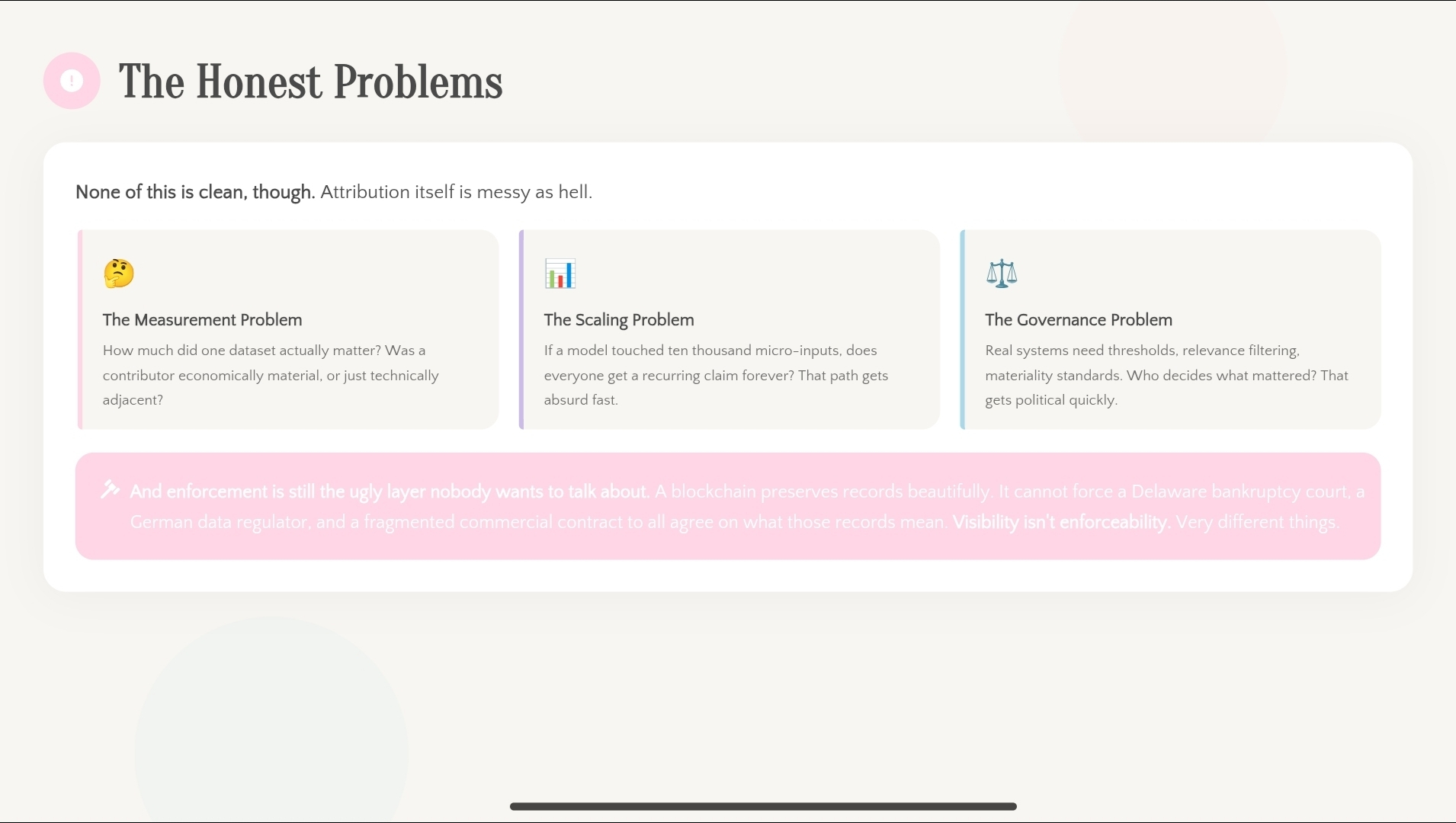
So any real system needs thresholds. Relevance filtering. Materiality standards. Maybe deliberate exclusion.Which immediately raises governance questions. Who decides what mattered? That gets political quickly.And enforcement is still the ugly layer nobody wants to talk about. A blockchain preserves records beautifully. It cannot force a Delaware bankruptcy court, a German data regulator, and a fragmented commercial contract to all agree on what those records mean. Visibility isn’t enforceability. Very different things.Why I Keep Coming Back to It Anyway Still. I can’t shake the feeling that the market is misunderstanding where attribution infrastructure becomes actually necessary.
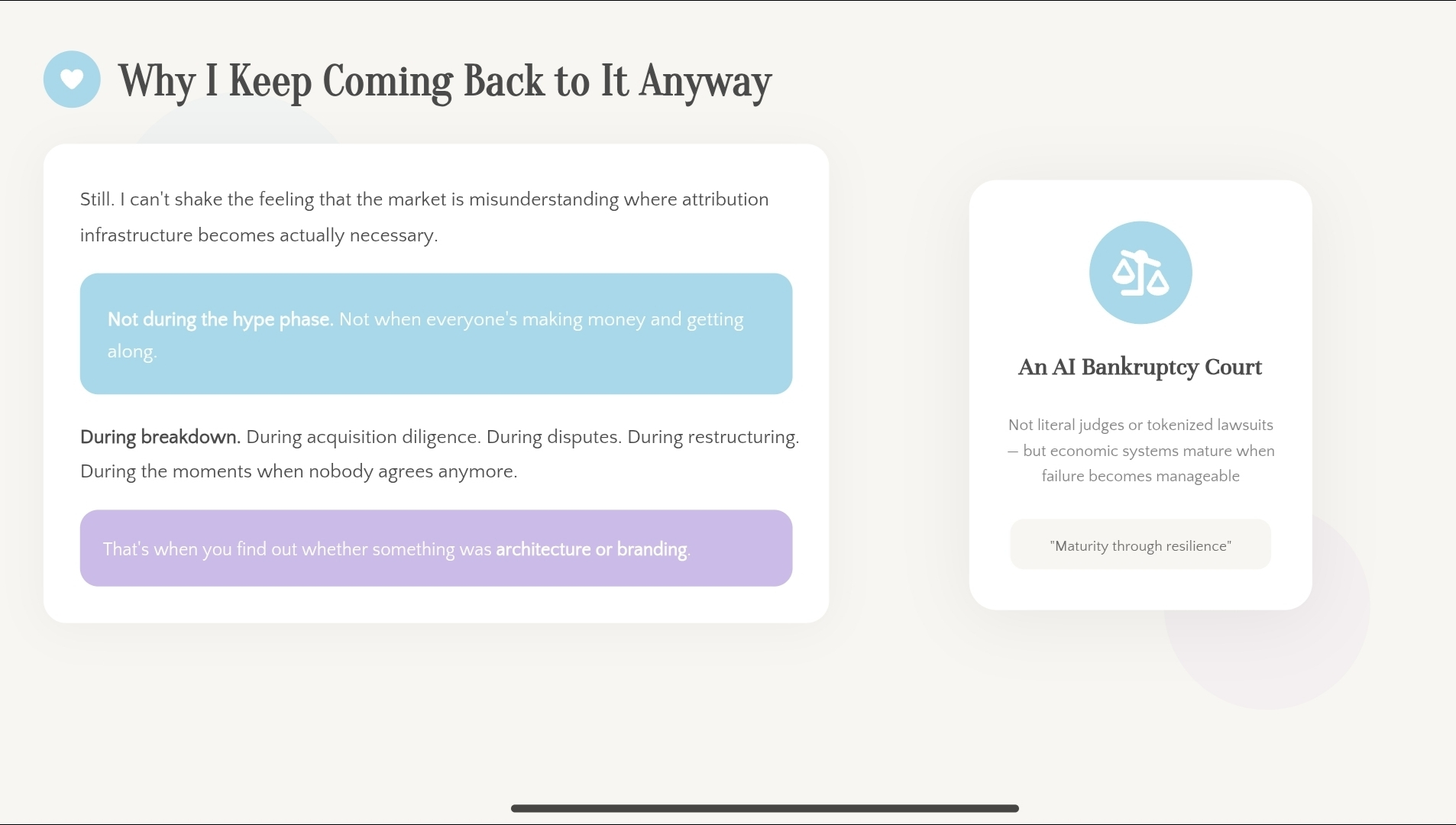
Not during the hype phase. Not when everyone’s making money and getting along. During breakdown. During acquisition diligence. During disputes. During restructuring. During the moments when nobody agrees anymore. That’s when you find out whether something was architecture or branding.When I describe OpenLedger as resembling an AI bankruptcy court, I don’t mean literal judges or tokenized lawsuits. I mean something simpler: economic systems mature when failure becomes manageable.AI still feels young because it mostly talks about acceleration. Infrastructure that helps markets survive disagreement might end up mattering more than infrastructure that just helps optimism move faster.
It’s a less exciting story.
Might be the real one though.