
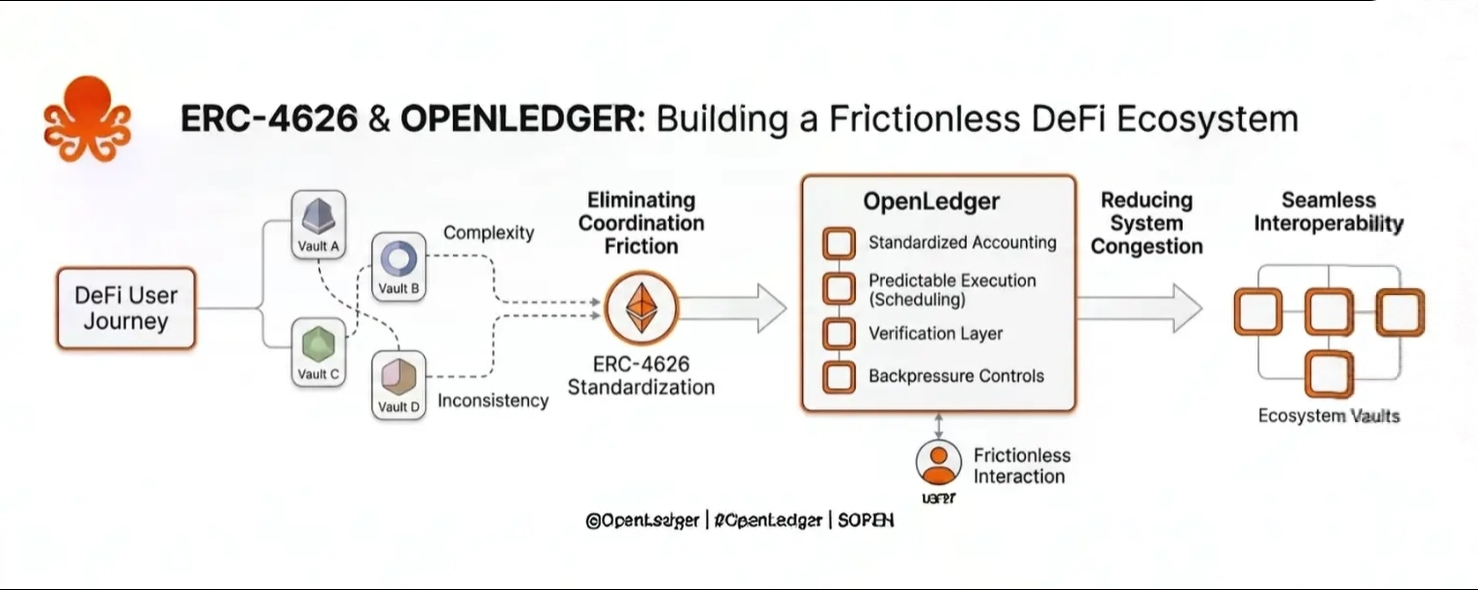
There was a moment when I was moving assets acr0ss a few DeFi platforms late at night, and I remember stopping halfway through the process because something felt unexpectedly tiring. Not risky. Not broken. just mentally exhausting in a way that is difficult to explain unless you spend a lot of time interacting with different protocols.
One vault displayed balances differently. Another represented shares in a completely different format. I kept opening extra tabs just to confirm whether I was interpreting the numbers correctly.
And the strange part was that every platform technically worked.
That experience changed how 1 look at DeFi infrastructure.
In my experience watching crypto systems evolve, the biggest problems are not always dramatic failures. Sometimes the deeper issue is inconsistency between systems that are supposed to work together. Small differences in accounting logic, vault structure, or asset representation may not seem important at first, but over time they quietly create friction everywhere.
What matters in practice is not only whether a protocol functions on its own. It is whether multiple systems can remain coordinated once users, liquidity, and workloads constantly move between them.
I often think about it like traveling through different cities where every train station uses completely different signs and ticket formats. The trains still move. The stations still operate. But the overall experience becomes slower and more confusing because every transition forces people to relearn basic interactions again.
DeFi increasingly feels similar to that.
As ecosystems beCome more connected, consistency starts becoming part of scalability itself. From a system perspective, reducing coordination friction matters just as much as increasing throughput.
That is honestly why ERC-4626 continues to hold my attention.
What interests me more is not the standard as a trend, but the thinking behind it creating a shared structure for tokenized vaults so protocols can interact with each other more predictably without constantly rebuilding their own isolated accounting systems.
And when I look at how @OpenLedger approaches infrastructure, this kind of standardization feels naturally aligned with the ecosystem’s longer term direction.
What caught my attention is that the design in OpenLedger seems focused less on isolated protocol activity and more on how different layers continue coordinating as complexity increases over time.
and honestly, I think that matters more than people realize.
Because resilient systems are usually shaped by smaller architectural decisions happening quietly underneath the surface.
Scheduling matters because vault interactions still need predictable execution during heavy activity. Task separation matters because accounting flows, liquidity movement, and verification layers should not interfere with each other unnecessarily. Verification flow matters because systems managing value need consistency across integrations, especially once multiple protocols begin interacting simultaneously.
Congestion control becomes important too. Weak coordination often creates bottlenecks long before systems visibly fail. That is where workload distribution and controlled parallelism become meaningful not because they sound impressive, but because they help maintain stability when demand becomes uneven.
Backpressure is another thing I quietly pay attention to. Strong infrastructure absorbs pressure gradually instead of allowing instability to spread across the ecosystem all at once.
And honestly, the more time I spend studying infrastructure, the more I feel standards are often underestimated precisely because they work quietly in the background.
Most users rarely notice smooth coordination when everything functions properly.
they only notice it when systems stop communicating clearly with each other.
A reliable ecosystem is not the one making the loudest claims. It is the one quietly reducing friction while complexity continues growing underneath the surface.
Good infrastructure rarely draws attention to itself. It simply keeps things working when the environment around it becomes more connected and demanding.