
A little after midnight, I found myself staring at OpenLedger without really meaning to. Not in that dramatic “I discovered something” way. More like the way you keep refreshing a chart even after you know nothing useful is going to appear there. The market was doing what it always does. People were forcing confidence into sentences. Liquidity was moving before anyone had a clean explanation. Everyone seemed busy trying to decide whether this was another AI narrative or something with actual weight behind it.
At first, I thought I was watching another familiar cycle. Then I realized the token was not the part bothering me. It was the question underneath it.
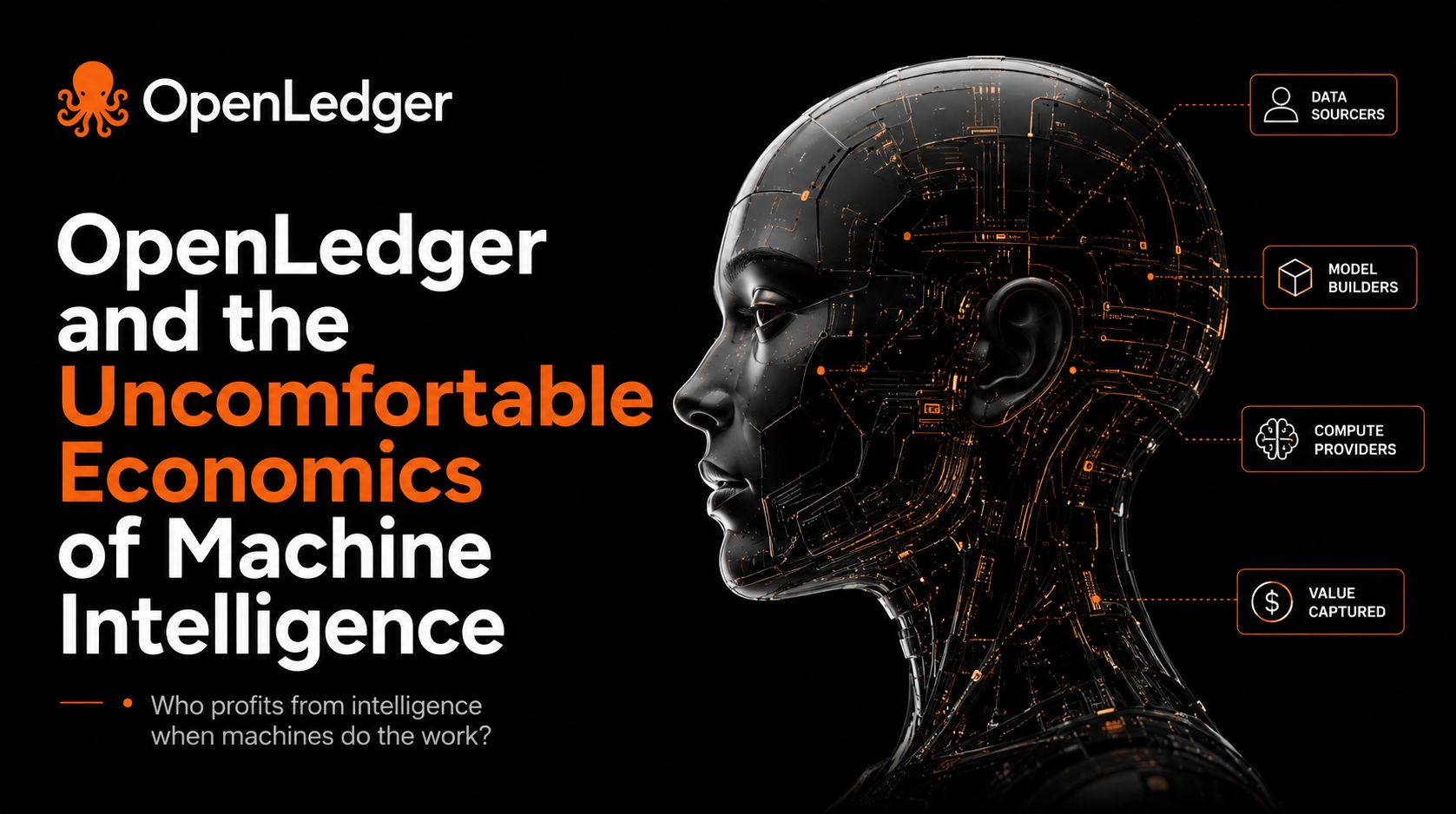
Who gets paid when AI starts creating value?
Most of the AI economy right now feels strangely invisible. People feed systems with data, feedback, behavior, corrections, prompts, labels, taste, attention, and work. Machines improve from all of it. Platforms capture most of it. And the average user is left with the feeling that they participated in something, but cannot quite prove what they contributed.
That is where OpenLedger started to feel more interesting to me. Not because it magically solves everything. I do not think any project does. But because it seems to be pointing at a problem the market keeps trying to avoid: AI needs an economy around it, and that economy cannot only belong to the companies sitting closest to the servers.
If machines are going to produce, verify, route, and act across the internet, someone has to track what matters. Who contributed useful data. Who improved a model. Who verified an output. Who helped an agent become more reliable. Who deserves a reward when intelligence becomes less like a tool and more like a working layer running quietly behind everything.
That is not a hype story. It is actually a little uncomfortable.
Because incentives always change people. The moment contribution becomes payable, people start optimizing for reward. The moment data becomes valuable, people start treating it like inventory. The moment AI output needs verification, trust stops being a feeling and becomes a market.
OpenLedger sits right inside that tension.
And maybe that is why I cannot look at it with clean optimism or clean doubt. It feels too early, too messy, too connected to a larger shift happening across crypto and AI. The internet is becoming less human on the backend, even while the front still looks human. Behind every simple interface, more systems are beginning to talk to other systems. Agents, models, validators, datasets, payments, proofs, incentives. A quiet machine economy forming under familiar screens.
The market still wants easy labels for it. AI token. Data network. Infrastructure play. Incentive layer. But those labels feel too small. OpenLedger feels more like a sign of pressure building somewhere deeper.
Maybe it becomes useful infrastructure. Maybe it gets distorted by the same incentive games that ruin so many open systems. Maybe both happen at once.
That is the part I keep coming back to. Crypto has always promised better coordination, but coordination is not romantic when real money enters the room. It becomes messy. Emotional. Strategic. Sometimes ugly. AI adds another layer of weirdness because now the participants are not only people anymore. Machines are entering the economy too.
So when I look at OpenLedger, I do not see a simple bet. I see a question taking shape.
If AI creates value from many invisible inputs, can that value be traced fairly?
I do not know the answer. I am not even sure the market wants the answer yet. But something has shifted. The speculation is still there, loud as ever, but beneath it there is this quieter movement toward attribution, verification, and machine-driven economic activity.
And once I noticed that, it became hard to unsee.
The chart went back to being a chart. The timeline went back to pretending it understood everything. But the question stayed with me.
Maybe the next phase of AI is not just about smarter machines. Maybe it is about who gets remembered, rewarded, or erased when those machines start working.