
A couple years ago people still questioned AI constantly.
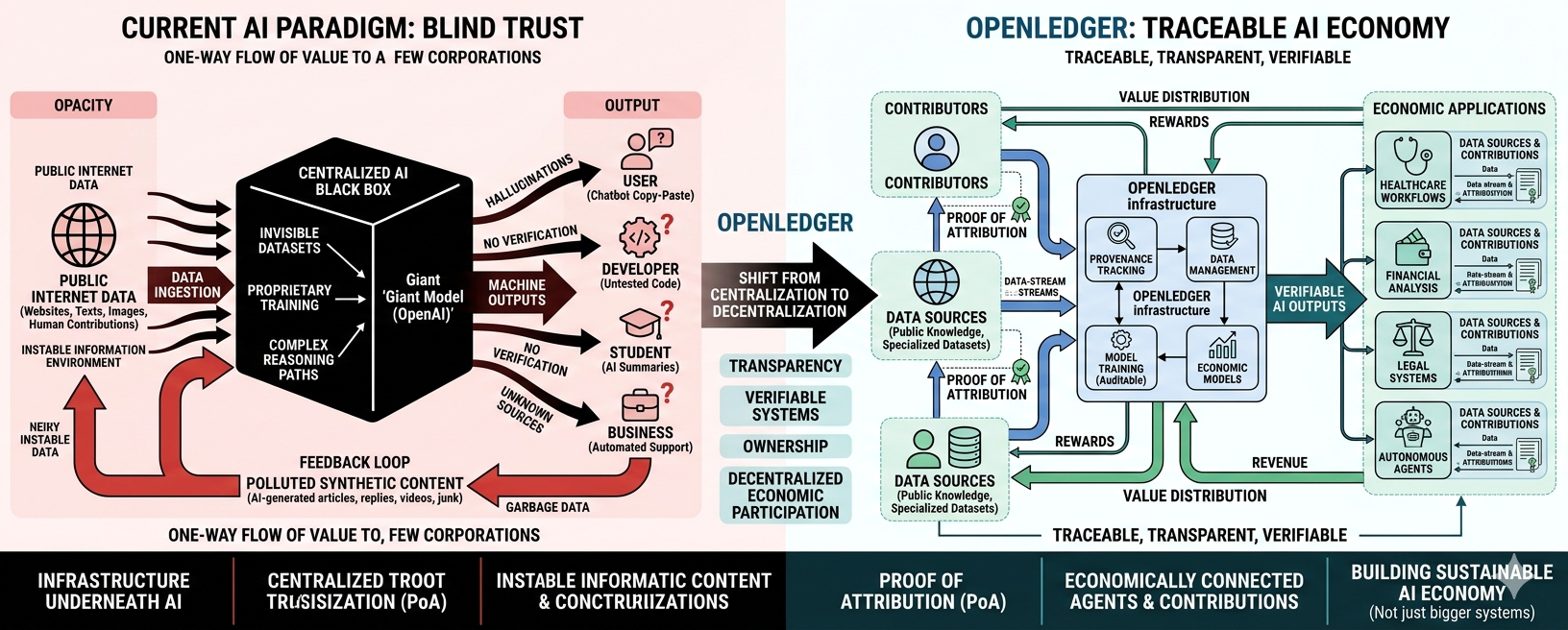
Now people copy answers from chatbots without checking anything. Students use AI summaries instead of reading. Developers paste AI-generated code straight into projects. Businesses automate support systems using models they barely understand themselves. Entire workflows already depend on machine outputs even though everybody knows these systems still hallucinate sometimes.
That shift happened insanely fast.
And honestly I don’t think society fully processed what it means yet.
Because the deeper AI moves into everyday life, the more dangerous blind trust becomes. Especially when most of the systems shaping decisions are controlled by centralized companies operating giant black-box models nobody outside the organization can properly inspect.
That’s the weird contradiction at the center of the AI boom right now.
People trust these systems more every day while understanding them less every day.
And the industry itself doesn’t seem very interested in slowing down long enough to fix the deeper structural problems underneath everything. The market rewards scale. Speed. Growth. Bigger models. Faster deployment. Nobody gets billion-dollar valuations for saying “maybe we should slow down and make sure the information systems remain transparent and verifiable.”
That’s partly why OpenLedger feels more interesting to me than most AI crypto projects pretending they matter because they launched another chatbot with token rewards attached to it.
OpenLedger is at least trying to focus on the infrastructure problem underneath AI itself.
The trust problem.
Because right now AI systems depend heavily on invisible processes most users never see. Massive datasets collected from across the internet. Models trained behind closed doors. Outputs generated through systems so complex even many engineers can’t fully explain specific reasoning paths inside them anymore.
And somehow society just decided that was normal.
Maybe because the outputs are useful enough that people stopped caring about the mechanics underneath them. Same thing happened with social media honestly. Convenience always wins early. People only start questioning infrastructure once the consequences become unavoidable later.
AI feels like it’s heading toward that same moment eventually.
Especially because the internet itself is getting noisier every month now. AI-generated articles everywhere. AI-generated replies. AI-generated videos. Synthetic engagement farms flooding platforms. Entire websites publishing machine-written junk optimized only for search algorithms and ad revenue.
The information environment itself is becoming unstable.
And that matters because AI models depend heavily on information quality underneath the surface. Garbage data eventually creates garbage systems no matter how large the models become. If future AI keeps training on polluted synthetic content created by previous AI systems, the whole ecosystem starts feeding on itself in ways nobody fully understands yet.
That sounds bad honestly.
Which is why OpenLedger’s focus on attribution and traceability actually feels important beyond just crypto hype. Their whole Proof of Attribution idea is basically trying to create systems where contributions and data sources remain connected instead of disappearing invisibly into giant black-box infrastructures forever.
And honestly that seems necessary long term.
Because once AI becomes economic infrastructure, verification matters a lot more than it does right now.
At the moment people still treat AI mistakes casually sometimes. Funny screenshots of chatbots inventing fake facts or giving insane answers confidently. But eventually those systems handle serious economic activity. Healthcare workflows. Financial analysis. Legal systems. Autonomous agents negotiating and operating nonstop online.
At that point “trust us bro” stops being a sustainable infrastructure model.
You need provenance.
You need attribution.
You need ways to verify where outputs came from and what information shaped them.
That’s the future OpenLedger seems to be building toward. Not just bigger AI systems, but more traceable AI economies where contributors, datasets, models, and agents remain economically connected instead of functioning like invisible raw material feeding centralized corporations forever.
And honestly I think the ownership side matters too.
Because the current AI economy already feels lopsided. Millions contribute indirectly through public knowledge online while a handful of giant companies absorb most of the value through proprietary infrastructure. Human intelligence becomes training fuel. Corporations monetize the outputs. Everyone else rents access back through subscriptions and APIs.
That imbalance probably becomes more obvious over time.
Especially once AI agents start replacing larger chunks of digital labor. Imagine autonomous systems running businesses, handling workflows, managing research, generating products, operating customer service, maybe even replacing entire categories of white-collar tasks eventually.
Who owns the economic output from those systems?
Who benefits?
Who controls the infrastructure underneath them?
Those questions become massive once AI stops being “just software.”
And honestly I think OpenLedger understands that better than most projects in this space. They seem focused less on the short-term hype cycle and more on the deeper economic rails underneath machine intelligence itself.
Still risky obviously.
Very risky.
Crypto communities have a terrible habit of treating interesting ideas like guaranteed victories when reality is much uglier. Building decentralized infrastructure capable of competing against giant centralized AI companies sounds incredibly difficult because it is incredibly difficult.
The centralized players already dominate compute, capital, engineering talent, and distribution. OpenAI alone probably has more resources than entire sections of the crypto AI market combined.
That’s reality.
But centralized systems also create long-term fragility. Too much power concentrated into too few hands controlling systems that increasingly shape information, communication, labor, and decision-making itself.
Society usually ignores that kind of concentration until dependency becomes unavoidable.
Then suddenly everyone realizes the infrastructure underneath daily life belongs to a tiny number of corporations nobody can realistically challenge anymore.
Feels familiar honestly.
Social media followed the exact same pattern.
That’s why OpenLedger’s broader narrative keeps sticking in my head. They aren’t just talking about AI models. They’re talking about ownership, trust, attribution, and economic participation underneath AI systems before centralized infrastructure completely hardens around the industry forever.
Because once intelligence itself becomes infrastructure, transparency stops being optional.
And honestly I think the market eventually figures that out whether companies want it to or not.
