
I have been tracking AI-related crypto projects for the past few years, and one pattern keeps showing up again and again. Most teams focus on building smarter models, faster inference engines, or cheaper computing infrastructure. Very few stop to ask a different question: who actually gets paid when AI creates value?
That question sits at the center of OpenLedger (OPEN), an AI-focused blockchain project that is trying to build an economic system around data, models, and autonomous agents. While countless startups are competing to create the next breakthrough AI application, OpenLedger is working on the financial rails underneath the entire ecosystem.
The idea sounds simple at first. Data powers AI. Models generate intelligence. Agents perform tasks. Yet the people contributing those resources often have limited ways to capture long-term value. OpenLedger wants to change that by turning AI assets into liquid, tradable, and rewardable components of a decentralized economy.
Why does this matter?
Look at how today's AI industry operates. Large models are trained using massive collections of data gathered from across the internet. Researchers publish papers that push the field forward. Developers create specialized datasets and fine-tuned models. Communities contribute feedback that improves performance over time. Despite all these contributions, ownership and revenue tend to concentrate around a handful of dominant platforms.
The real problem is not technological. It is economic.
AI has become one of the most valuable industries on the planet, yet its reward mechanisms remain surprisingly narrow. OpenLedger's thesis is that artificial intelligence needs an ownership layer just as much as it needs computational power.
At the heart of the project is the concept of liquidity. In traditional finance, liquidity describes how easily an asset can be bought, sold, or exchanged. Stocks are liquid because markets connect buyers and sellers efficiently. Real estate is less liquid because transactions require time, negotiation, and paperwork.
Now think about AI assets.
A high-quality dataset may be extremely valuable, but finding buyers and managing licensing agreements can be difficult. A niche machine-learning model might solve a real business problem yet struggle to reach customers. Specialized knowledge often remains locked inside organizations despite having potential value elsewhere.
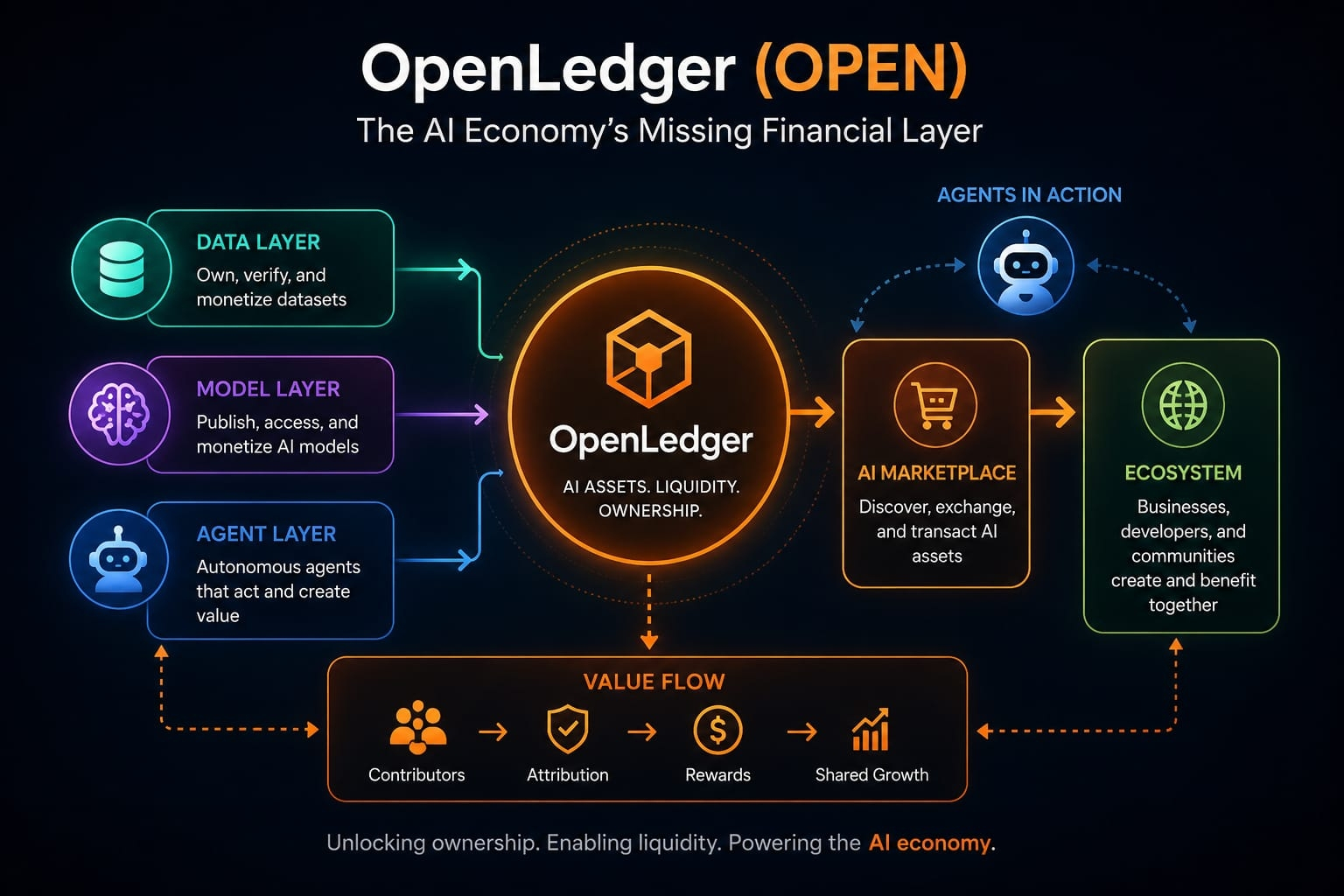
OpenLedger attempts to solve this friction by creating infrastructure where datasets, models, and AI agents can participate in a shared marketplace.
That approach immediately separates it from many blockchain projects currently chasing AI narratives. Some networks focus primarily on decentralized computing. Others specialize in model hosting or data storage. OpenLedger is taking a broader view by connecting multiple parts of the AI value chain into one economic system.
The architecture reflects that ambition.
The data layer focuses on ownership, attribution, validation, and monetization. Contributors can theoretically provide datasets while maintaining verifiable records of usage and value creation. Instead of treating data as a static resource that disappears into a training pipeline, OpenLedger aims to make it an active economic asset.
Above that sits the model layer, where developers can publish and monetize AI models. Think about an independent researcher who builds a highly effective legal-analysis model. Traditionally, commercializing that work requires enterprise sales, partnerships, or venture funding. OpenLedger offers an alternative path where models can potentially generate revenue through network usage.
Then comes the most interesting piece: autonomous agents.
AI agents have become one of the hottest topics in technology. Unlike traditional software, agents can plan actions, gather information, interact with tools, and pursue goals with varying degrees of independence. Many industry observers believe agent-based systems will become a major force in enterprise operations over the next decade.
But here's the catch.
If agents eventually handle research, procurement, scheduling, customer service, and countless other tasks, they will need economic infrastructure. They will need ways to access services, acquire information, pay for resources, and potentially earn revenue.
OpenLedger is positioning itself for that future.
The project envisions an environment where agents are not isolated software tools operating inside closed platforms. Instead, they become participants in a broader digital economy capable of interacting with models, datasets, and services through standardized mechanisms.
Of course, vision alone does not guarantee success.
OpenLedger enters a highly competitive market where dozens of projects are attempting to merge blockchain and artificial intelligence. Competition comes from decentralized compute networks, AI marketplaces, agent ecosystems, and infrastructure providers. Winning attention in such a crowded sector requires more than an interesting whitepaper.
Adoption remains the biggest challenge.
Building a marketplace is easy compared to attracting enough participants to make that marketplace useful. Developers need incentives to deploy models. Data providers need confidence that attribution systems work fairly. Businesses require reliability and compliance before integrating critical operations. Without strong network effects, even sophisticated platforms can struggle to gain traction.
There are technical challenges as well. Measuring the value of individual data contributions is notoriously difficult. AI systems often learn from millions of inputs simultaneously, making attribution a complex problem. Scalability is another concern. Supporting AI-related activity at meaningful scale requires balancing performance, decentralization, and cost.
Regulation adds another layer of uncertainty. Governments are still developing frameworks around AI governance, digital assets, intellectual property rights, and data ownership. Rules established over the next few years could significantly influence how projects like OpenLedger evolve.
Still, the broader trend working in OpenLedger's favor is hard to ignore. AI continues moving from experimental technology into the center of economic activity. As that shift accelerates, questions about ownership, compensation, and participation become harder to avoid.
That is what makes OpenLedger worth watching.
The project is not simply asking how to build better AI. It is asking how the value generated by AI should be distributed in the first place. Whether OpenLedger ultimately becomes a foundational piece of AI infrastructure or one chapter in a larger industry experiment remains to be seen. What is clear, however, is that the conversation it is trying to start may become one of the defining debates of the next decade: who owns intelligence, and who deserves to benefit from it?