
Lately I keep coming back to the same thought about AI, and it’s not even the flashy part everyone talks about. Not the new chatbots or image tools or whatever gets trending for a week and then disappears from timelines. It’s something quieter, but honestly much bigger underneath it all.
Who actually owns this whole machine?
Because the more you look at it, the more you realize AI didn’t just appear out of thin air. It’s built on massive amounts of data, constant human interaction, and endless contributions from users across the internet. Every time someone types, clicks, uploads, or interacts with a system, they’re indirectly feeding it something valuable. And yet most of that value gets pulled upward into a very small group of companies.
That imbalance has always existed, but with AI it feels sharper somehow. More obvious. Almost harder to ignore once you start noticing it.
And that’s probably why projects like @OpenLedger start to feel interesting, even if you’re someone who’s seen a lot of “next big thing” narratives come and go.
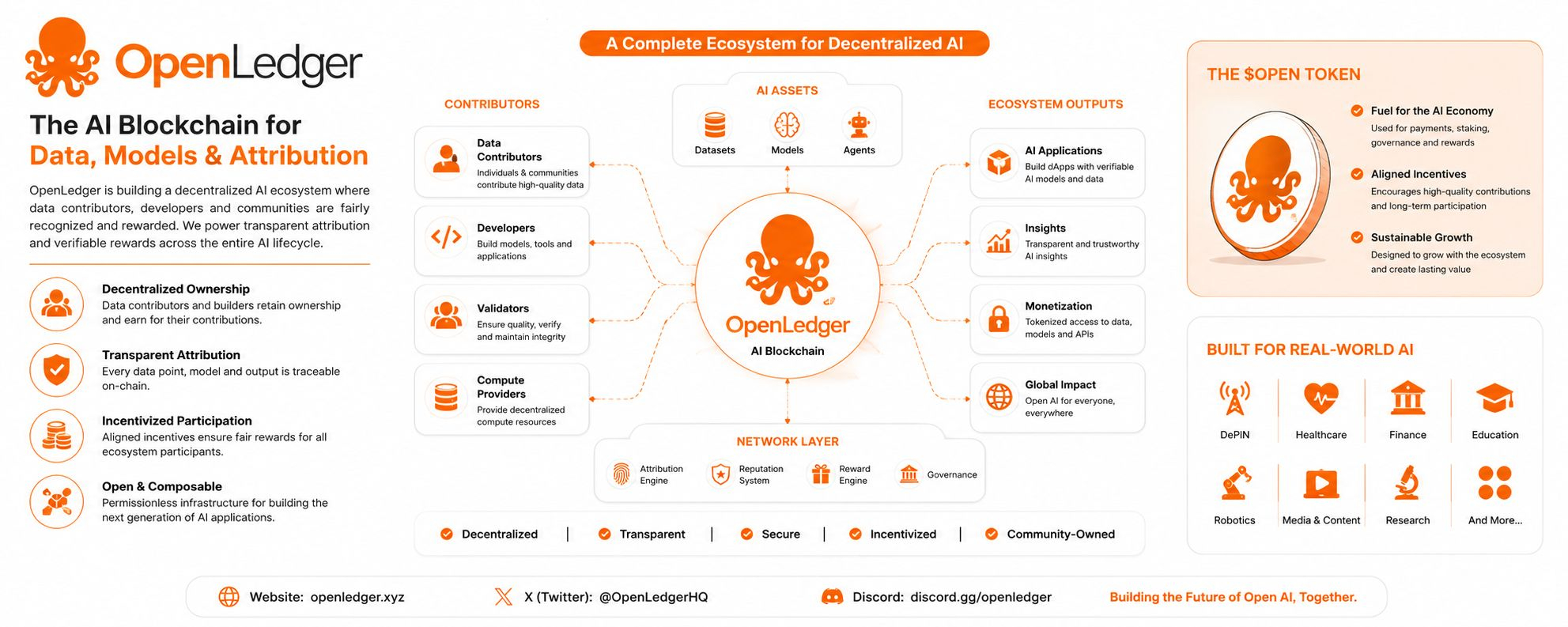
The idea behind $OPEN, at least in the way I understand it, is not just about building another AI platform. It’s more about rethinking the structure underneath AI itself. Who contributes, who gets rewarded, and how value actually moves through the system.
And yeah, that sounds a bit abstract at first. But when you break it down, it actually connects to something very simple. Right now, AI systems are trained on huge datasets that come from everywhere — people, apps, platforms, public content, private interactions. But the people contributing to that ecosystem rarely see any direct return unless they are already inside the system as a paid provider or company.
Everyone else is just… part of the background process.
OpenLedger is trying to challenge that idea. Or at least reshape it. The way it’s positioned suggests a system where data contributors, developers, and communities are not just passive inputs but active participants in the value chain. That shift alone changes the dynamic quite a bit.
Because suddenly it’s not just “AI built by companies for users.” It becomes something closer to a shared infrastructure, where participation itself has meaning beyond just usage.
Now, I’ve seen enough projects in the AI + blockchain space to be a little cautious here. It’s honestly one of those areas where hype can get ahead of reality very quickly. Sometimes “AI” is just added to branding. Sometimes blockchain gets forced into places where it doesn’t really solve anything. You can usually feel when something is being stitched together just to catch attention.
But OpenLedger doesn’t immediately give me that impression. It feels more focused on the infrastructure layer — things like attribution, coordination, and how value flows between participants in a decentralized AI environment. That’s less about surface-level features and more about the foundation everything else is built on.
And foundations matter more than people think, even if they’re not the exciting part.
Because if AI keeps growing the way it’s growing now, it’s going to touch everything. Finance, healthcare, education, media, research, even basic daily decision-making tools. It’s already happening. Slowly at first, then all at once.
And when something becomes that embedded in everyday life, questions start shifting. People stop asking only “what can it do?” and start asking “who controls it?” and “who benefits from it?”
Right now, the answer to that is still pretty centralized. A small group of companies sits at the top of the stack, controlling most of the infrastructure, the models, and the data pipelines. That doesn’t automatically mean the system is broken, but it does mean it’s very concentrated.
And concentration tends to attract pressure over time.
This is where ideas like $OPEN start to feel relevant. If there’s even a partial shift toward decentralized contribution and transparent attribution, it changes how value is distributed. It doesn’t necessarily remove big players from the equation, but it could introduce a parallel system where contributors are more directly tied to outcomes.
Think about it like this. If you’re part of the data layer, or you contribute to model training, or you help build applications on top of these systems, there’s a logical expectation that value flows back in some measurable way. Not just indirectly through ecosystem growth, but more directly tied to participation.
That’s the promise, at least in theory.
Of course, execution is a completely different story. A lot of projects sound great in early narratives and then struggle when reality shows up — scalability issues, adoption barriers, coordination problems, regulatory friction. Especially in something as complex as AI infrastructure combined with decentralized systems.
So I don’t think it’s something to overhype or assume is guaranteed to work out.
But I also don’t think it should be dismissed too quickly.
There’s a kind of shift happening in how people think about technology ownership. We went from fully centralized systems, to slightly more distributed platforms, and now there’s this push toward something even more open where participation itself becomes part of the economy. Whether OpenLedger becomes a major piece of that or just one experiment among many is still unclear.
Still, it’s interesting to watch because it taps into a very real question that’s not going away anytime soon.
What happens when intelligence itself becomes a shared resource?
And if that’s the direction things are moving in, then systems like OpenLedger are at least pointing toward one possible answer — a version where contributors aren’t invisible, and value doesn’t only flow upward.
I don’t think we’re at the point where any of this is settled. It’s early, messy, still forming. But sometimes that’s exactly when the most important shifts start, not when everything is obvious but when things are still being figured out in real time.
So yeah, $OPEN is one of those things I’m not rushing to judge. Not calling it revolutionary, not dismissing it either. Just watching how it develops, and where it actually lands once theory meets reality.
Because that’s usually where the truth shows up anyway.