
The AI space is already getting annoying. Fast.
Every project says the same thing now. “AI-powered.” “Next generation.” “Revolutionary infrastructure.” Cool. Whatever. Most of it is just people throwing buzzwords together and hoping retail gets excited long enough to pump a token.
Meanwhile the real problems are still sitting there untouched.
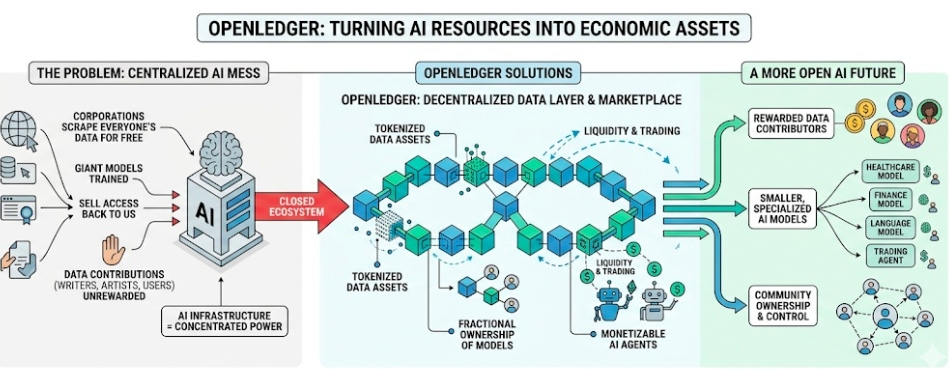
Big companies scrape everyone’s data for free. They train giant models on it. Then they sell access back to us like they built everything alone. Writers, artists, random users posting online every day, all feeding these systems without getting much back. That’s the part nobody wants to say out loud because the whole AI industry kind of depends on pretending this is normal.
It isn’t normal.
And crypto honestly hasn’t helped much either. Half the “AI crypto” projects look like they were made in a weekend. Fancy websites. Big promises. Zero actual reason to exist. Some don’t even need blockchain at all. They just slap “AI” on the front because that’s where attention is right now.
That’s why OpenLedger caught my attention a little. Not because I think it’s magically going to save the industry. Probably not. But at least it’s trying to deal with a real issue instead of inventing fake ones.
The whole idea behind OpenLedger is pretty simple when you strip away the tech talk. Data has value. AI models have value. AI agents have value. Right now most of that value gets locked inside centralized systems controlled by giant companies. OpenLedger wants to make those things tradable and monetizable on-chain instead.
Honestly, that makes more sense than half the garbage getting funded right now.
People underestimate how weird the current AI economy actually is. Millions of people create data every day without realizing they’re basically training future AI systems for free. Every post. Every comment. Every image. Every conversation. Everything gets absorbed into the machine eventually.
Then the same companies training those systems turn around and charge everyone subscriptions.
That model works for corporations. Not for normal people.
OpenLedger seems to be betting on a future where AI becomes more open instead of completely controlled by a handful of companies. Maybe data contributors get rewarded. Maybe smaller developers can monetize specialized models. Maybe AI agents become assets people actually own instead of rented tools sitting behind another monthly payment wall.
And yeah, maybe that sounds idealistic. Crypto loves sounding idealistic before reality punches it in the face. We’ve seen enough projects collapse already to know better.
Still. The problem itself is real.
AI is becoming infrastructure now. That’s the important part. This isn’t just some fun tech demo anymore. Businesses are using it. Traders are using it. Students are using it. Developers are using it. People are building entire workflows around AI systems already and we’re still early.
Which means whoever controls the infrastructure later controls a massive amount of power.
That should bother people more than it does.
Right now most AI systems are locked ecosystems. Closed models. Closed ownership. Closed access. Users put value in. Corporations pull money out. Simple as that.
OpenLedger is trying to flip some of that around by treating AI resources like economic assets instead of locked products. Data becomes something valuable on-chain. Models become something tradable. Agents become something that can generate revenue openly instead of sitting inside centralized apps forever.
At least that’s the idea.
The interesting part is the focus on liquidity. Most people ignore that word because it sounds boring, but it matters. Liquidity changes everything. If AI models and data can move through open markets easier, smaller builders actually have a chance. Niche datasets become useful. Smaller AI systems can survive instead of getting crushed by giant corporations with unlimited compute.
And honestly, smaller specialized AI probably matters more than people think.
Everyone got obsessed with giant models for a while. Bigger. Bigger. Bigger. More GPUs. More money. More training data. But now we’re starting to see smaller focused systems doing better in certain tasks because they’re cleaner and more specialized.
That changes the game a bit.
A focused healthcare model matters. A finance model matters. A regional language model matters. A trading agent matters. Suddenly AI stops being one giant thing and starts becoming thousands of smaller economies connected together.
That’s where something like OpenLedger could actually fit.
But there’s still a lot that can go wrong. Let’s not pretend otherwise.
Crypto people love talking about “decentralization” until you check who owns the tokens. AI people love talking about “open innovation” until investors get involved. Most projects end up chasing hype because hype pays faster than building real infrastructure.
And regulation is coming too. Hard.
Governments are already nervous about AI. Copyright fights are getting uglier. Data ownership fights are getting uglier. Nobody fully agrees on what AI companies should even be allowed to train on anymore.
So this whole space is messy. Really messy.
But I think that’s exactly why projects like OpenLedger keep getting attention. Because underneath all the hype there’s a real tension building online. People know their data has value now. People know AI companies are making insane amounts of money. People know something feels off about the current setup.
The internet trained these models. Humans trained these models. Communities trained these models.
Yet ownership stays concentrated at the top.
That doesn’t feel sustainable long term.
And the thing people really aren’t ready for yet is AI agents. Everyone keeps talking about chatbots while agents are quietly becoming more important. Trading agents. Research agents. Automation agents. Systems that can actually perform tasks on their own instead of just answering questions.
Once those agents start interacting with each other economically, things get weird fast.
Agents paying for data access. Agents renting compute. Agents using models from other networks. Entire machine economies running in the background while humans barely notice.
Sounds crazy right now. But honestly so did AI-generated videos a few years ago.
The infrastructure being built today matters because later it becomes impossible to separate power from infrastructure. Whoever controls the pipes controls the flow.
That’s why I think OpenLedger is at least looking in the right direction even if the entire sector still feels chaotic. It’s focusing on ownership and incentives instead of just screaming “AI” nonstop for engagement farming.
And maybe that’s the biggest thing here.
Most AI projects feel fake because they’re selling dreams before solving basic problems. OpenLedger at least seems focused on a problem that actually exists. Data ownership. AI monetization. Open access. Real incentives.
Not saying it’s guaranteed to win. Most projects don’t.
But if AI really becomes the next major layer of the internet, then systems around ownership and liquidity are going to matter a lot more than people think right now.
Because eventually people are going to ask the question the industry keeps avoiding.
If everyone’s data is building the future of AI, then why do only a few companies own almost everything?
#Openledger @OpenLedger $OPEN #openledger
