
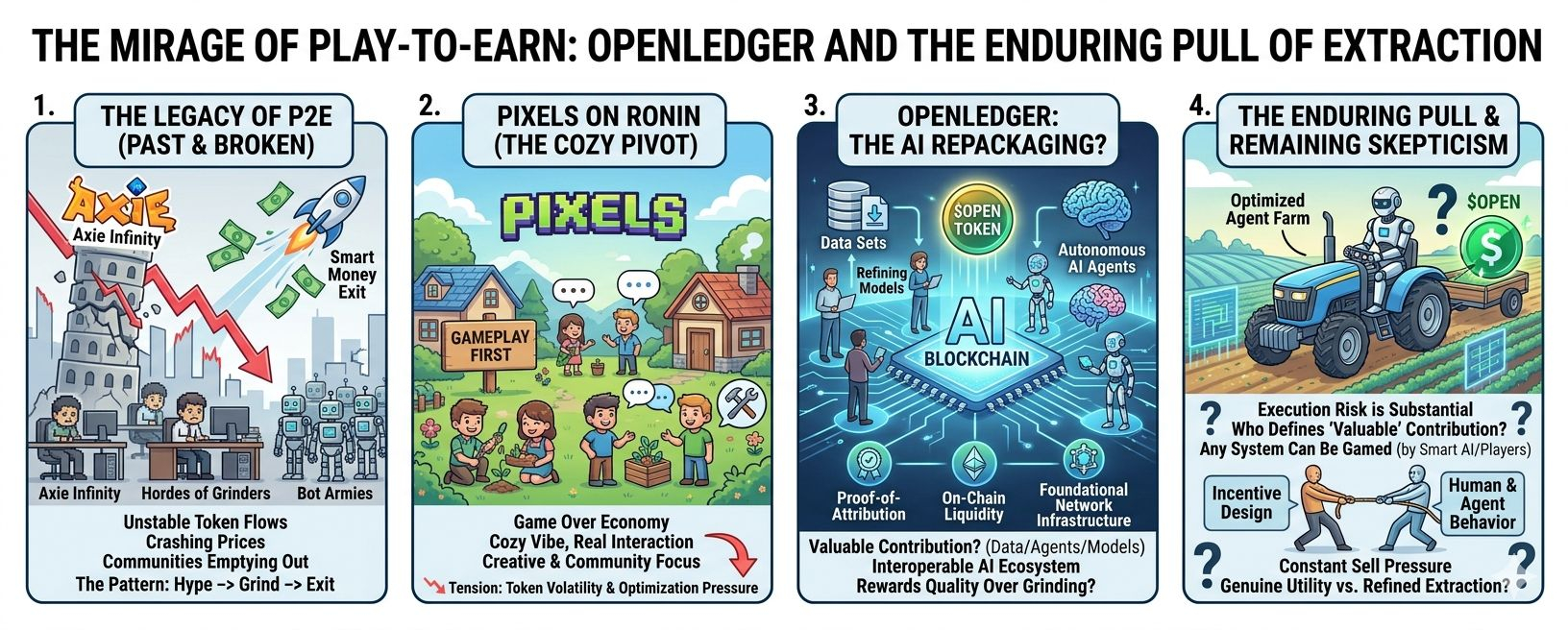

To be completely honest, I get this quiet sense of fatigue every time a new blockchain project arrives claiming it will finally solve crypto gaming. It feels like the same story on a slightly upgraded difficulty setting. Axie Infinity once lit a genuine spark — giving people in tough spots actual earning potential — but reality eventually settled in: unsustainable token flows, bot armies, crashing prices, and communities that slowly emptied out. The pattern is etched in crypto history now. Explosive early hype, hordes grinding for rewards like it’s overtime at a dead-end job, smart money exiting cleanly, and then the long, awkward silence that follows.
OpenLedger, with its $OPEN token, stands out a bit from the usual crowd. Billed as an AI Blockchain designed to unlock liquidity around data, models, and autonomous agents, it reaches into play-to-earn territory without being just another farming simulator. The vision includes verifiable contributions, AI agents participating meaningfully, and on-chain attribution that supposedly makes rewards feel fairer. It’s an ambitious pitch — turning intangible inputs into real economic value. Yet the same skeptical voice in my head keeps asking: Is this project genuinely addressing the broken core of crypto gaming, or is it simply repackaging the extraction model with a more sophisticated AI wrapper?
The fundamental flaw in most play-to-earn experiments has never really been the technology or the pixelated aesthetics. It’s the brutal collision between clever incentive design and how humans — and now increasingly smart AI agents — actually behave when money is on the table. Most players don’t arrive drawn by rich storytelling or compelling mechanics. They chase the yield. They repeat monotonous tasks, sell rewards instantly to cover costs, and the project responds by minting more tokens to keep the illusion alive. What starts as a game quickly morphs into precarious gig work with wildly unpredictable pay. The actual gameplay often feels like an afterthought — just enough scaffolding to justify the token flows until the next market cycle.
That’s why I’ve spent time reflecting on something like Pixels on Ronin. It took a refreshing approach by leading with the game itself — a relaxed pixel farming sim with building, social interaction, and a genuine cozy vibe — before layering on serious economic mechanics. In that sense, it got the order right.
The strength here is intuitive: when people show up because they enjoy tending virtual land and chatting with neighbors, you build something stickier than pure yield tourists who disappear the moment rewards dip. The creative and community elements can turn casual players into invested participants who actually care about the world they’re helping shape.
But the risk is ever-present, and it’s a tough one to dodge. As soon as tokens and real financial stakes enter, player behavior starts shifting in subtle but damaging ways. Spreadsheets replace spontaneity. Optimization crowds out joy. Even a project like Pixels has had to wrestle with this tension constantly, fighting to preserve the soul of the experience amid token volatility. It’s a delicate balance that few manage to sustain long-term.
OpenLedger tries to navigate similar waters but through an AI-first lens. Rather than pure button-click farming, the model emphasizes contributing data, refining models, or deploying agents that deliver tangible on-chain value. The idea of proof-of-attribution — where your input creates measurable impact and you’re rewarded proportionally — feels like a meaningful evolution. It gestures toward rewarding quality and utility over sheer grinding volume. Positioning itself as a broader network infrastructure, rather than a single isolated game, is another smart elevation. The dream is interoperable AI components powering multiple experiences, with liquidity flowing naturally toward genuine usefulness.
On paper, these elements carry real promise. They could soften some of the worst extractive behaviors by better aligning rewards with actual value created. Giving creators liquidity for their datasets or trained agents might reduce reliance on pure speculation and hype cycles.
Yet the real issue remains stubborn. Who defines “valuable” contribution in practice? Any metric system can — and will — be gamed, especially as sophisticated players and autonomous agents gain an edge. Farming doesn’t vanish with AI; it often becomes more efficient and concentrated. And then there’s the $OPEN token staring back at us. No matter how elegant the attribution and utility mechanics look, tokens live under constant sell pressure. Earners cash out. Speculators flip. If organic usage and demand don’t outpace the outflows, the familiar problems of inflation, dilution, or value leakage loom large.
It sounds good on paper — a decentralized AI ecosystem where participants truly own and monetize their contributions in a fairer way. But the execution risk here is substantial. Crypto’s environment is unforgiving: attention shifts quickly, building sustained engagement is difficult, and creating something that remains both genuinely enjoyable and economically resilient over years is exceptionally rare. Transitioning from “one engaging experience” to “foundational network for AI participation” is an intelligent strategy, but it demands excellence across many fronts simultaneously.
I come away with this nuanced, slightly uneasy perspective. Efforts like OpenLedger — and the stronger attempts such as Pixels — show real learning from past failures. They’re grappling more seriously with incentive design, human (and machine) behavior, and the need for authentic utility rather than endless token printing. That intellectual honesty is worth appreciating.
Still, I remain slightly skeptical. The deep tension between pure play and financial extraction doesn’t simply dissolve with better technology or AI enhancements. It often just evolves into more refined, harder-to-detect forms.
It’s an interesting project with thoughtful ambitions. Whether it manages to break the old cycle or merely delays it with smarter packaging… only time will tell. I’ll be watching closely to see how both the agents and the humans actually behave once the real money starts flowing.
