
The more I observe the AI market, the more I feel the most important battle isn’t about which model is smarter or which infrastructure is cheaper. It’s about how different systems quietly reshape the way humans interact with intelligence itself.
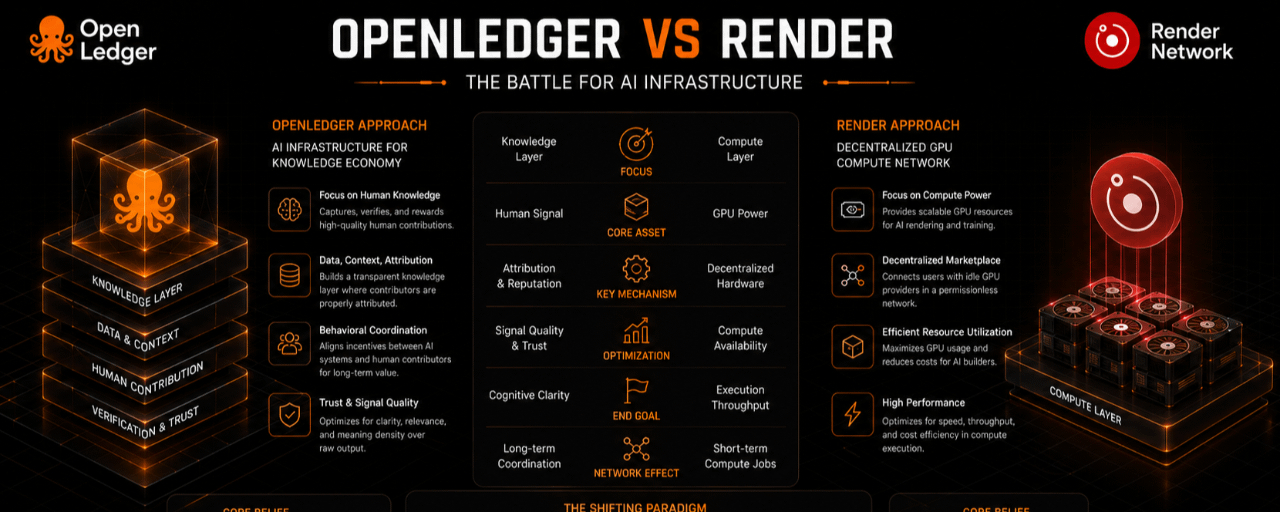
And when I compare OpenLedger and Render, I don’t really see a direct compute war the way many people frame it. From my perspective, it feels more like a competition between two different approaches to organizing human behavior around AI.
Render follows a logic the crypto market already understands well: unused resources, distributed GPUs, decentralized compute, infrastructure marketplaces.
It’s a familiar and compelling narrative because it creates the feeling that computing power is being pulled away from centralized tech giants and redistributed to the network.
But over time, I’ve started to think compute was never the hardest problem.
Attention was.
People no longer suffer from a lack of tools. What they increasingly lack is the mental capacity to process the overwhelming number of tools already available.
That’s why many AI products generate enormous hype initially but struggle to maintain long-term engagement. Most users aren’t actually searching for unlimited capabilities. They’re searching for reduced cognitive friction.
People want systems that help them think less chaotically.
And this is where OpenLedger appears to approach the market differently.
It doesn’t seem to treat AI purely as an infrastructure challenge, but more as a coordination challenge between humans, knowledge, and incentives.
If Render focuses on optimizing the compute layer, OpenLedger seems focused on optimizing the knowledge layer that sits above it — where data, contribution, context, and participation become the real foundation rather than hardware alone.
At first, that distinction sounds subtle.
But underneath it are two completely different assumptions about the future of AI.
One side assumes the bottleneck is computational power.
The other assumes the real bottleneck is the quality of human-generated signals.
And increasingly, it feels like the market is shifting from the first problem toward the second.
A few years ago, the conversation centered entirely around model strength.
Now the questions are changing:
What data is AI learning from? Who produces that data? And what incentives keep people contributing meaningful, high-quality information?
That shift matters more than many realize.
The internet already contains endless information, but very little meaning density.
People react faster than ever, yet think more shallowly than ever.
Everything online is optimized for engagement. Very few systems are optimized for clarity.
Ironically, AI seems to intensify this tension.
As automation scales, the value of raw execution declines while informational noise expands exponentially.
Which creates a strange paradox: the more AI-generated content exists, the harder it becomes for humans to identify what’s actually trustworthy.
That’s why I think infrastructure in the next cycle may no longer be defined only by GPU networks or decentralized nodes.
Infrastructure is slowly becoming whatever shapes cognitive behavior.
The systems that help humans filter signals, coordinate knowledge, and reduce noise may eventually gain a larger advantage than systems that simply generate more output.
And recently, the market reaction itself seems to reflect that transition.
Render represents an era where the central problem is insufficient compute.
OpenLedger appears to emerge in an era where the problem becomes coordination between AI and human knowledge.
They aren’t necessarily direct competitors. They’re optimizing for entirely different futures.
And perhaps the hardest question is that nobody fully knows yet which future the AI economy ultimately values more:
Compute? Or trust?
Because historically, the systems that dominate the internet are rarely the ones with the most advanced technology alone.
They’re the ones that reshape human behavior in the most natural and sustainable way.
I still don’t know whether OpenLedger can fully achieve that vision.
But the longer I watch this market evolve, the more it feels like the AI infrastructure battle is slowly moving away from hardware — far more than most people currently realize.