
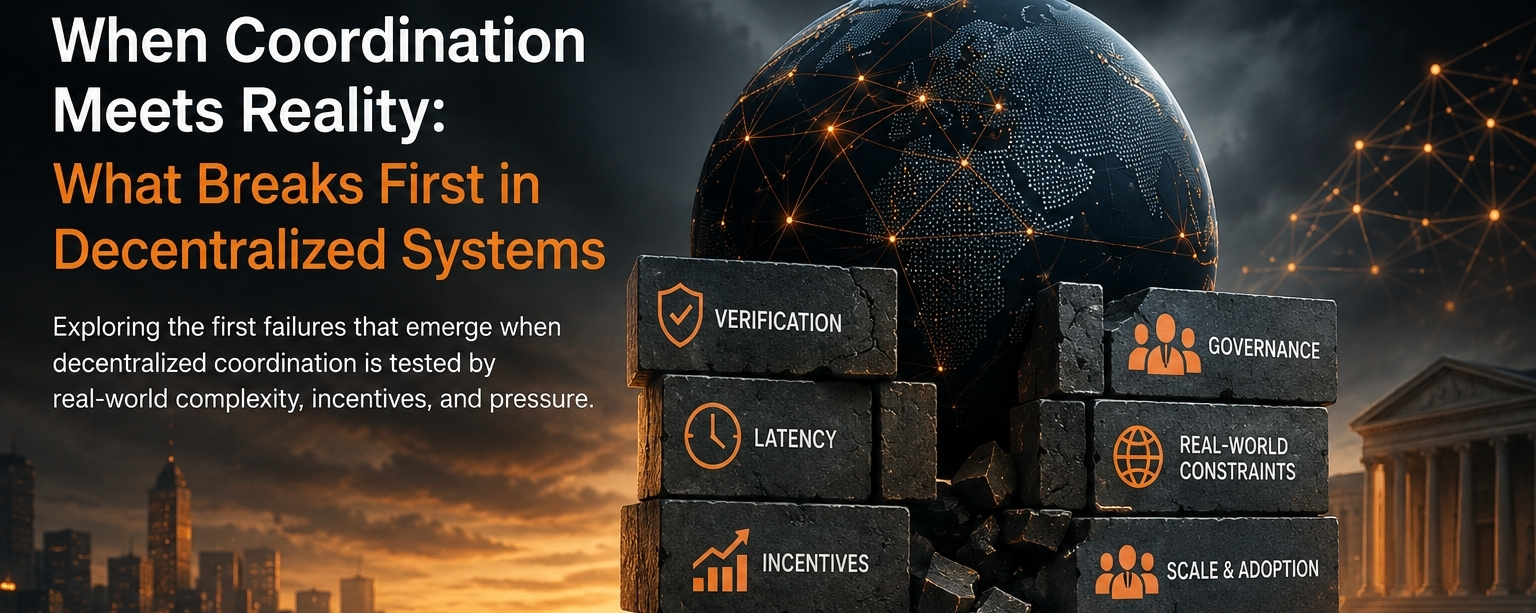
I keep returning to one question whenever I study decentralized protocols in high-stakes environments: what actually breaks first when a coordination system leaves the comfort of theory and runs into the disorder of real life? That question matters more than the usual debates about speed, decentralization, or elegance. In my view, a system is never truly tested when everything is calm. It is tested when people disagree, when incentives shift, when data gets messy, and when the environment stops cooperating with the design.
My own reading of these systems is that the first failure is rarely dramatic. It does not usually begin with a total collapse. More often, it begins quietly. A process takes too long. A decision becomes harder to justify. A trusted input turns out to be less reliable than expected. A small workaround becomes normal practice. That is how coordination systems weaken in the real world: not through one loud event, but through repeated strain on the assumptions underneath them.
In high-stakes settings like finance, AI, governance, robotics, or identity, those assumptions matter even more. A protocol may be technically decentralized, but that alone does not make it stable. It still has to deal with human behavior, competing motives, uneven information, and the fact that real-world actors do not behave like neat model participants. I think this is where many systems become fragile. They are designed to coordinate abstract actors, but they end up serving institutions, developers, users, regulators, and opportunists all at once.
The first place I usually look is verification. A decentralized system can preserve records well, but that does not automatically mean those records are meaningful. It can confirm that a message was submitted or that a transaction happened, but it cannot always confirm whether the underlying data was accurate, honest, or even useful in context. In finance, that becomes dangerous when bad inputs distort decisions. In AI, it becomes harder still because outputs can appear polished while remaining difficult to audit in a practical way. In identity systems, the problem is even more delicate, because the whole structure depends on whether the underlying credentials actually correspond to the person or thing they claim to represent.
From my perspective, this is one of the central tensions in decentralized design. The protocol may be excellent at recording activity, yet poor at judging reality. That gap is easy to ignore when usage is light. It becomes impossible to ignore once stakes rise and mistakes begin to compound.
Latency is another weak point that I think deserves more attention than it usually gets. Decentralized coordination often costs time, and time matters. A process that is acceptable in a slow-moving environment may be disastrous in a live one. Financial systems move quickly. Automated agents act continuously. Security incidents do not wait for consensus. Governance decisions lose meaning when the decision comes too late to matter. I have come to think that delay is not just an inconvenience in these systems. It can become a structural liability.
This creates a hard trade-off. If a protocol favors decentralization and broad participation, it often gives up some speed. If it favors responsiveness, it usually concentrates more authority somewhere. There is no clean escape from that trade-off. I do not think any serious researcher should pretend otherwise. In practice, the question is not whether the trade-off exists. The question is which form of friction the system can survive without losing its purpose.
Incentives are where the picture becomes even more complicated. A protocol can define good behavior in advance, but it cannot prevent participants from adapting those rules to serve their own interests. People are not static inputs. They respond to opportunity. They chase advantage. They exploit ambiguity. That is not a flaw in human nature so much as a basic fact that protocol designers have to live with.
I have seen this pattern repeated in many coordination systems: a design works well when participants are aligned, and then it begins to drift when the economic or political context changes. Some actors start optimizing for short-term gain. Others begin using the system in ways its designers did not expect. At that point, the protocol is no longer managing cooperation alone. It is also managing competition, and competition tends to reveal every soft spot.
Governance is where those soft spots become impossible to hide. Decentralized systems often present governance as a way to preserve neutrality while still allowing change. In theory, that sounds balanced. In practice, it is messy. Someone has to decide what happens during a crisis, how upgrades are approved, whether exceptions are allowed, and who has standing to intervene. Once a protocol reaches that stage, it cannot avoid power. It can only decide how visible, distributed, and accountable that power will be.
My own view is that this is one of the hardest balancing acts in the field. Too much rigidity makes the system unable to respond. Too much flexibility makes it feel centralized and politically exposed. A system can easily end up in the uncomfortable middle, where it is neither fast enough to feel useful nor distributed enough to feel fully trustworthy.
Real-world constraints push all of these tensions into sharper relief. Users do not always behave as the protocol assumes. Regulators do not care that a system is elegant if it cannot be explained, supervised, or contained. Scale changes everything. A protocol that looks stable with a small group can become much harder to manage once it is exposed to broad adoption, automated exploitation, and institutional pressure. At that point, the system is no longer operating in a controlled test environment. It is operating in a living ecosystem.
That is why failure in these systems often looks like gradual erosion rather than collapse. The protocol may still function, but people begin relying on side agreements, trusted intermediaries, or unofficial exceptions to keep things moving. Verification becomes slower or more expensive than the users can tolerate. Governance becomes dominated by a smaller set of voices. The system still exists, but it increasingly depends on practices that were never supposed to be necessary.
I think that is the most important lesson here. Decentralized coordination is not defeated first by a lack of code. It is defeated first by pressure on assumptions. It assumes that participants will remain aligned, that information will stay useful, that decisions can be made at a workable pace, and that legitimacy can survive under stress. Real life tests all of that at once.
So when I ask what breaks first, my answer is usually not the infrastructure itself. It is the expectation that coordination can remain clean once the world becomes complicated. The system does not fail because it is decentralized. It fails when it discovers that decentralization does not remove the need for judgment, trade-offs, and responsibility. In that sense, stress does not merely expose weakness. It tells us where the real work of coordination has always been hiding.