

i keep thinking people talk about Proof of Attribution inside OpenLedger (@OpenLedger ) in this very soft way, almost like it’s just a nicer payment rail for AI. contribute data, shape a model, help an inference happen, then later OpenLedger moves and everyone gets to call it fair. clean story. maybe too clean. too easy. like the architecture only exists for the happy ending.
because the longer i sit with OpenLedger, the less Proof of Attribution feels like a reward system to me. it feels more like a memory layer that makes blame harder to wash off, and that changes the mood completely.
in old AI the black box did something very convenient for everyone powerful inside it. it hid value, obviously, but it also hid responsibility. if a model got trained on bad data, if a weird inference path shaped an answer, if some agent did something reckless after receiving model output, the whole thing blurred together inside one giant OpenLedger system and people just said the model responded. maybe there was a policy issue, maybe a safety issue, maybe a bad dataset, maybe lazy fine-tuning, maybe hidden retrieval, maybe some cheap shortcut in the pipeline. from the outside it all collapsed into one foggy sentence.
the model answered.
that sentence protected a lot more than people admit. because once you cannot separate Datanet influence from model behavior, or model behavior from agent execution, or execution from outcome, nobody really has to carry the full weight of what happened. the platform keeps the upside. the structure absorbs the blame.
and maybe that was the real product for a while… not just intelligence, but blur.
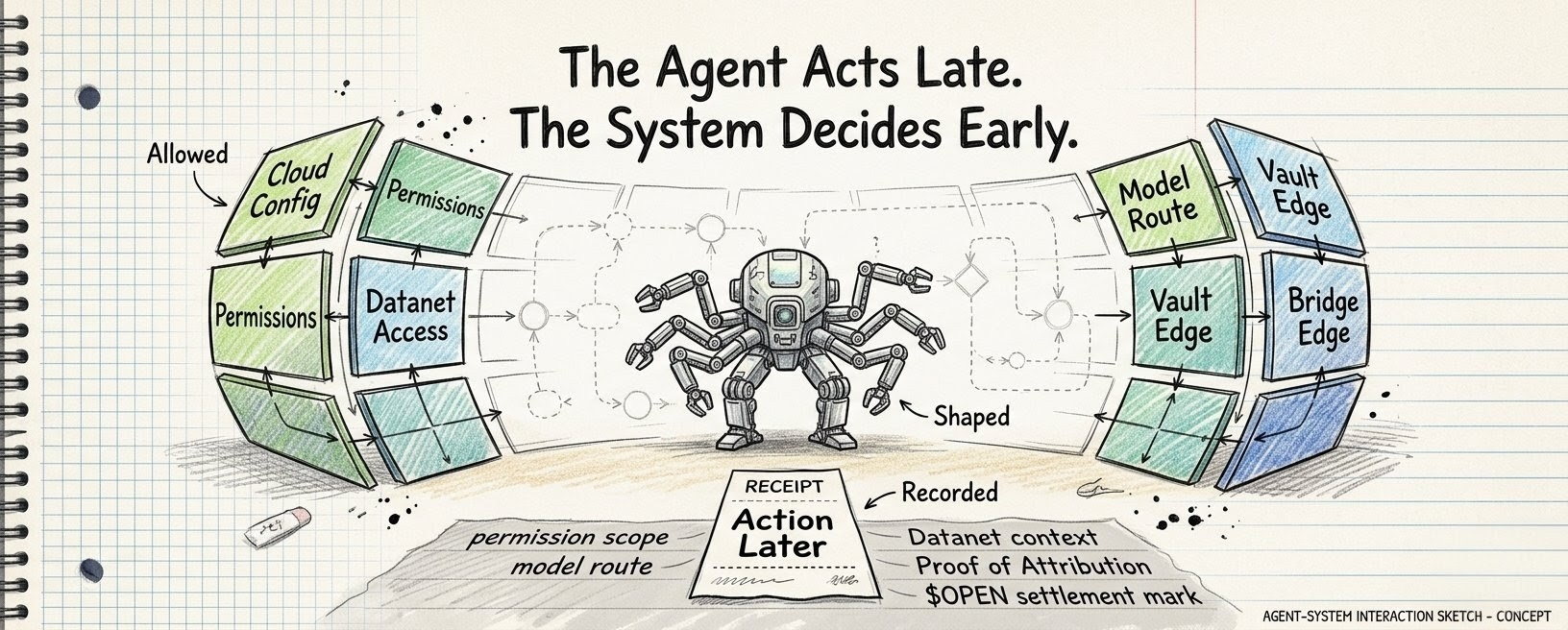
OpenLedger keeps bothering me because it tries to break that convenience. everyone says that like it’s only good news. attribution, fairness, rewards, payable AI, contributors finally getting paid, great. yes, fine. that part is real. but the darker side is that once you build a system that tries to remember which Datanet mattered, which model path got used, which OpenLoRA specialization bent the behavior, which OctoClaw-routed agent actually triggered the action, you are not just building a reward machine.
you are building a liability surface.
and i don’t think people really sit with that long enough.
because what happens when the output is good? easy. everyone likes attribution then. the Datanet helped, the model path worked, the inference route was useful, OpenLedger moved, reward distribution looks honest enough, good story.
but what happens when the output is wrong? or worse, what happens when it is persuasive and wrong?
that is where Proof of Attribution stops sounding warm to me. because then the system is not just asking who should get paid. it starts quietly asking who shaped this enough to still be visible when someone comes back looking for the reason it failed.
that could be a Datanet problem. maybe the data was biased, stale, overfit to one kind of pattern, too narrow but still powerful enough to bend the result. maybe the model path itself was weak. maybe OpenLoRA loaded a narrow specialization that improved confidence more than correctness. maybe an OctoClaw-configured agent took the output and carried it into an execution flow it never should have touched. maybe the answer was smart in the most dangerous way… coherent enough to act on, wrong enough to hurt.
and what happens then… who is “in” the failure? who stays attached to it? who gets named by the trail?
in old AI that whole mess dissolves into platform fog.
in OpenLedger, at least in theory, it leaves residue.
and residue is not neutral.
that’s the part i keep circling. Proof of Attribution sounds like a financial primitive on the surface, but underneath it is also a memory primitive for causal exposure. the second value moves through a path, someone will eventually ask what else moved with it. which Datanet history. which model route. which OpenLoRA specialization. which agent permission surface. which chain of dependency got us here.
reward is just the happy version of that question.
liability is the unhappy one.
same architecture though.
on openLedger, i can’t reduce PoA to “contributors get paid” anymore. that sentence is too innocent. yes, contributors can get paid. but contributors can also get located inside a causal trail. builders can get located there too. model deployers. agent operators. maybe even the people who allowed a Datanet onto an active surface in the first place. once the architecture starts remembering influence, the architecture also starts remembering exposure.
and honestly that feels closer to the real world than the promotional version does. because outside crypto, mature OpenLedger systems usually become more accountable at exactly the moment they become more economic. supply chains, accounting standards, audit trails, settlement records, internal controls… none of that exists because humans are noble. it exists because once enough value moves through a system, somebody eventually wants to know where responsibility should land when the story goes bad.
AI is heading toward that same wall.
OpenLedger just seems weirdly early in admitting it. not loudly maybe. but structurally. that is what keeps sticking with me. not the slogans… the shape of the memory.
because think about what PoA really means in practice if OpenLedger actually grows. it means an inference is not just a service event. it is a recorded event with causal claims underneath it. this Datanet mattered. this model path mattered. maybe this OpenLoRA load mattered. maybe this agent execution route turned a suggestion into an action. and once those claims become economically meaningful, they become hard to ignore the second someone replays the inference route and asks why that Datanet, that model path, and that agent action stayed attached.
who gets paid for the inference?
nice question.
who gets questioned for the inference?
heavier question.
same trail.
and i think that is the future pressure hiding inside this whole design of openLedger. people keep imagining attribution as a nicer marketplace feature, but if agents really start touching workflows, capital, business automation, maybe medical context, maybe legal filtering, maybe any category where wrong but confident stops being cute, then PoA becomes more than a payout engine. it becomes a replay surface for contested inference, where the Datanet residue, model route, OpenLoRA bend, and OctoClaw-triggered action can still be inspected after OpenLedger already moved.
show me what shaped this.
show me what model route got used.
show me what Datanet narrowed the answer.
show me what OpenLoRA layer bent it.
show me what agent path turned output into action.
that’s not reward language anymore.
that’s audit language.
or maybe even worse than audit language. maybe it is pre-dispute language. the kind of language a system learns before everyone starts fighting with it in public.
and maybe that’s exactly what OpenLedger is actually building whether people like it or not.
because once you make AI less black-box, you don’t only make upside more shareable. you make causality harder to bury. and causality is dangerous for anyone who got used to hiding inside aggregate systems. a big centralized model can always absorb blame through vagueness. a traceable path cannot do that as easily. not perfectly, obviously. no attribution system is magically pure. influence can still be partial, messy, overlapping, arguable.
but arguable is already different from invisible.
invisible protected the old system.
messy but replayable is still better than black-box disappearance.
still uncomfortable though.
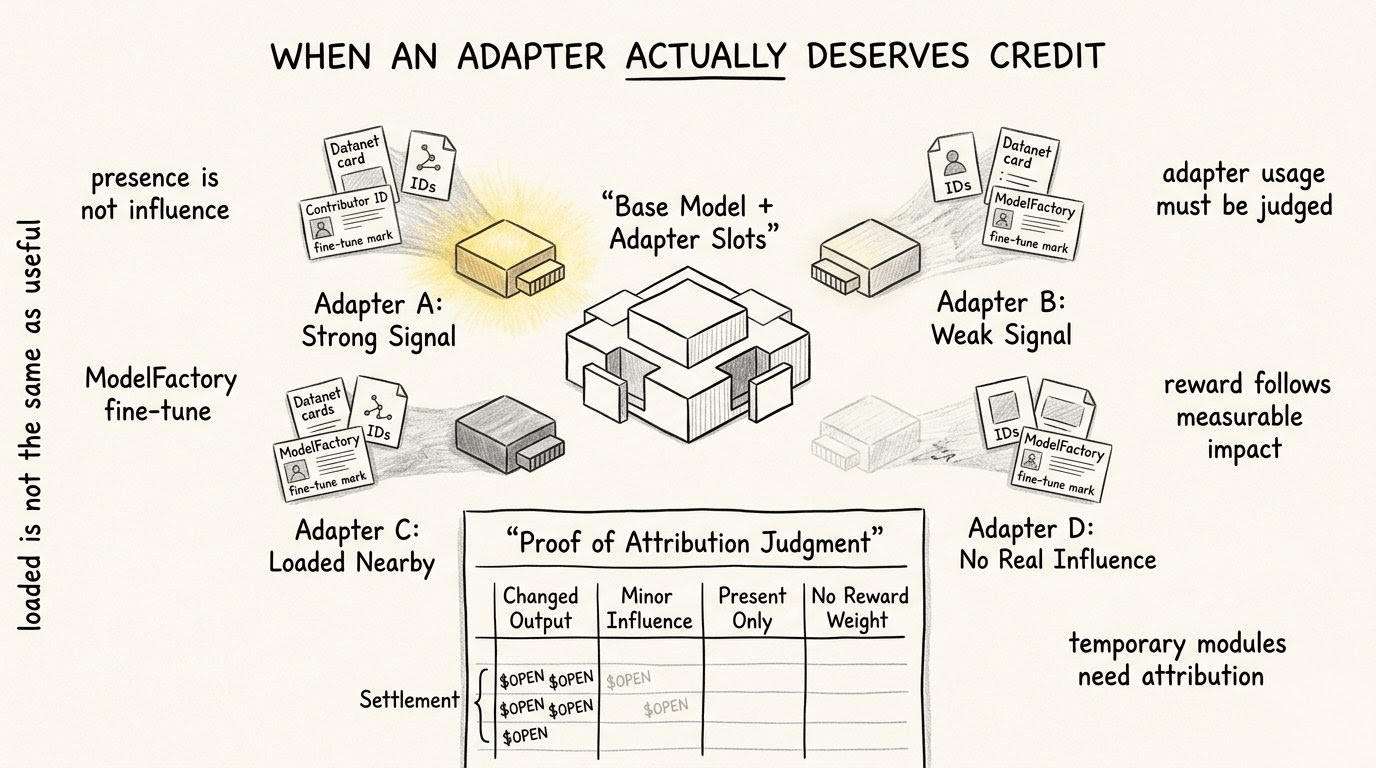
especially because influence in AI is rarely clean. that’s another thing people skip. Proof of Attribution sounds crisp when someone explains it on a slide. this data shaped that output, this contributor gets that reward. alright. but in reality model behavior is layered and ugly. one Datanet might provide most of the useful structure. another might provide tiny but important edge cases. OpenLoRA might bend the answer into a narrow domain. the base model path might still carry most of the reasoning load. the agent might turn a suggestion into an action because of its configuration inside OctoClaw. now tell me where responsibility stops and starts.
where does it stop, really?
at the data?
at the model route?
at the specialization layer?
at the agent that crossed the line from output into action?
you can’t do it perfectly.
but you also can’t pretend that means you shouldn’t try.
and OpenLedger seems to be trying from the architectural side instead of the public-relations side. that’s why it keeps feeling more serious than a lot of AI-token noise to me. it is not only saying let contributors get paid. it is quietly setting up a world where Datanet trails, model routes, adapter effects, and agent actions can’t just be used to distribute upside. they can also be revisited when outcomes become contested.
that matters.
because contested outcomes are the real future of AI, not just good outputs. the more AI enters serious systems, the less “the model said so” will be accepted as a final explanation. people will want to know what fed it, what narrowed it, what specialized it, what triggered execution, what economic route it entered after that. the answer itself will be too small. the trail will matter more.
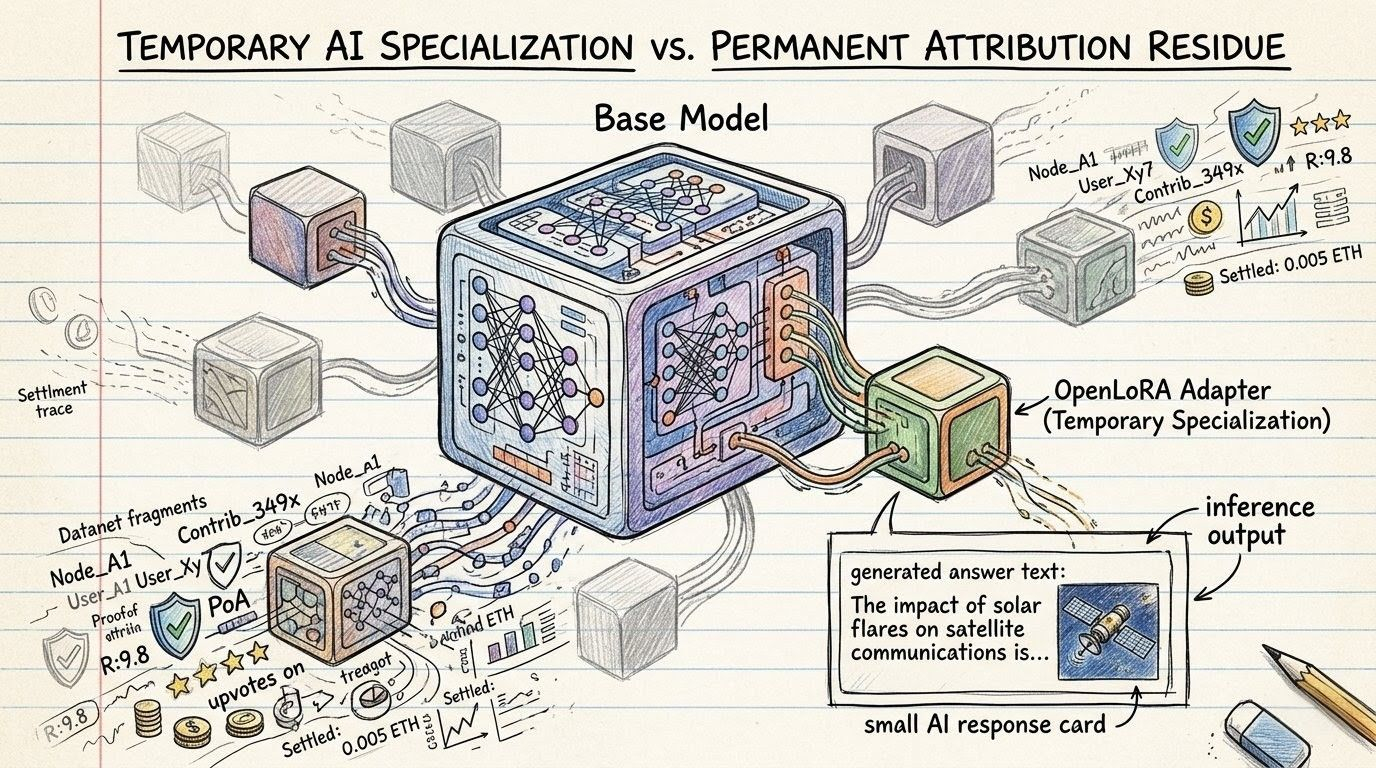
in that world, Proof of Attribution stops being this optimistic feature and starts becoming infrastructure for disputes. not only who deserves the reward, also who was close enough to the route to deserve scrutiny.
that is colder, but probably more honest.
and this is why i keep thinking OpenLedger might be building a harsher kind of fairness than people expect. not fairness as in everyone feels included. fairness as in the system leaves enough memory behind that value and responsibility have a chance to travel through the same path instead of being separated. old AI loved separating them. platforms kept value, contributors disappeared, and responsibility floated upward only when convenient. OpenLedger is at least pointing toward a world where that split becomes harder to maintain.
if your Datanet mattered, maybe you get paid.
if your Datanet mattered and something went wrong, maybe your influence is still visible.
if your model path carried the inference, maybe that is upside.
if your model path carried the inference into a bad outcome, maybe that is exposure too.
if your OpenLoRA specialization bent the answer in a decisive way, maybe that matters too.
if your agent route turned output into action, maybe that matters in both directions.
that symmetry is uncomfortable. good. it should be.
because without the uncomfortable part, attribution is just marketing language.
with the uncomfortable part, it starts to look like architecture.
that’s the line i keep coming back to OpenLedger. architecture, not branding. memory, not vibes.
and maybe that is the real shift hiding underneath Proof of Attribution. it is not just trying to answer the economic question of AI, though it does that. it is also preparing for the accountability question before most of the market is ready to ask it properly. what survives after the answer? what survives after the payout? what survives after the agent acts? what remains when somebody comes back later and says alright, this worked, or this failed, now show me the path.
what remains… that’s the whole thing, isn’t it?
OpenLedger seems to want that path to still exist.
not as a vibe. as residue.
and residue changes behavior. once OpenLedger systems know they will leave replayable residue behind, they start acting differently. builders act differently. data contributors maybe act differently. agent operators definitely should. because the architecture is no longer only a place where value might pass through. it is a place where memory hardens after value moves.
that is why Proof of Attribution does not feel soft to me anymore.
it feels like a receipt that can turn into evidence.
and in AI, that might matter more than the reward itself.