
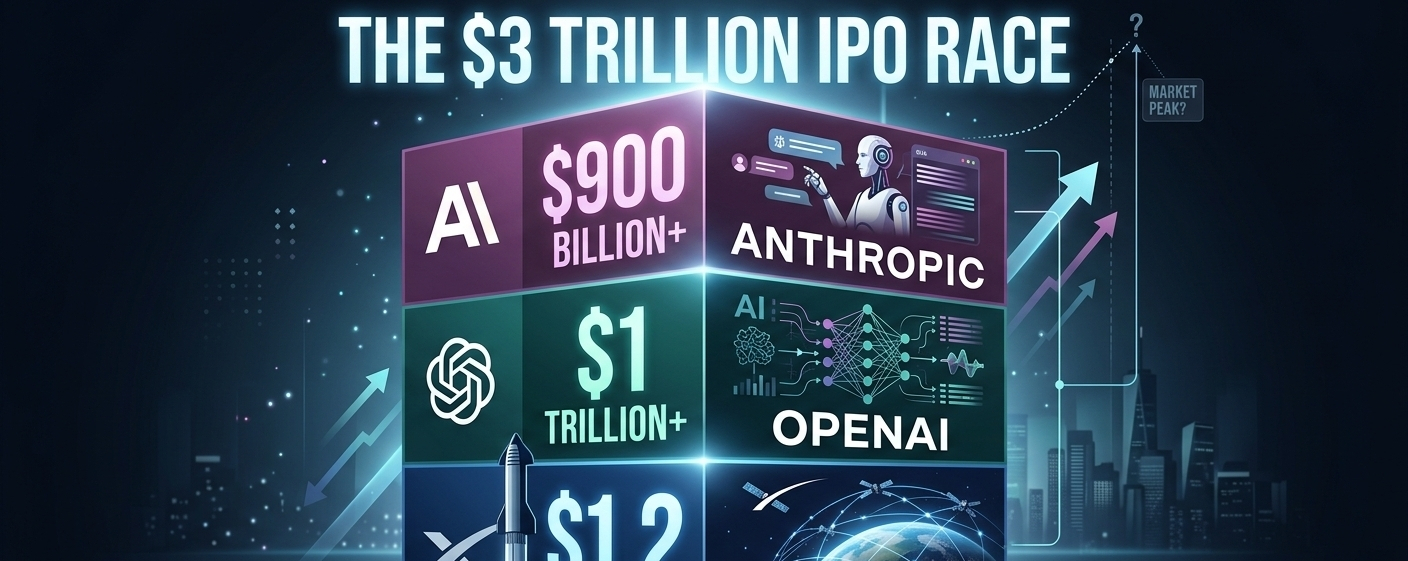
Wall Street is watching one of the most dramatic IPO windows in modern history. Three private giants — SpaceX, OpenAI and Anthropic — are racing to list within months of each other, together chasing valuations that could top $3 trillion. The scale, speed and timing have investors and strategists scrambling to price both opportunity and risk.Big numbers, bigger implications
SpaceX filed its prospectus on May 20 and has set the stage for a Nasdaq debut as soon as mid‑June under the ticker SPCX. If SpaceX lists above $1 trillion, it would be the first U.S. company to do so. OpenAI, after a March funding round that valued it around $852 billion, is preparing a confidential IPO filing and reportedly aims for roughly $1 trillion. Anthropic — which surged in private-market value this year — is targeting a fall listing with private rounds implying valuations near $900 billion.Combined, these offerings could add more than $3 trillion in market value and potentially raise over $125 billion, dwarfing recent IPO activity and reshaping index weightings, ETF flows and institutional allocation strategies.Why this matters now
The timing magnifies the stakes. Multiple mega-IPOs hitting public markets in quick succession can absorb liquidity, push valuations higher, and concentrate market risk in a handful of headline names — echoes of the late‑1990s dot‑com era that make veteran strategists uneasy. Rising bond yields and tougher borrowing conditions also shorten the time horizon investors want from growth stories, making sky-high private valuations harder to justify.OpenAI’s own forecasts underscore the tension: the company reportedly expects a multibillion‑dollar loss in 2026, highlighting how far investors would be buying future potential rather than near‑term profits. For SpaceX, the blend of cash‑flow from Starlink and capital needs for Starship’s ambitions will be watched closely. Anthropic’s progress on consumer and enterprise AI products will determine whether its private-market momentum survives the public markets.Market signals and product reactions
Wall Street strategists have flagged the trio as a possible market-top signal. Anthony Scaramucci labeled them the "Holy Trinity" of IPO risk, and comparisons to bubble dynamics are increasingly common in media coverage.At the same time, crypto and derivatives venues have already begun to offer ways for retail and institutional traders to express views. Binance launched SPCXUSDT and OPENAIUSDT pre‑IPO perpetual contracts, letting traders take directional exposure ahead of listings. These products spotlight a new bridge between private-company enthusiasm and public trading — but they also concentrate leverage and headline risk.How investors might approach this windowRebalance exposure: Diversify away from single‑name concentration; mega-IPOs can dominate index returns and volatility.Watch liquidity and lockups: Be mindful of floated share size, lockup expiries, and how much capital comes to market.Stress-test valuations: Consider scenarios where revenue growth slows or margins compress; high-growth forecasts are less certain in rising-rate environments.Use derivatives cautiously: Pre‑IPO and perpetual products enable exposure but add leverage and counterparty complexity.Viral factors to watchNarrative dominance: AI and space travel are media magnets — a single product demo or launch success could send a stock sharply higher.Retail social amplification: Communities on X (formerly Twitter), Reddit and Telegram can rapidly build momentum — and volatility.Cross-market arbitrage: Price movements in one listing could spill into ETFs, crypto derivatives, and other large-cap plays.Binance angle (CTA)
For traders who want exposure, Binance now offers pre‑IPO perpetual contracts and a broad derivatives suite. Use these products with clear risk limits, position sizing, and stop-loss discipline.
#SpaceX #OpenAI #Anthropic #IPO #SPCX