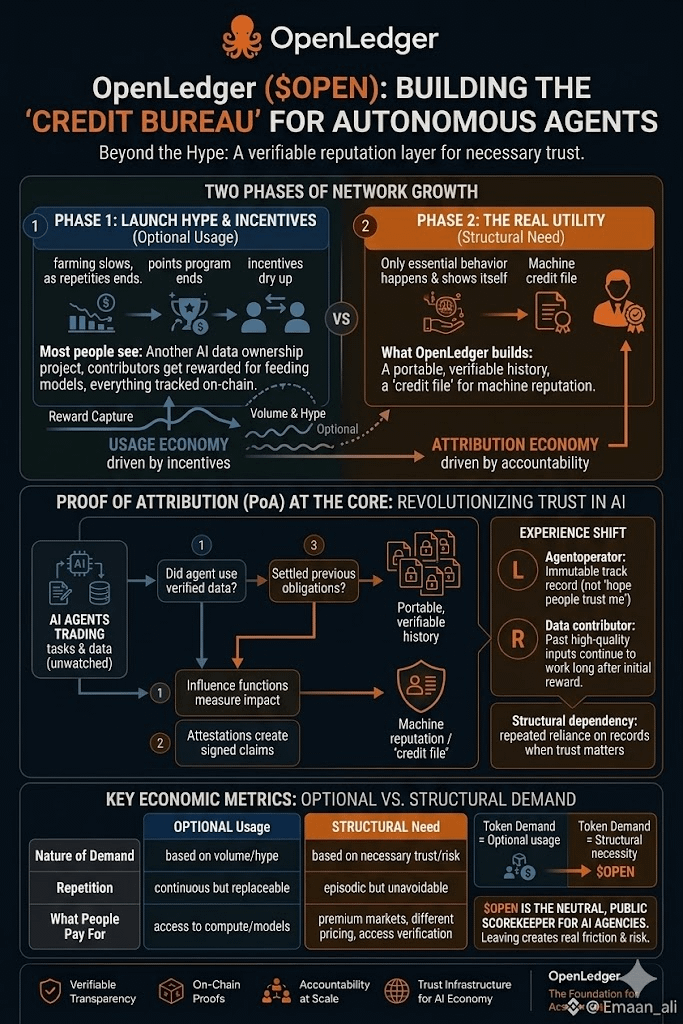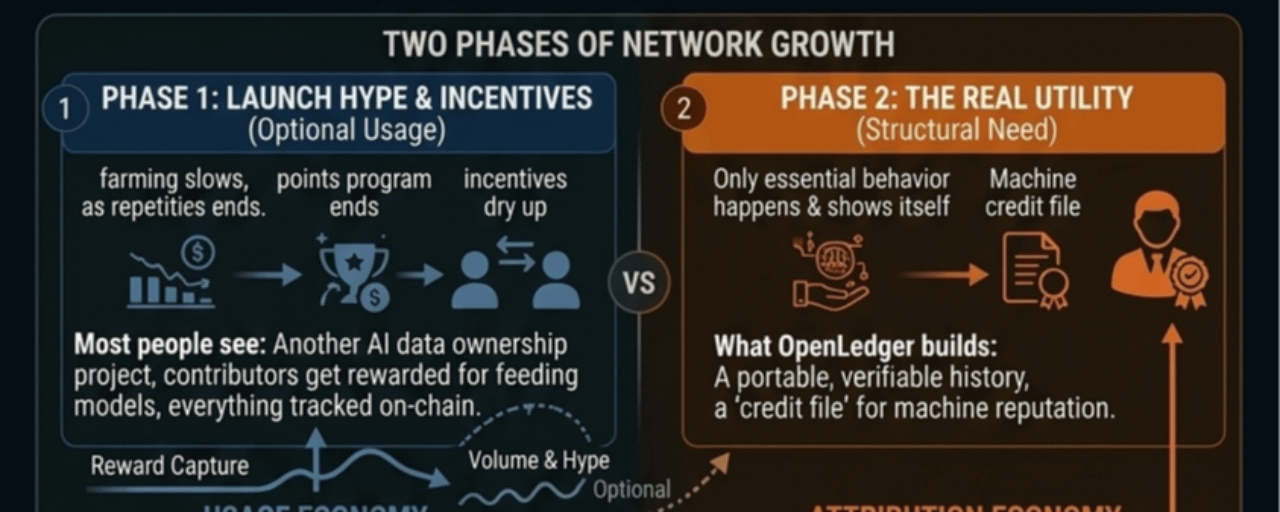
I have this habit in crypto: when a new infrastructure story gets loud, I fast forward past the launch hype and try to picture what the system looks like once the easy incentives dry up. When the farming slows down, the points programs end, and only the behavior that actually matters keeps happening. That’s usually when the real value (or the real weakness) shows itself.
OpenLedger makes me think about that second phase a lot.
Most people see it as another AI data ownership project, contributors get rewarded for feeding models, everything is tracked on chain, and $OPEN captures the value. That part is real. But the deeper idea that keeps pulling me back is something closer to a “credit bureau for autonomous agents.”
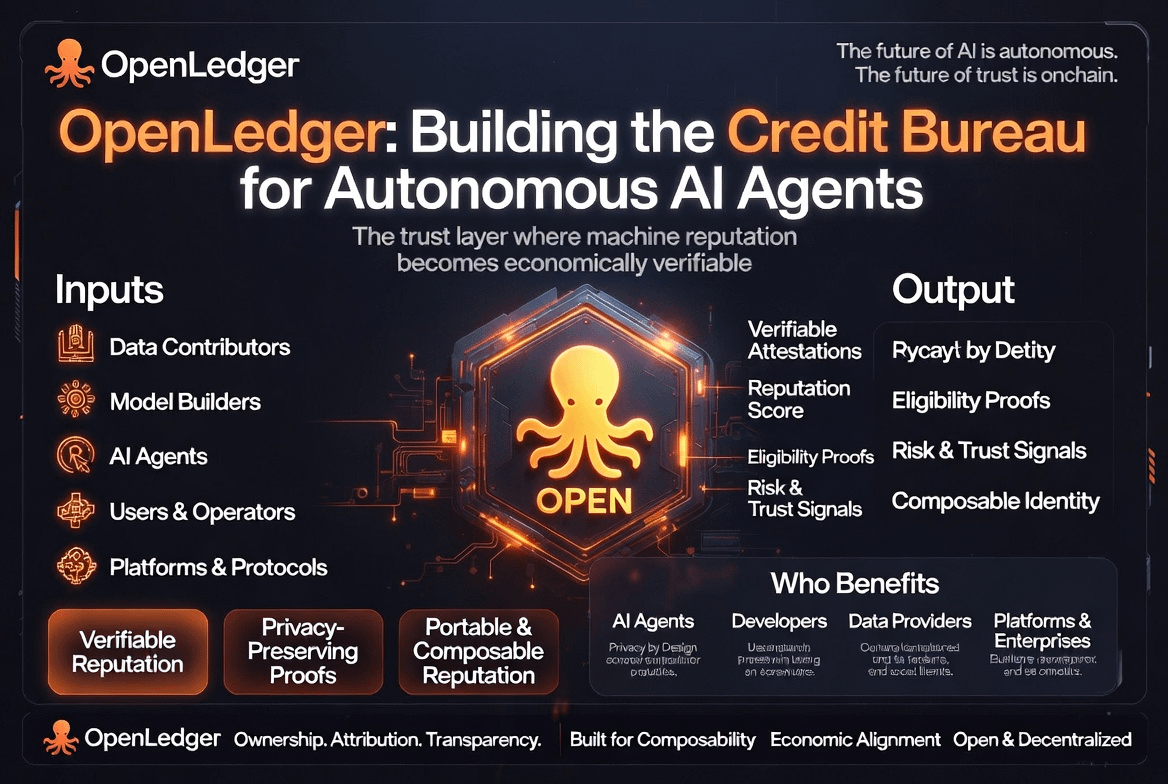
Imagine thousands of AI agents trading, negotiating tasks, routing data, and executing workflows across different networks, all without a human watching every move. The biggest risk isn’t whether they can act. It’s whether they can be trusted to keep acting. Did this agent use verified data before? Has it settled previous obligations cleanly? Did it ever try to hide provenance or game the system?
This is where OpenLedger’s technology gets interesting. Through its Proof of Attribution system, every contribution, every inference, and every interaction can be cryptographically recorded on chain. Influence functions measure exactly how much a specific dataset or feedback actually affected the final output. Attestations create signed, reusable claims about behavior and quality. Over time, these records build a portable, verifiable history, a kind of machine reputation or “credit file” that other systems can check before granting access to higher value opportunities.
For developers and agent operators, the experience shifts from “hope people trust me” to “here’s my immutable track record.” For data contributors, it means past high quality inputs continue to work in your favor long after the initial reward. And for the broader crypto community, it creates a new kind of dependency: not just activity, but repeated reliance on OpenLedger’s records when trust actually matters.
That distinction is crucial. A network can have lots of transactions and still not be necessary. The real test for $OPEN is whether leaving the system creates real friction or risk for AI agents and the platforms that use them. If builders start requiring OpenLedger attestations before allowing agents into premium markets, or if networks begin pricing agents differently based on their verified history, then token demand moves from optional usage to structural need.
Of course, this is still early. The market loves simple metrics, daily users, volume, TVL. A machine credibility layer might look quiet or even boring at first. But if autonomous agents really become the next big economic layer, someone has to keep the public, neutral score. @OpenLedger is positioning itself to be that layer.
Whether it succeeds will depend on whether agents and platforms eventually refuse to operate without those records. That’s the uncomfortable but exciting question I keep coming back to.