

Most markets still price tokens like static objects.
As if supply schedules exist in isolation.
As if emissions are just spreadsheets.
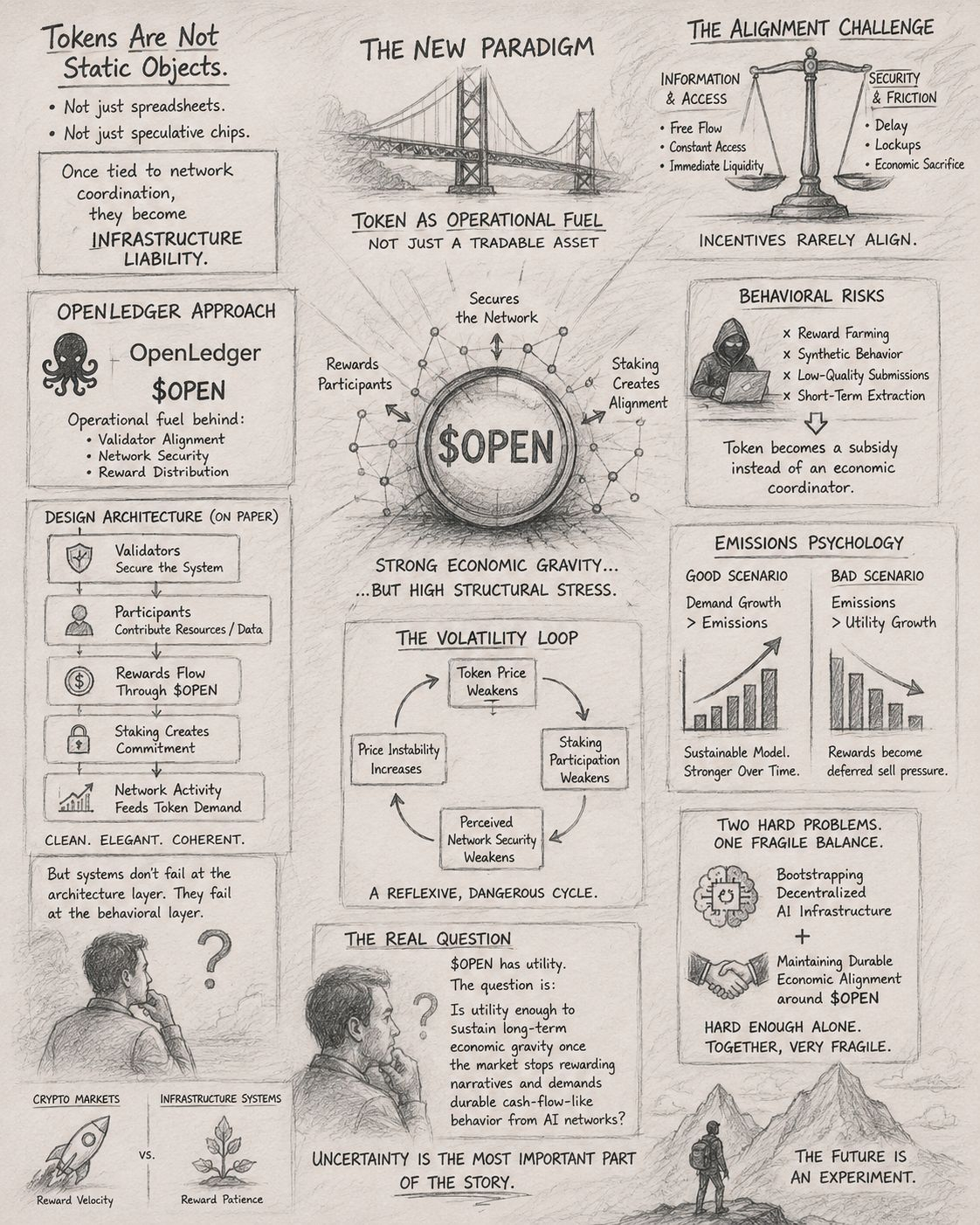
I think that framework breaks down the moment a token becomes tied to actual network coordination.
Because then the token stops being a speculative chip.
And starts behaving like infrastructure liability.
That distinction matters more than people think.
Especially in AI-linked crypto systems.
Information wants to move freely.
Models want constant access to compute.
Contributors want immediate liquidity.
But security systems require friction.
Delay.
Lockups.
Economic sacrifice.
Those incentives rarely align cleanly.
And that is where OpenLedger becomes interesting.
Not because $OPEN promises another “AI economy.”
Most projects say that now.
What caught my attention is something narrower.
OpenLedger appears to position $OPEN not simply as a tradable asset, but as the operational fuel behind validator alignment, network security, and reward distribution.
In theory, that creates stronger economic gravity.
In practice, it also creates more structural stress.
Because once a token secures a network, every market cycle becomes a security event.
That changes the analysis entirely.
On paper, the design looks coherent.
Validators secure the system.
Participants contribute resources or data.
Rewards flow through $OPEN.
Staking creates commitment.
Network activity theoretically feeds token demand.
Clean architecture.
Almost elegant.
But crypto systems rarely fail at the architecture layer.
They fail at the behavioral layer.
That is the pattern I keep noticing.
The question is not whether staking exists.
The question is whether staking survives volatility.
Because under real market pressure, token utility and token liquidity begin fighting each other.
Participants want rewards denominated in appreciating assets.
But they also want optionality.
Fast exits.
Transferability.
Security systems, meanwhile, require the opposite.
They require tokens to become temporarily illiquid.
Locked.
Inactive.
Economically trapped inside coordination mechanisms.
That tension becomes dangerous during reflexive drawdowns.
If token price weakens, staking participation can weaken alongside it.
If participation weakens, perceived network security weakens too.
Which then feeds back into price instability.
A circular dependency.
Not unique to OpenLedger.
But very relevant to it.
Especially because AI infrastructure markets are already brutally competitive.
Compute costs compress margins.
Data quality is hard to verify.
And incentive systems are constantly gamed.
People underestimate that last point.
Transparent reward systems sound fair.
Until users begin optimizing specifically for the reward surface instead of the network’s intended purpose.
Then the network slowly fills with synthetic behavior.
Low-quality submissions.
Reward farming.
Short-term extraction loops.
The token becomes less of an economic coordinator.
More of a subsidy mechanism.
I am less sure the market fully prices that risk.
Particularly in AI ecosystems where contribution quality is difficult to audit at scale.
Another layer worth watching is emissions psychology.
Every token economy eventually faces the same uncomfortable question:
Are rewards being generated from actual economic throughput.
Or from future dilution?
The difference matters.
A lot.
If network demand genuinely expands faster than emissions, the token model can stabilize over time.
Maybe even strengthen.
But if emissions outpace meaningful utility growth, rewards stop feeling like income.
They start resembling deferred sell pressure.
That transition can happen slowly.
Then all at once.
And this is where OpenLedger becomes less of a simple AI token story and more of a coordination experiment.
Because the system is trying to solve two difficult problems simultaneously:
Bootstrapping decentralized AI infrastructure.
And maintaining durable economic alignment around $OPEN.
Either challenge alone is hard.
Together, they create a very fragile balancing act.
Still, I think dismissing these systems entirely would also be lazy analysis.
There is genuine demand emerging for decentralized AI coordination layers.
That trend feels real.
The deeper uncertainty is whether tokenized incentive systems can maintain integrity once speculative liquidity dominates user behavior.
Crypto markets reward velocity.
Infrastructure systems reward patience.
Those are fundamentally different cultures.
So the real question surrounding OpenLedger is not whether OPEN has utility.
It probably does.
The harder question is whether utility alone is enough to sustain long-term economic gravity once the market stops rewarding narratives and starts demanding durable cash-flow-like behavior from AI networks.
I do not think we know that answer yet.
And honestly, the uncertainty itself may be the most important part of the story.