
Look, I understand why projects like OpenLedger are getting attention right now. Artificial intelligence is hot. Crypto is trying to reinvent itself after years of scandals, collapses, and promises that aged like milk in the sun. Put the two together and suddenly investors start talking about “infrastructure for the AI economy” as if they’ve stumbled onto the next electricity grid.
I’ve seen this movie before.
The pitch always sounds clean in the beginning. Too clean. OpenLedger says the modern AI industry is unfairly centralized, that a handful of giant firms control the models, the data, the compute, and eventually the money. And they’re not wrong about that part. Microsoft, Google, Amazon, OpenAI these companies are building enormous gravity wells around AI infrastructure. Smaller developers orbit them because they have no choice. The compute costs alone are crushing.
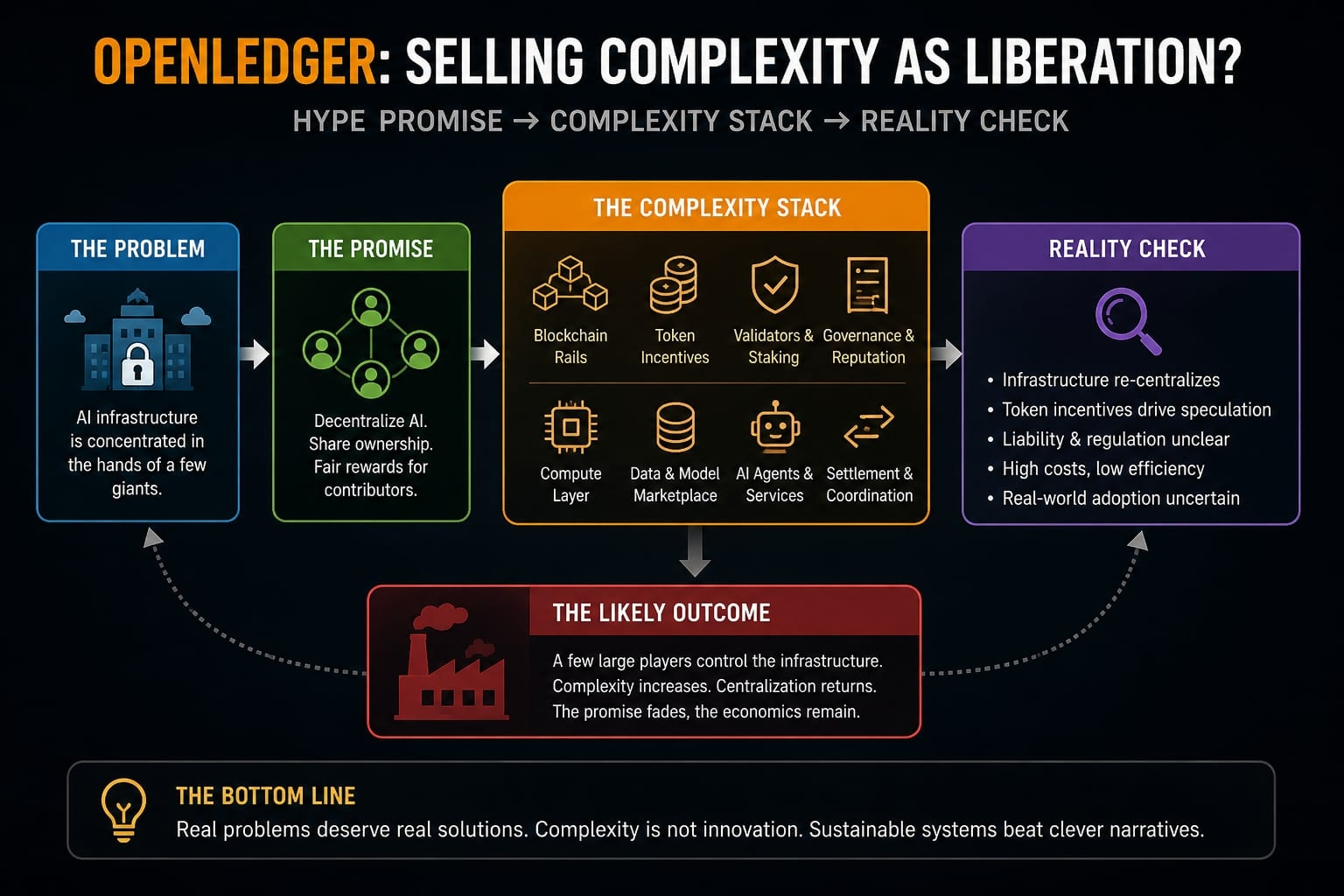
So OpenLedger arrives with a familiar crypto promise: decentralize the system, spread ownership across the network, let people monetize their data, their AI models, their autonomous agents, and create a shared economic layer where everyone participates instead of a few giant firms taking everything.
It sounds tidy. On paper, at least.
But once you peel back the marketing, the first question practically asks itself: do we actually need blockchain for this problem, or is blockchain simply being attached because the funding environment rewards it?
That’s the part nobody likes discussing honestly.
The core problem OpenLedger claims to solve is real enough. AI systems are becoming centralized because AI development naturally favors scale. Bigger datasets. Bigger data centers. Bigger GPU clusters. Bigger balance sheets. That’s not an accident. That’s economics. Training advanced models costs absurd amounts of money and energy. The barriers to entry keep rising.
Now here comes the important part. Centralization in AI is not happening because nobody thought about decentralization hard enough. It’s happening because centralized infrastructure is faster, cheaper, easier to coordinate, and brutally efficient at scale.
That’s the uncomfortable truth sitting underneath the entire AI industry right now.
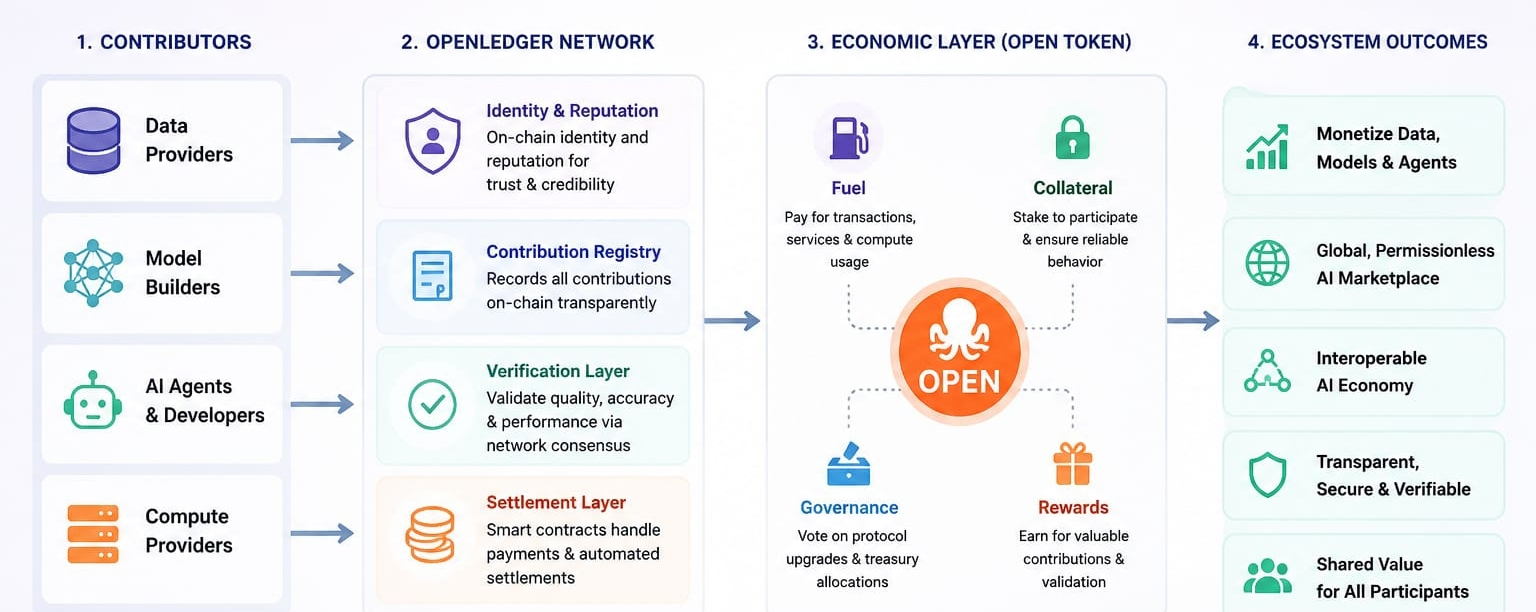
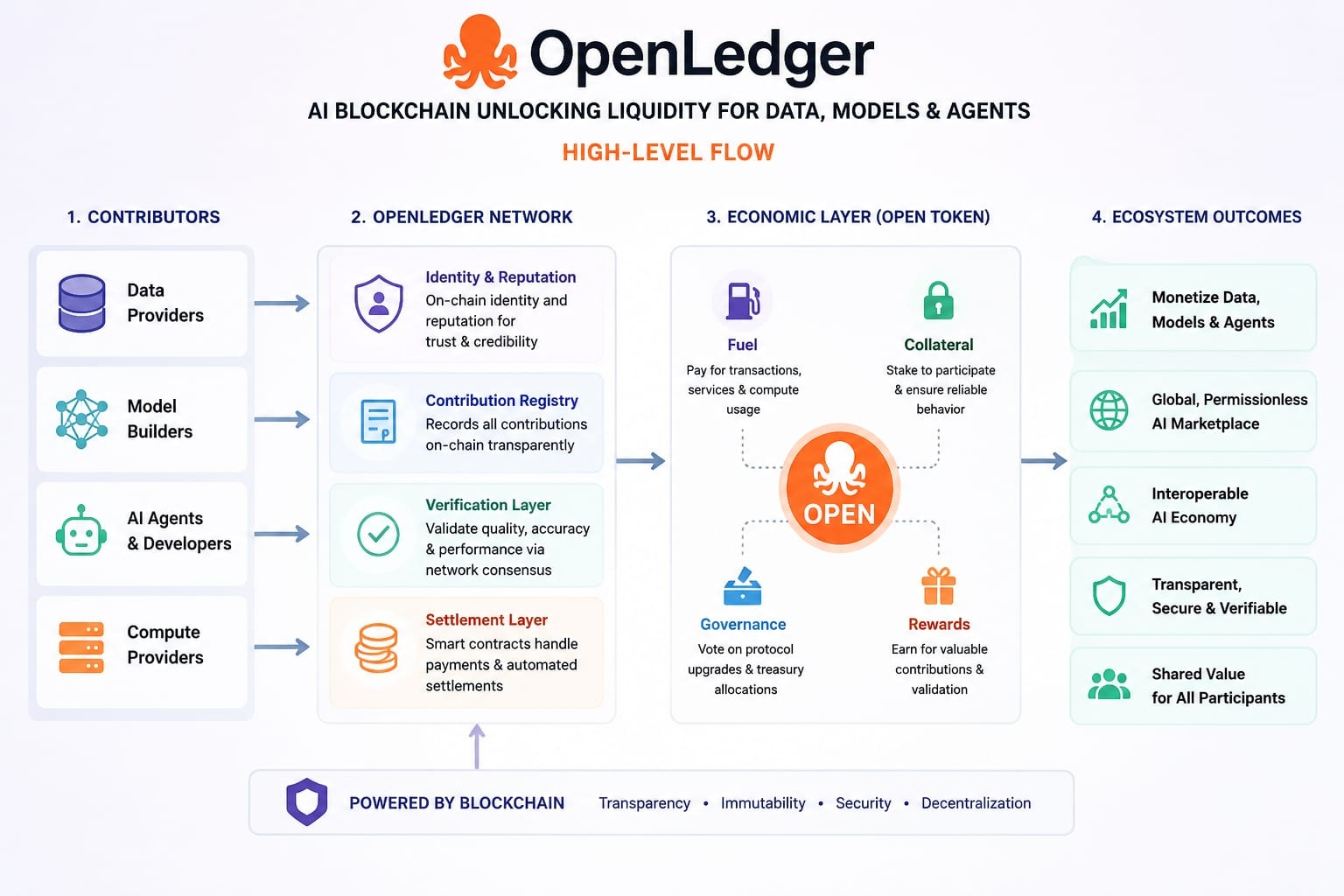
OpenLedger’s answer is essentially this: build a decentralized marketplace where data providers, model builders, validators, and AI agents interact through blockchain rails instead of centralized corporate platforms. In theory, contributors get compensated fairly, AI services become portable across networks, and autonomous systems can transact with each other directly.
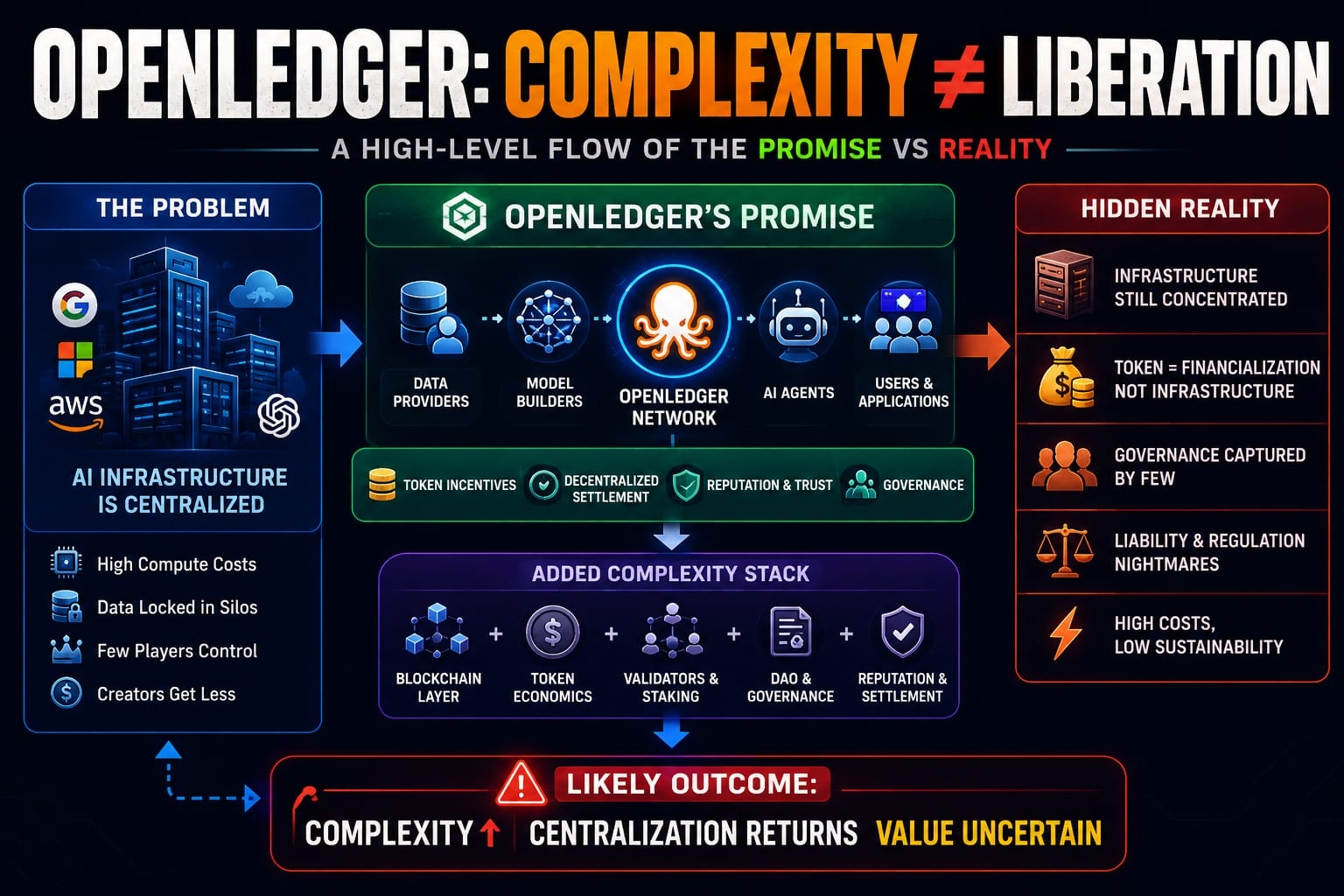
The idea sounds clever right up until you start imagining what operating this thing actually looks like in the real world.
Because now you’re stacking one difficult system on top of another difficult system.
AI systems are already messy. They hallucinate. They degrade. They produce unreliable outputs. They require endless retraining. They consume staggering amounts of compute. Then OpenLedger adds blockchain coordination layers, token incentives, validator systems, decentralized governance, staking mechanics, reputation tracking, and settlement infrastructure on top of it all.
Let’s be honest. Complexity is not automatically innovation.
Sometimes complexity is just friction wearing expensive clothes.
And here’s where I start getting skeptical fast. OpenLedger talks heavily about decentralization, but the economics of AI infrastructure naturally pull toward concentration. That’s the part the marketing decks tend to glide past very quickly.
Who owns the GPUs?
Who controls the cloud infrastructure?
Who has access to industrial-scale compute resources?
Certainly not ordinary users sitting on laptops contributing “valuable data” from their bedrooms.
The likely outcome is that a handful of large operators end up controlling the majority of the infrastructure anyway because they can afford the hardware, bandwidth, storage systems, and operational costs required to keep the network functioning. Which means the system slowly recentralizes while still marketing itself as decentralized.
Crypto has done this over and over again.
Mining pools centralized. Staking concentrated. Governance captured by insiders and venture funds. Token voting became a polite theater performance where a small number of wealthy participants quietly controlled outcomes while everyone else pretended the process was democratic.
I don’t see why AI blockchains magically escape that gravity.
Then there’s the token itself. Ah yes. The token.
Every infrastructure project now claims its token has “utility.” Fuel for the network. Governance. Verification. Collateral. Incentives. Settlement. Coordination. Fine. But after twenty years covering tech bubbles, I’ve learned to follow the money before I follow the architecture diagrams.
Who gets rich first here?
Usually early investors.
Usually insiders.
Usually the people who acquired large token allocations before the public arrived.
The token often becomes less about operating infrastructure and more about financializing anticipation. You’re not investing in working systems. You’re investing in the hope that someone else will buy the narrative later at a higher valuation.
That’s not infrastructure. That’s theater attached to infrastructure vocabulary.
And there’s another issue that keeps bothering me about projects like OpenLedger. The human reality problem.
Everybody talks about autonomous AI agents trading services with each other across decentralized systems as if it’s inevitable. But most businesses don’t actually want autonomous complexity. They want reliability. They want support contracts. They want someone to sue when things break.
That last part matters more than crypto people like admitting.
If an AI agent operating on OpenLedger makes a catastrophic error, leaks private information, manipulates financial activity, or causes commercial damage, who is responsible? The validator? The model creator? The token holders? The DAO governance community? The anonymous node operator in another country?
Good luck explaining decentralized liability structures to regulators after the first serious disaster.
And the disasters always arrive eventually.
I’ve watched enough “future of everything” technologies hit the wall to recognize the pattern. Early excitement focuses on theoretical possibilities. Nobody wants to discuss operational headaches because operational headaches don’t pump valuations. But real systems live or die based on boring details: compliance, accountability, uptime, customer support, legal responsibility, and economic sustainability.
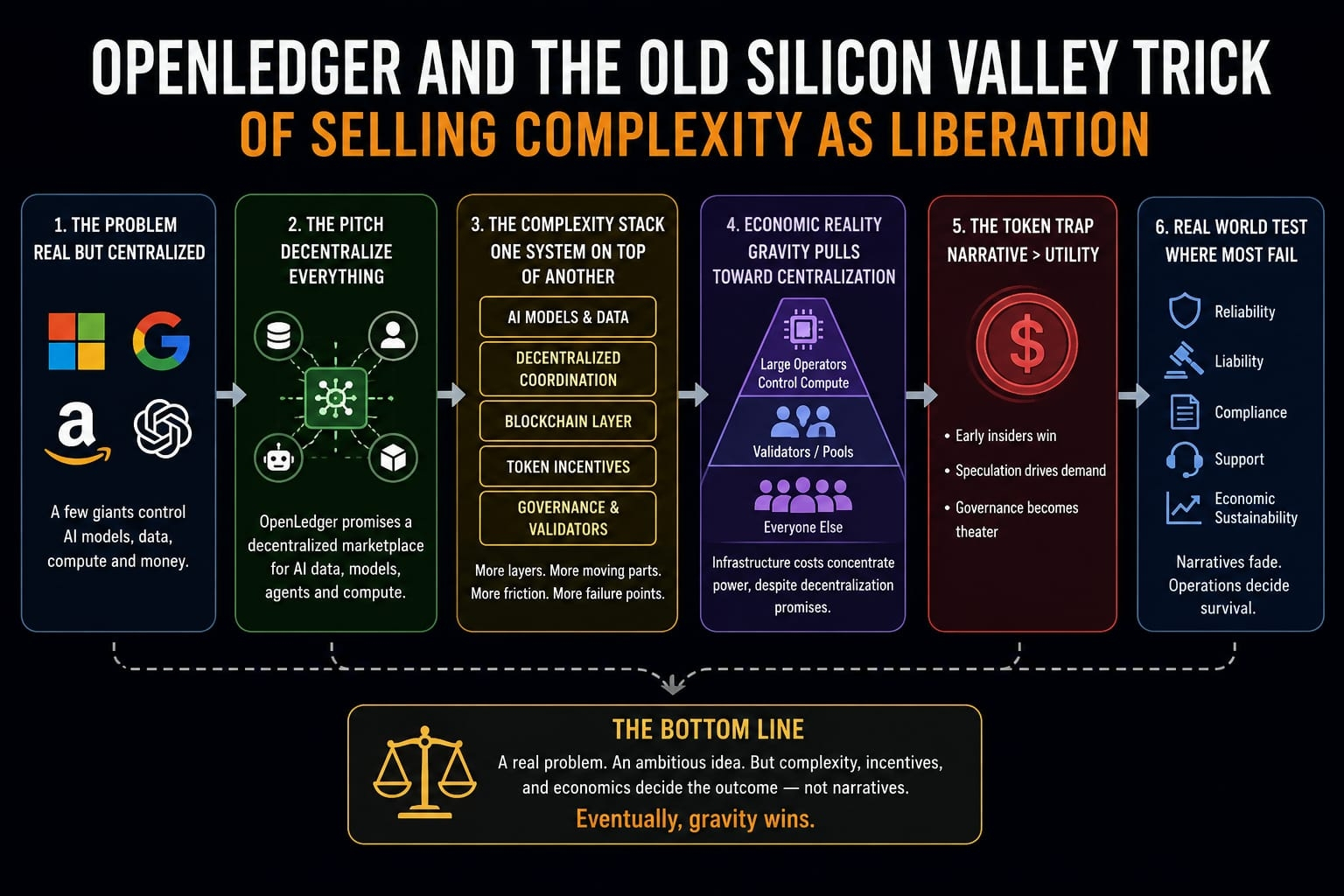
That’s where the fantasy starts leaking air.
OpenLedger also assumes something deeper that deserves more skepticism than it gets. The project assumes that decentralized coordination is inherently superior for AI ecosystems. I’m not convinced.
Centralized systems dominate for a reason. They are easier to optimize. Easier to govern. Easier to secure. Easier to upgrade. Easier to regulate. Most importantly, they are easier to scale under pressure.
People in crypto often treat centralization like a moral failure instead of an engineering tradeoff.
Sometimes centralization wins because it works better.
And then there’s the hidden cost nobody wants front-page attention on: infrastructure economics.
AI already burns through astonishing amounts of electricity and hardware. OpenLedger adds blockchain coordination overhead on top of that. More validation. More synchronization. More distributed processing. More nodes. More storage replication.
Who absorbs those costs?
Either users pay them directly, token inflation subsidizes them temporarily, or the system quietly depends on a small number of industrial operators carrying most of the infrastructure burden behind the scenes.
Again. Centralization sneaks back in through the basement door.
The irony here is hard to ignore. OpenLedger markets itself partly as an alternative to concentrated AI power, yet the economics of advanced AI systems naturally reward concentration at almost every level: compute access, semiconductor supply chains, energy consumption, and network infrastructure.
You can decentralize governance documents. You can decentralize wallet ownership. You can decentralize token distribution narratives.
But GPU clusters cost real money.
Massive money.
And that changes everything.
Now look, I’m not saying OpenLedger is fraudulent or pointless. That would be lazy analysis. There is a genuine coordination problem emerging around AI systems, particularly if autonomous software agents become more common over the next decade. Questions around identity, settlement, trust, and interoperability are real. Infrastructure for machine-to-machine interaction will probably matter eventually.
But there’s a huge gap between identifying a future problem and building a sustainable economic system around it.
That gap is where most “next big things” go to die.
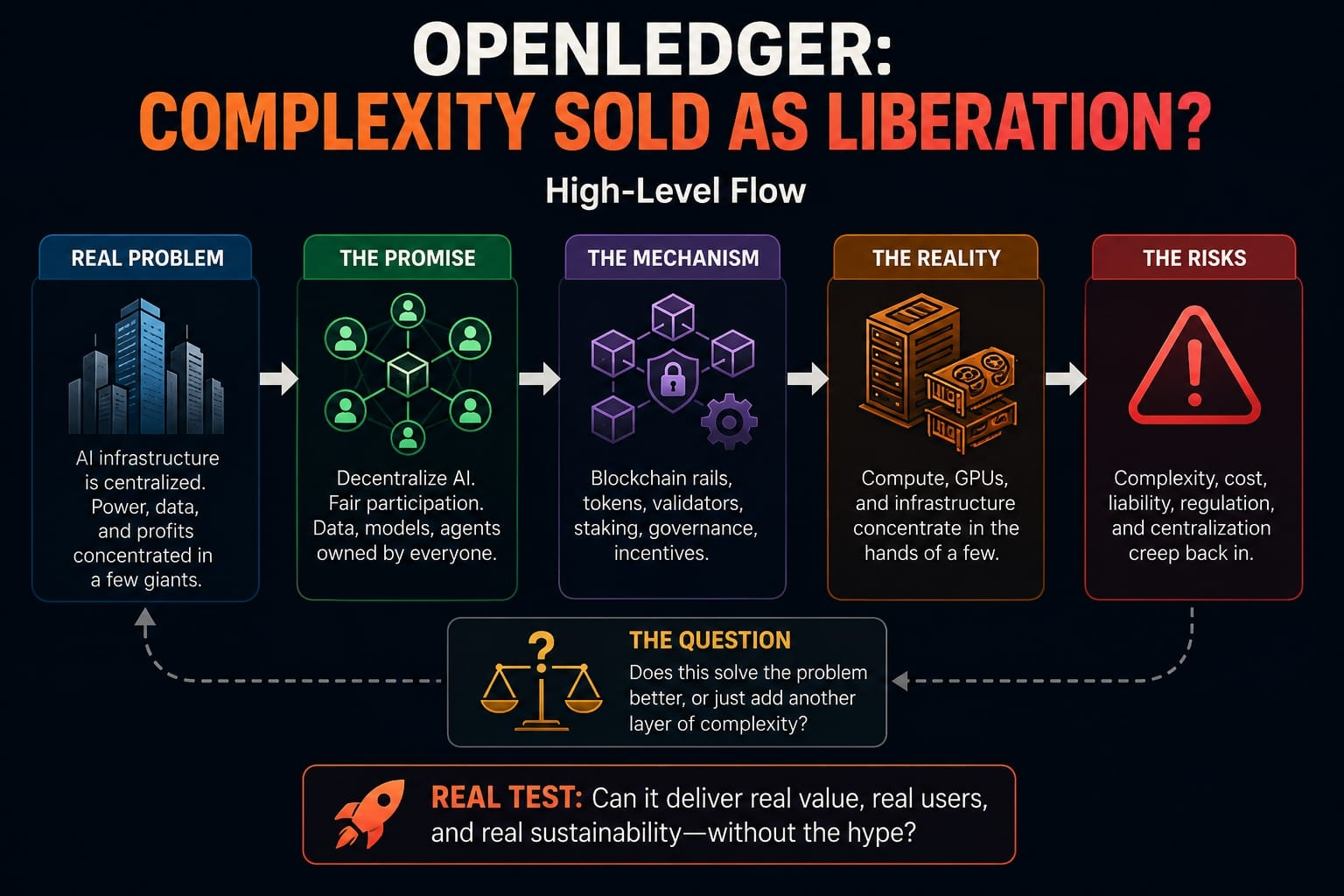
Because eventually the market stops caring about whitepapers and starts asking brutal operational questions. How many real users exist? How much genuine activity occurs on the network? Who depends on this infrastructure enough to keep paying for it during a downturn? Can the system survive without speculative token demand propping up attention?
That’s the phase where narratives meet gravity.
And gravity usually wins.