


I’ve been thinking about this a lot lately, especially after watching how quickly AI tools have become part of everyday routines.
A few months ago, most people around me were still treating AI like a fun shortcut. Something to save time. Something that could write faster, answer faster, summarize faster. But recently, the conversation feels different. People are starting to question whether these systems actually know anything at all, or if they’re just getting very good at sounding confident.
And honestly, that shift feels important.
I noticed this after seeing several situations where AI generated information that looked completely believable, but turned out to be wrong in small, almost invisible ways. Not dramatic mistakes. Just subtle ones. The kind that quietly pass through because nobody checks carefully anymore.
It made me stop and think for a moment.
Maybe the real issue with AI was never intelligence itself. Maybe it was verification.
That’s probably why projects like @OpenLedger stayed in my mind longer than I expected. Not because of noise or hype, but because the idea behind it touches something people are slowly starting to care about more.
Proof.
Not “trust me.”
Not “probably correct.”
Not “the model sounds convincing.”
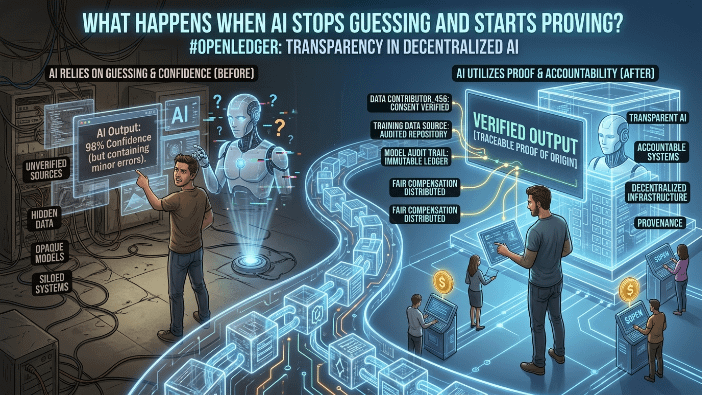
Actual proof of where information came from, how models were trained, and whether outputs can be verified beyond confidence scores.
I’m not even sure most people realize how strange the current AI environment really is. We ask systems questions every day without knowing what data shaped the answer. Sometimes the information is outdated. Sometimes biased. Sometimes invented. Yet the responses arrive with perfect grammar and calm certainty.
That certainty can be dangerous.
For some reason, blockchain suddenly makes more sense in this context than it did a few years ago.
I used to think blockchain discussions were mostly about tokens and speculation. But now, with AI becoming part of search, work, education, healthcare, and even decision-making, the need for transparent systems feels less theoretical.
It feels necessary.
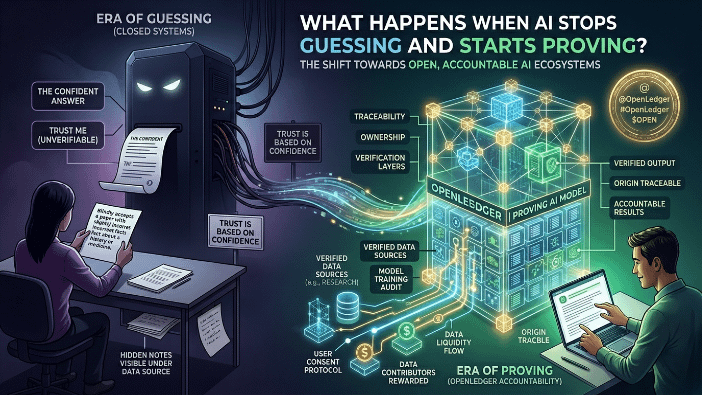
The interesting thing about #OpenLedger is that it doesn’t just talk about AI performance. It keeps circling back to accountability. Data sources. Ownership. Verification layers. Incentives.
Those things sound boring at first until you realize they affect almost every AI interaction people have.
I remember watching someone compare AI to a student taking an exam with hidden notes under the table. The answers may look impressive, but if nobody knows where the information came from, trust slowly disappears.
That comparison stayed with me.
And maybe that’s where $OPEN becomes interesting in a quieter way. Not as some loud trend, but as part of a larger shift where people start demanding systems that can actually explain themselves.
Not perfectly.
Just honestly.
I think we’re entering a phase where AI alone is no longer enough. The next layer is proving the origin of intelligence itself.
Who contributed the data?
Was consent involved?
Was the model manipulated?
Can outputs be traced?
Can contributors be rewarded fairly?
Those questions felt niche before. They don’t anymore.
Sometimes I wonder if future AI systems will look completely different from today’s models. Less centralized. Less hidden. More collaborative.
Almost like ecosystems instead of products.
That’s another reason #openledger keeps appearing in conversations around decentralized AI infrastructure. The project seems more focused on creating conditions where data, models, and agents can interact transparently instead of existing behind closed walls.
And honestly, that feels healthier.
I also think people underestimate how emotional this topic actually is.
Data sounds technical until you realize your habits, conversations, writing style, preferences, and ideas are all part of it. AI systems learn from human behavior constantly, but most individuals never see value returned back to them.
That imbalance has been sitting in the background for years.
Now it feels harder to ignore.
The phrase “data liquidity” sounded abstract to me the first time I heard it. But after thinking about it more, it started feeling simple. Information moves everywhere. Companies benefit from it. Models improve from it. Entire industries grow from it.
Yet the people generating that data usually remain invisible.
Maybe blockchain-based AI networks are partly an attempt to fix that imbalance.
Not perfectly, of course. Every system has flaws. But at least there’s an effort to build traceability into the process itself.
I think that’s why this conversation around #open feels different from older crypto narratives. It’s less about replacing humans and more about making AI relationships more transparent between humans, models, and infrastructure.
And transparency might become the most valuable thing of all.
Especially once AI becomes harder to distinguish from reality.
Lately I’ve been noticing how quickly people trust polished outputs. If something sounds intelligent, many assume it is intelligent. But polished language has never been the same thing as truth.
That’s probably the deeper issue here.
AI became extremely good at guessing.
Now people want systems that can prove.
Maybe that’s the real transition happening quietly underneath everything else.
Not smarter machines.
More accountable ones.
And for some reason, that feels like a much bigger change than most people realize.
