
Crypto has always been driven by a simple promise: remove friction, increase access, and create systems that work without traditional gatekeepers.
Over the past decade, that promise has produced multiple waves of innovation. Decentralized finance challenged traditional banking infrastructure. NFTs transformed digital ownership into tradable assets. GameFi attempted to merge entertainment with economic incentives. AI tokens introduced speculation around machine intelligence.
Most of these narratives shared one common characteristic: they promised to create new forms of value.
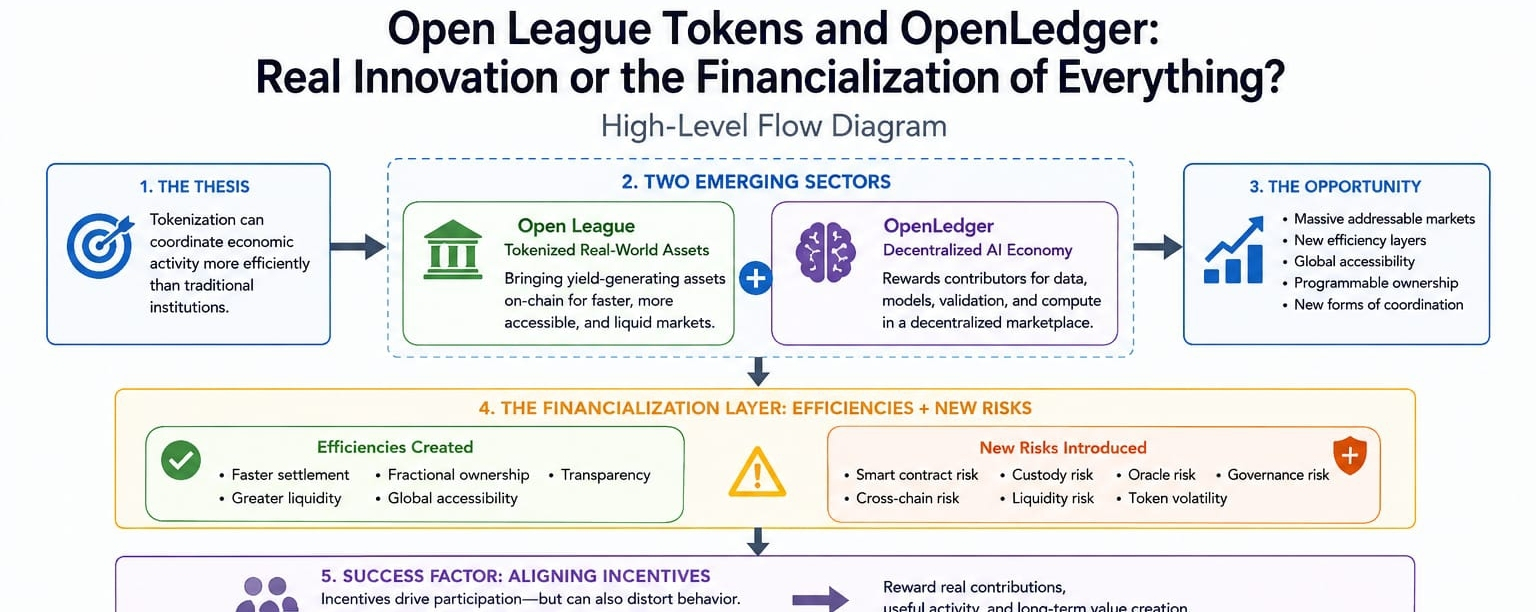
Today, two emerging sectors are attracting significant attention from investors and builders alike: tokenized real-world assets and decentralized AI economies.
Open League and OpenLedger sit at the center of these trends.
Although they operate in completely different markets, both projects are built on the same underlying thesis:
Tokenization can coordinate economic activity more efficiently than traditional institutions.
The opportunity is enormous.
The risks may be equally significant.
The real question is not whether tokenization works. Blockchain technology has already proven that digital ownership can be represented on-chain.
The more important question is whether tokenization creates genuinely productive systems or simply adds additional layers of complexity around existing activities.
Why Investors Are Paying Attention
The market environment has changed dramatically over the past two years.
Speculative narratives alone are no longer sufficient.
Investors increasingly want assets that produce measurable utility, sustainable demand, and long-term economic activity.
This shift explains the growing interest in both tokenized financial products and decentralized AI infrastructure.
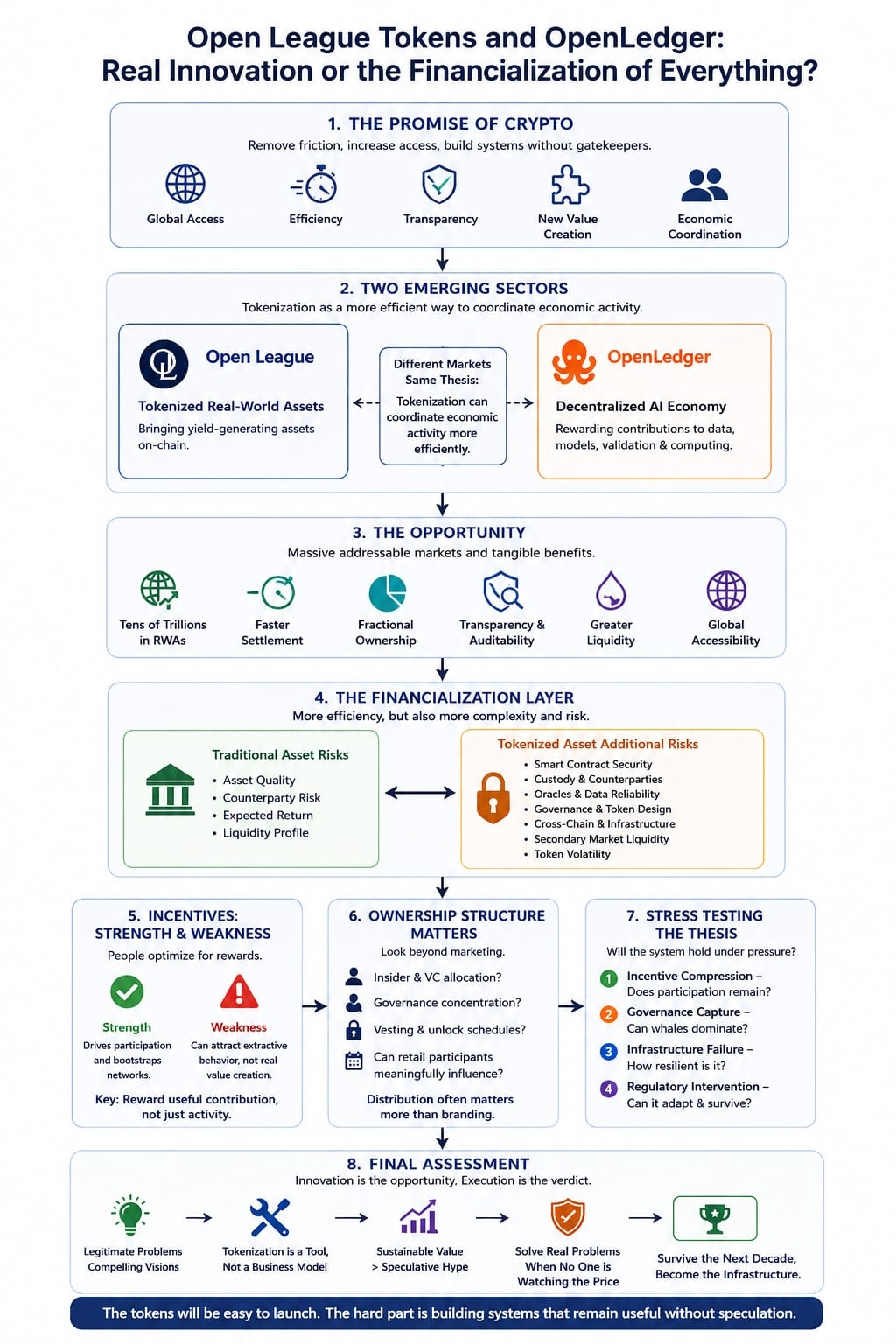
Open League focuses on bringing yield-generating assets into blockchain ecosystems.
Its vision aligns with one of the largest opportunities in modern finance: the tokenization of real-world assets.
Traditional financial products often suffer from settlement delays, geographic restrictions, limited liquidity, and high barriers to entry.
Tokenization attempts to solve these problems by converting ownership rights into programmable digital assets that can move across blockchain networks.
If successful, investors gain access to:
• Faster settlement
• Fractional ownership
• Improved transparency
• Greater liquidity
• Global accessibility
The addressable market is massive.
Global bond markets, money market funds, treasury products, and private credit markets collectively represent tens of trillions of dollars.
Even a small migration of these assets onto blockchain infrastructure would create one of the largest growth opportunities in crypto history.
OpenLedger approaches a different problem.
Artificial intelligence development is becoming increasingly centralized.
The cost of training advanced models continues to rise.
Access to high-quality datasets remains limited.
Computational resources are concentrated among a small number of technology companies.
OpenLedger proposes an alternative model.
Instead of relying entirely on centralized organizations, contributors can earn rewards for supplying datasets, validating outputs, improving models, and participating in ecosystem development.
In theory, this creates a decentralized marketplace for intelligence rather than a centralized monopoly on intelligence.
The concept is powerful.
The execution will determine whether it succeeds.
The Financialization Layer
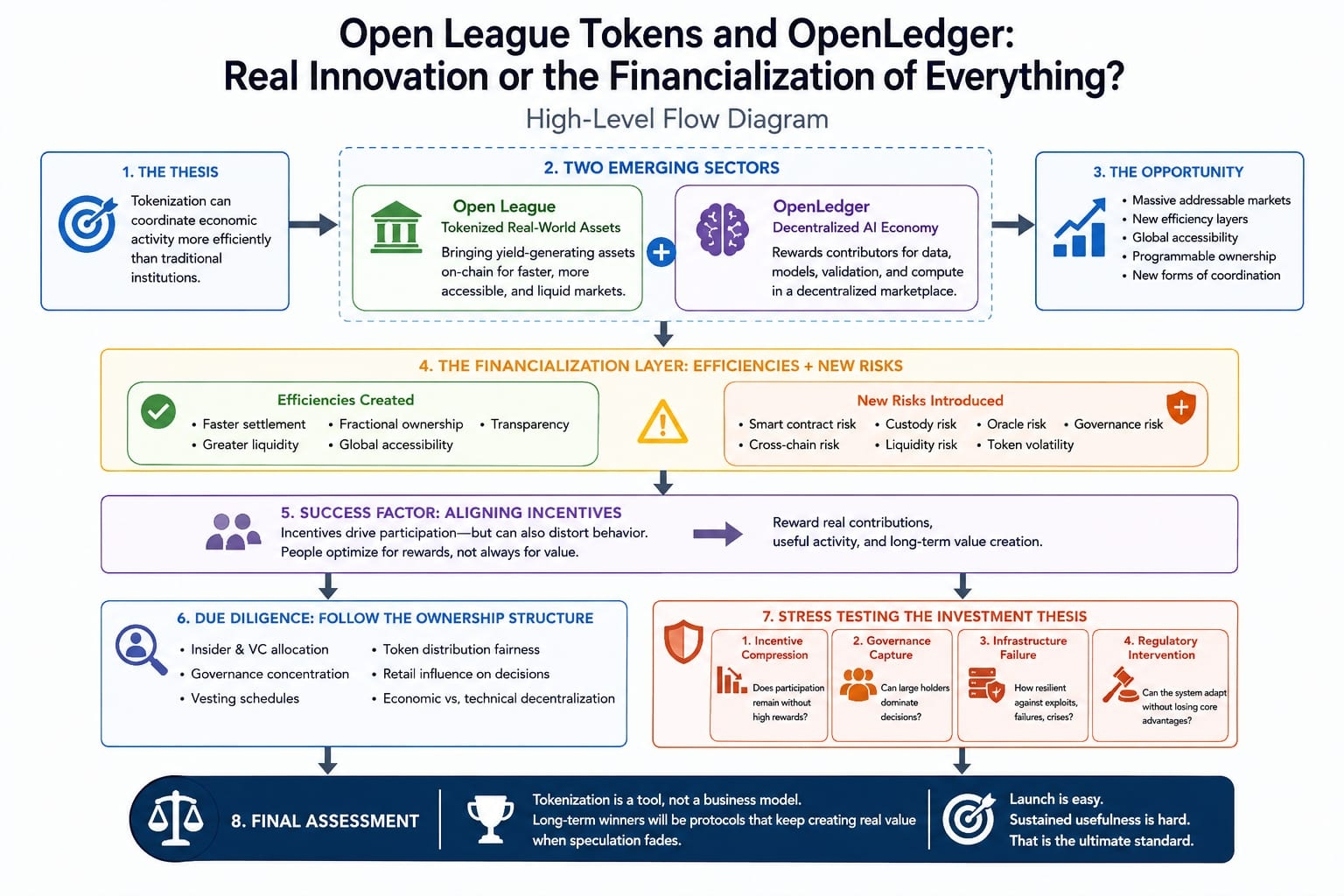
Every tokenized system introduces both efficiencies and additional risks.
Consider a traditional income-generating asset.
An investor normally evaluates:
• Asset quality
• Counterparty risk
• Expected return
• Liquidity profile
A tokenized version introduces additional considerations:
• Smart contract security
• Custodial arrangements
• Oracle reliability
• Governance decisions
• Cross-chain infrastructure
• Secondary market liquidity
• Token volatility
Blockchain does not eliminate risk.
It redistributes risk.
This distinction is critical because many investors mistake transparency for safety.
An asset being visible on-chain does not automatically make it less risky.
It simply makes certain risks easier to observe.
The same principle applies to decentralized AI economies.
OpenLedger is not only building technology.
It is building an incentive structure around technology.
Participants must trust that rewards remain attractive, governance remains fair, validators remain honest, and economic incentives remain aligned with actual value creation.
History suggests this is easier said than done.
Incentives: Crypto's Greatest Strength and Weakness
Every successful blockchain network is fundamentally an incentive machine.
Bitcoin rewards security.
Ethereum rewards validation.
DeFi rewards liquidity.
OpenLedger rewards contribution.
The challenge is that incentives often generate behavior that was never intended.
Liquidity mining attracted capital but often failed to create loyal users.
Play-to-earn gaming attracted participants but struggled to maintain sustainable economies.
Social reward systems increased engagement but frequently encouraged low-quality content.
The lesson is simple.
People optimize for rewards.
Not necessarily for value creation.
The long-term success of OpenLedger depends on whether its incentive mechanisms reward genuinely useful contributions rather than merely rewarding activity.
The difference between those two outcomes determines whether a protocol becomes infrastructure or speculation.
Follow the Ownership Structure
Whenever a project promotes decentralization, investors should investigate ownership before marketing.
Several questions deserve attention:
• How much supply is controlled by insiders?
• What percentage belongs to venture investors?
• How concentrated is governance power?
• How quickly do vesting schedules unlock?
• Can retail participants meaningfully influence protocol decisions?
Crypto history repeatedly demonstrates that technical decentralization does not always produce economic decentralization.
Many networks appear decentralized at the infrastructure level while remaining highly concentrated at the ownership level.
For long-term investors, token distribution often matters more than branding.
Stress Testing the Investment Thesis
Bull markets reward narratives.
Bear markets expose weaknesses.
The true test of Open League and OpenLedger will occur when conditions become difficult.
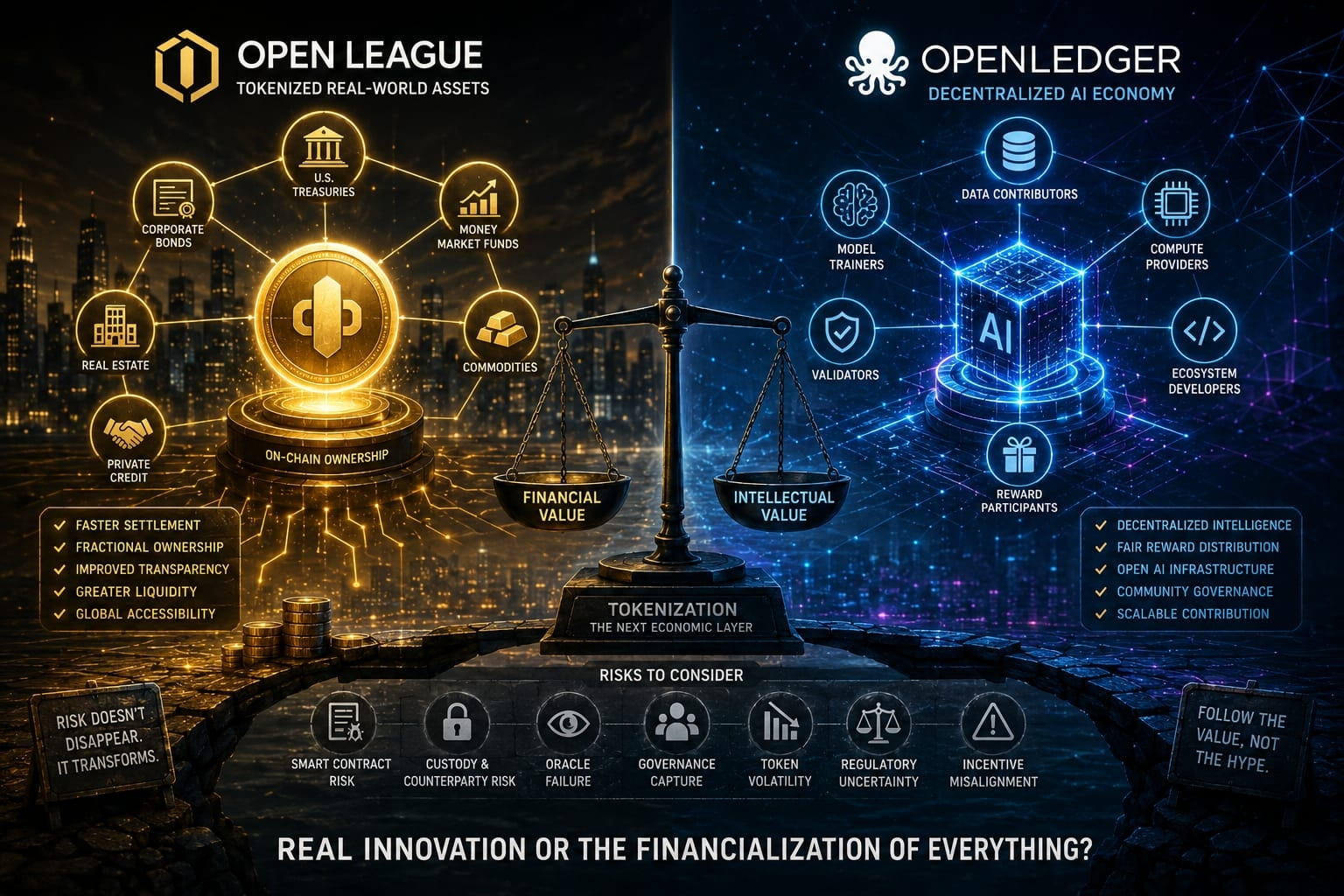
Investors should evaluate four critical scenarios.
Scenario 1: Incentive Compression
If token rewards decline significantly, does participation remain strong?
Or does activity disappear once financial rewards become less attractive?
Scenario 2: Governance Capture
Can large token holders dominate decision-making?
If governance becomes concentrated, how decentralized is the system in practice?
Scenario 3: Infrastructure Failure
How resilient are the protocols against smart contract exploits, liquidity crises, oracle failures, and operational disruptions?
Scenario 4: Regulatory Intervention
As tokenized assets and decentralized AI become larger industries, regulators will inevitably increase scrutiny.
Can these systems adapt without losing their core advantages?
The answers to these questions will ultimately determine whether the projects achieve long-term sustainability.
Final Assessment
Open League and OpenLedger represent two of the most important structural trends emerging in crypto today.
One seeks to tokenize real-world value.
The other seeks to tokenize digital contribution.
Both address legitimate inefficiencies.
Both offer compelling visions for the future.
Both could create entirely new economic models.
However, investors should avoid assuming that innovation automatically guarantees adoption.
Tokenization is a tool, not a business model.
A successful protocol must continue generating value even after speculation fades and incentives become less attractive.
The projects that survive the next decade will not be those with the most aggressive marketing campaigns.
They will be the projects that continue solving real problems when nobody is talking about the token price.
In crypto, launching a token is easy.
Building a system that remains useful without speculation is the difficult part.
That is the standard Open League and OpenLedger will ultimately be judged against.