
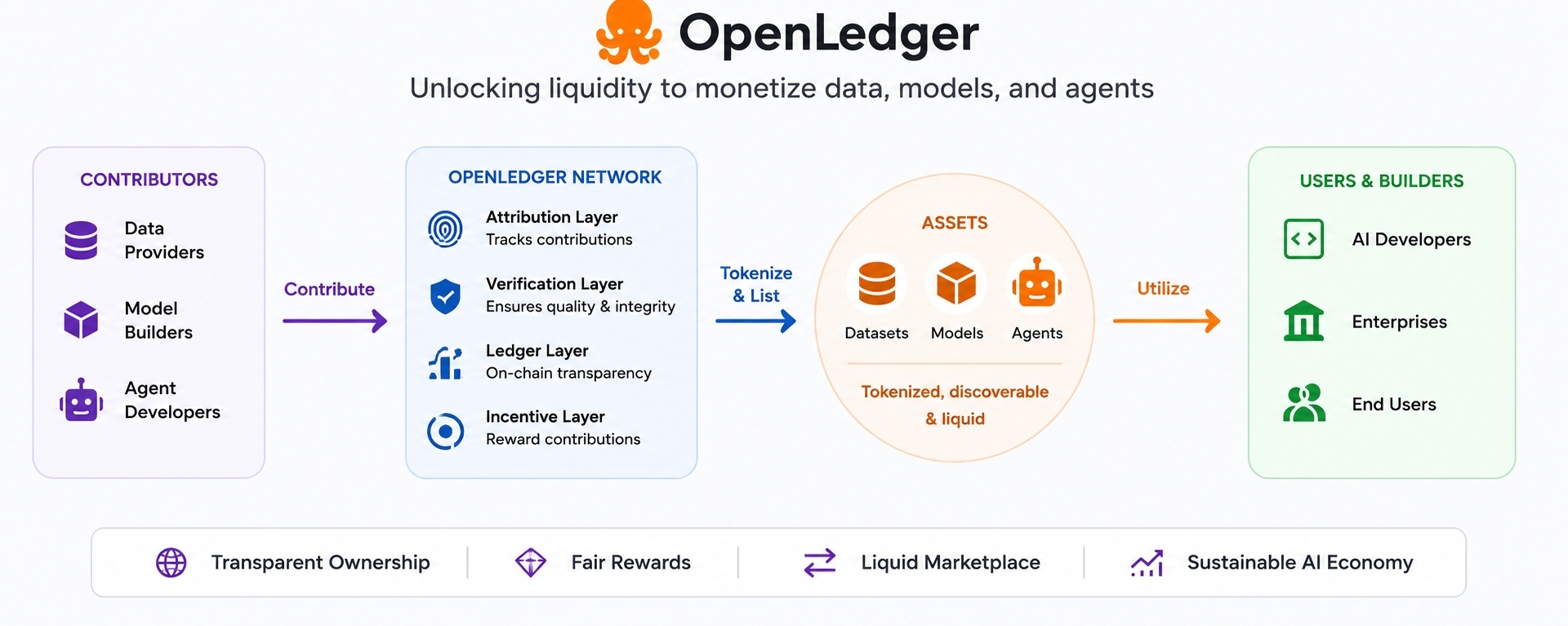

OpenLedger is one of those projects that becomes more interesting the longer I sit with it. Not because the idea is immediately obvious, but because it seems to be looking at a part of the AI economy that most people barely notice.
A lot of attention in AI goes toward the finished product. People talk about the model, the chatbot, the agent, or whatever application sits in front of the user. The conversation usually ends there. What gets less attention is everything that exists underneath those products. The data that trains them. The contributors who create useful information. The builders who develop models. The countless inputs that make AI possible in the first place.
OpenLedger appears to be built around the belief that those underlying contributions should not disappear into a black box.
What attracted me to the project is that it is not trying to manufacture a new problem in order to justify its existence. The imbalance it is addressing already exists. AI systems generate enormous amounts of value, yet the people and resources that help create that value are often difficult to identify once everything becomes part of a larger ecosystem. The further AI develops, the more important that question becomes.
Who benefits when intelligence becomes a product?
That question sits quietly in the background of almost every AI discussion, and OpenLedger seems to be building around it.
The project's vision revolves around creating an environment where data, models, and AI agents can become economic assets rather than invisible resources. In theory, contributors are not simply providing inputs and hoping someone else captures the value. Instead, their contributions can be recognized, measured, and rewarded within the network itself.
What makes this compelling is that the idea extends beyond crypto.
Even outside blockchain, there is growing debate around ownership in the age of AI. Data is valuable. Models are valuable. The problem is that value often becomes concentrated in places far removed from the people who helped create it. OpenLedger seems to be exploring whether a different structure can exist, one where economic participation is more directly connected to contribution.
Of course, having a meaningful goal and successfully building around it are very different things.
The challenge isn't convincing people that contributors deserve recognition. Most people would agree with that. The challenge is creating a system that can accurately determine what a contribution is worth.
That sounds simple until real users arrive.
Some data is useful. Some data is noise. Some contributors add genuine value. Others learn how to maximize rewards without improving the network. Every incentive system eventually attracts people who optimize for the reward mechanism itself. That isn't necessarily malicious. It is simply how economic systems work.
Because of that, OpenLedger's future probably depends less on technology and more on incentives.
Can the network consistently reward quality over quantity?
Can it attract valuable contributors without encouraging behavior that weakens the ecosystem over time?
Can it create enough economic opportunity to grow while maintaining standards that prevent the network from becoming flooded with low-value activity?
Those questions feel far more important than any short-term metric.
Another aspect that stands out is the project's attempt to position itself as infrastructure rather than a destination. Infrastructure projects rarely generate the same excitement as consumer-facing products because their success is often invisible. If they work, people simply use the applications built on top of them. Most users never think about the layers beneath.
That creates both an opportunity and a challenge.
The opportunity is that infrastructure can become deeply embedded if it solves a real problem. The challenge is that adoption depends heavily on builders. Developers are ultimately practical. They choose tools that make their lives easier and improve the products they are creating. OpenLedger needs to offer more than a compelling vision. It needs to create advantages that builders can feel immediately.
That is where execution becomes critical.
The project is entering a market filled with AI platforms, data networks, model providers, and emerging agent ecosystems. Simply being connected to AI is no longer enough to stand out. What matters is whether OpenLedger becomes something participants genuinely need rather than something they can easily replace.
I think that distinction is often overlooked.
Crypto frequently rewards narratives before it rewards utility. The strongest projects eventually reverse that relationship. Utility becomes the reason people stay long after narratives lose momentum. OpenLedger's long-term relevance will likely depend on whether contributors, developers, and AI ecosystems continue finding value in the network even when market attention moves elsewhere.
The token is part of that equation, but not in the way many people assume. Its importance is tied to coordination. Networks need mechanisms that align participants around shared outcomes. The real test is whether those incentives create lasting engagement or merely temporary activity. Sustainable networks emerge when participation remains attractive because the ecosystem itself generates value, not simply because rewards are available.
That transition is difficult for almost every crypto project.
What gives OpenLedger a chance is that the problem it is attempting to solve feels increasingly relevant. AI is expanding rapidly, but conversations around ownership, attribution, and economic participation are still in their early stages. As these systems become more powerful and more integrated into everyday life, those questions will likely become harder to ignore.
Whether OpenLedger becomes an important piece of that future remains uncertain.
There is a meaningful difference between identifying an important problem and becoming the network that successfully solves it. Adoption must happen. Contributors must stay engaged. Builders must choose to integrate. Incentives must remain aligned. Value must flow through the ecosystem in ways that make participation worthwhile for everyone involved.
Those are difficult challenges, but they are also the challenges that matter.
After spending time studying the project, my impression is not one of certainty but of curiosity. OpenLedger feels like an attempt to build economic infrastructure for an AI economy that is still taking shape. The idea carries enough substance to be taken seriously, particularly because it focuses on ownership and value creation rather than chasing the latest trend. At the same time, many of its most important questions can only be answered through adoption and real-world usage.
For now, that is what makes the project worth watching. Not because its future is obvious, but because it is exploring a part of the AI landscape that may become far more important than it appears today.