
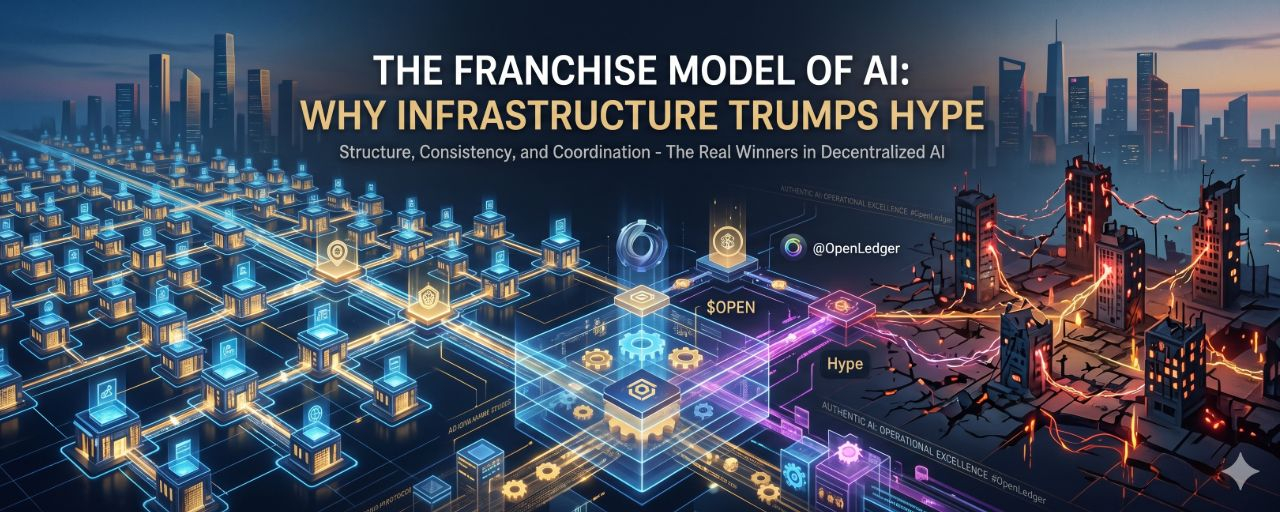
When we analyze the explosive trajectory of artificial intelligence, most market observers make the mistake of focusing entirely on the "brain" the large language models making headline news.
But if you look deeper into the structural mechanics of Web3 native AI ecosystems like @OpenLedger , an entirely different analogy comes to mind: the global franchise system.
Think about how major real-world franchises scale.
Their survival doesn't rely on a single central manager micromanaging every location.
Instead, it relies on a rock-solid operational protocol. Thousands of independent operators must execute tasks with absolute predictability under a shared rulebook.
If one location fails to maintain consistency, the integrity of the entire brand network begins to decay.
Right now, decentralized AI is facing this exact architectural crossroads.
Beyond the Sandbox: The Rise of Interconnected Networks
AI is no longer just software sitting isolated in a closed cloud environment.
We are moving rapidly toward autonomous networks where smart models act as data routing highways. They are constantly interacting with:
Dynamic, crowd-sourced external datasets
Permissionless data contributor pipelines
Continuous cryptographic feedback loops
Autonomous on-chain agents and execution layers
The major technical challenge of this decade isn't discovering raw intelligence; it’s organizing it.
When you have hundreds of decentralized nodes feeding data into an AI model, how do you prevent bad data from poisoning the system? How do you ensure coordination without centralized censorship?
Why I am Bullish on the Architecture of $OPEN
This critical infrastructure layer is precisely why @OpenLedger stands out to me in an ocean of speculative, hype driven crypto AI protocols.
While retail investors chase short term pumps driven by flashy, superficial front ends, the team behind $OPEN is quietly building the invisible coordination layer that turns chaotic data inputs into verifiable, enterprise-grade AI infrastructure.
For decentralized AI to transition from an experimental playground into global infrastructure the kind of tech that industries rely on blindly every single second the underlying plumbing is everything.
This means flawless data attribution , transparent contribution workflows, and unshakeable cross-system alignment.
The Silent Threat of Interconnected Failure
In highly complex distributed networks, system failures rarely happen out in the open with a dramatic, visible exploit. Instead, they happen quietly underneath the surface.
A minor data mismatch in one node flows into the next layer, slightly degrading the quality of the model’s outputs. Over time, subtle coordination failures compound, trust erodes, and the entire network becomes unreliable even if no single component appears broken.
When dependencies overlap continuously, simple errors multiply exponentially.
Final Thoughts: The Long Term Play
The ultimate winners in the Web3 x AI narrative will not be the projects screaming the loudest on social media or launching the most speculative token mechanics.
The crown will inevitably belong to the robust architectures capable of keeping massive, autonomous data pipelines functioning cohesively when human management becomes impossible.
By prioritizing structural integrity over artificial hype, #OpenLedger is positioning itself as a foundational backbone for the next generation of decentralized intelligence. It remains one of the most fundamentally compelling frameworks to watch closely.
