Most people are looking in the wrong direction.
They think the future of AI will be decided by who builds the smartest model.
Bigger models.
Faster inference.
More parameters.
Better benchmarks.
That was the first phase of the AI race.
The second phase may be something entirely different.
Because intelligence is rapidly becoming abundant.
Trust is not.
For decades, the internet optimized for distribution.
Information could move anywhere instantly.
Articles, images, videos, research, opinions, and ideas became infinitely reproducible.
The result was extraordinary access.
But there was a hidden cost.
The connection between information and its origin slowly disappeared.
Knowledge spread everywhere while attribution became weaker.
Sources vanished.
Creators lost visibility.
Context evaporated.
Now AI is accelerating that trend to an entirely new level.
Every day millions of pieces of content are generated, remixed, summarized, translated, and republished by machines.
Soon the internet will contain more synthetic content than human-created content.
At that point, intelligence itself stops being scarce.
Anyone can generate information.
Anyone can create images.
Anyone can build content.
Anyone can train models.
The scarce asset becomes something else:
Proof.
Proof of origin.
Proof of contribution.
Proof of ownership.
Proof of authenticity.
History shows that whenever abundance arrives, scarcity shifts elsewhere.
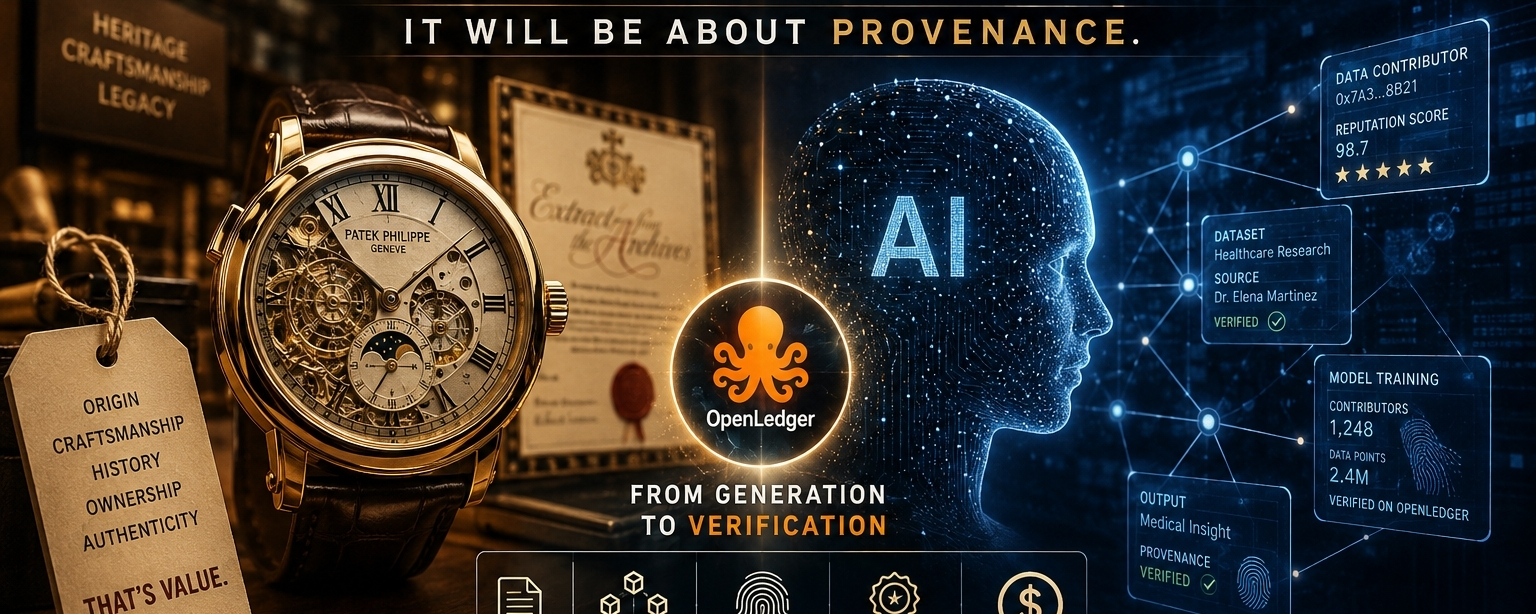
When manufacturing became cheap, luxury brands sold craftsmanship.
When information became free, attention became valuable.
When content becomes infinite, provenance becomes the premium asset.
This is why projects like OpenLedger are interesting.
Not because they are building another AI narrative.
But because they are exploring one of the biggest unanswered questions in the digital economy:
How do we preserve the connection between intelligence and the people who created it?
The future AI economy may require systems that record where knowledge originated, who contributed to it, how it evolved, and how value should be distributed back through that chain.
Without provenance, AI becomes a black box.
With provenance, AI becomes an economy.
That distinction matters.
Because the next generation of trillion-dollar digital markets may not be built around creating intelligence.
They may be built around tracking, verifying, and rewarding it.
Many investors are focused on who owns the models.
The bigger opportunity may be understanding who owns the data, the contributions, the reputation, and the proof behind those models.
The internet's first era rewarded distribution.
The AI era rewarded generation.
The next era may reward verification.
And when that shift arrives, authenticity becomes one of the most valuable assets in the entire digital world.
The future may not belong to whoever creates the most intelligence.
It may belong to whoever can prove where that intelligence came from. @OpenLedger #OpenLedger $OPEN