
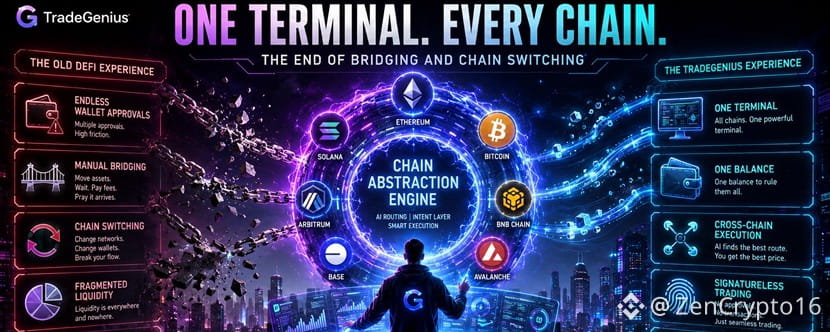
I spent some time exploring the TradeGenius architecture and one idea kept coming up throughout the documentation: chain abstraction.
At first glance, it sounds like another technical buzzword. The crypto industry is full of terms that get repeated so often they lose meaning. But after digging deeper into the concept, I started to understand why TradeGenius appears to be building around it as a core part of the platform.
One of the biggest challenges facing decentralized finance today is not liquidity, trading volume, or even the number of available protocols. The real challenge is usability.
Most experienced crypto users are already familiar with the routine. You hold assets on one chain but want to access liquidity on another. That means bridging funds, paying fees, switching networks, connecting wallets again, approving transactions, and hoping everything works as expected. For newer users, this process can feel overwhelming. Even for experienced traders, it can be frustrating and time-consuming.
The problem becomes even more noticeable when markets move quickly. Opportunities often exist across multiple chains at the same time. A trader may see an attractive position on one network while their funds are sitting somewhere else entirely. Moving assets between ecosystems can introduce delays, additional costs, and unnecessary complexity.
This is where TradeGenius becomes interesting.
Instead of asking users to constantly think about chains, bridges, and routing paths, the platform appears to be built around the idea that infrastructure should become invisible. The user focuses on the trade while the system handles the complexity behind the scenes.
That might sound simple on paper, but it represents a significant shift in how many DeFi platforms operate today.
Traditionally, users are responsible for understanding where liquidity exists, which bridge to use, how to move assets safely, and which network is required for execution. TradeGenius seems to be moving toward a model where those decisions are increasingly automated through routing systems and execution infrastructure.
What caught my attention is that this approach is not merely about convenience. It also has the potential to improve efficiency.
When liquidity becomes fragmented across dozens of networks, finding the best execution path becomes increasingly difficult. Traders may unknowingly accept worse pricing simply because they do not have visibility into all available liquidity sources. A platform capable of intelligently routing orders across chains could theoretically reduce some of these inefficiencies.
Another aspect worth discussing is the integration with Hyperliquid.
Many projects attempt to build entirely new ecosystems from scratch. While that approach can work, it also requires enormous effort to attract liquidity, users, and activity. TradeGenius appears to be taking a different path by integrating with existing liquidity infrastructure while focusing on execution quality and user experience.
From a product perspective, this feels like a practical decision.
Liquidity is often one of the hardest challenges for new trading platforms to solve. By connecting to established liquidity sources rather than recreating them, TradeGenius can focus resources on improving the trading experience itself.
I also found the relationship between chain abstraction and smart routing particularly interesting.
Most users never think about how complicated trade execution can become behind the scenes. A single transaction may involve multiple liquidity sources, several execution paths, and different networks. The average trader simply wants the best possible outcome.
If routing technology can identify efficient pathways automatically, users may benefit from better execution without needing to understand every technical detail involved.
This connects closely with another feature discussed in the ecosystem: signatureless trading.
For many crypto users, repeated wallet confirmations have become a normal part of the experience. Every interaction requires approvals, signatures, and additional steps. While these security measures are important, they also create friction.
TradeGenius appears to be exploring ways to reduce that friction while maintaining user control over assets. If implemented effectively, this could make on-chain trading feel significantly closer to the experience users expect from modern financial applications.
Of course, none of these ideas come without challenges.
In fact, one of the reasons I find the project interesting is because the vision itself is difficult to execute.
Building secure cross-chain infrastructure is not easy. Every additional chain introduces new variables, new risks, and new technical considerations. Routing systems must remain reliable. Security assumptions must remain strong. Liquidity sources must remain accessible. User experience must remain intuitive.
Balancing all of those requirements simultaneously is a significant engineering challenge.
There is also the question of scalability. As more chains emerge and liquidity continues to spread across ecosystems, maintaining seamless execution becomes increasingly complex. The technology must continue evolving alongside the broader crypto landscape.
This is why I think the long-term success of platforms like TradeGenius will depend less on marketing and more on execution.
The vision is compelling. The technology concepts are interesting. But ultimately, users will judge the platform based on whether it consistently delivers faster, simpler, and more reliable trading experiences.
Another reason the project stands out is that it appears focused on solving practical problems rather than creating entirely new ones.
Many crypto products introduce additional complexity in the pursuit of innovation. TradeGenius seems to be moving in the opposite direction. The objective is not necessarily to expose users to more infrastructure but to shield them from it.
That distinction matters.
When people talk about mass adoption, discussions often focus on regulation, institutional participation, or technological breakthroughs. While those factors are important, user experience may be equally critical. Most people do not want to become blockchain experts simply to complete a trade.
They want the benefits of decentralization without the operational headaches that often accompany it.
Chain abstraction, smart routing, liquidity aggregation, and seamless execution all point toward that broader objective. Whether TradeGenius ultimately achieves its vision remains to be seen, but the direction itself is worth paying attention to.
After reviewing the architecture and core concepts, my biggest takeaway is that TradeGenius is not trying to compete solely on speed or liquidity. Instead, it appears to be focused on reducing friction.
In many ways, that may be one of the most important opportunities in DeFi today.
The future of decentralized trading may not belong to the platform with the most features. It may belong to the platform that makes complexity disappear.
And that is exactly why the TradeGenius approach caught my attention.