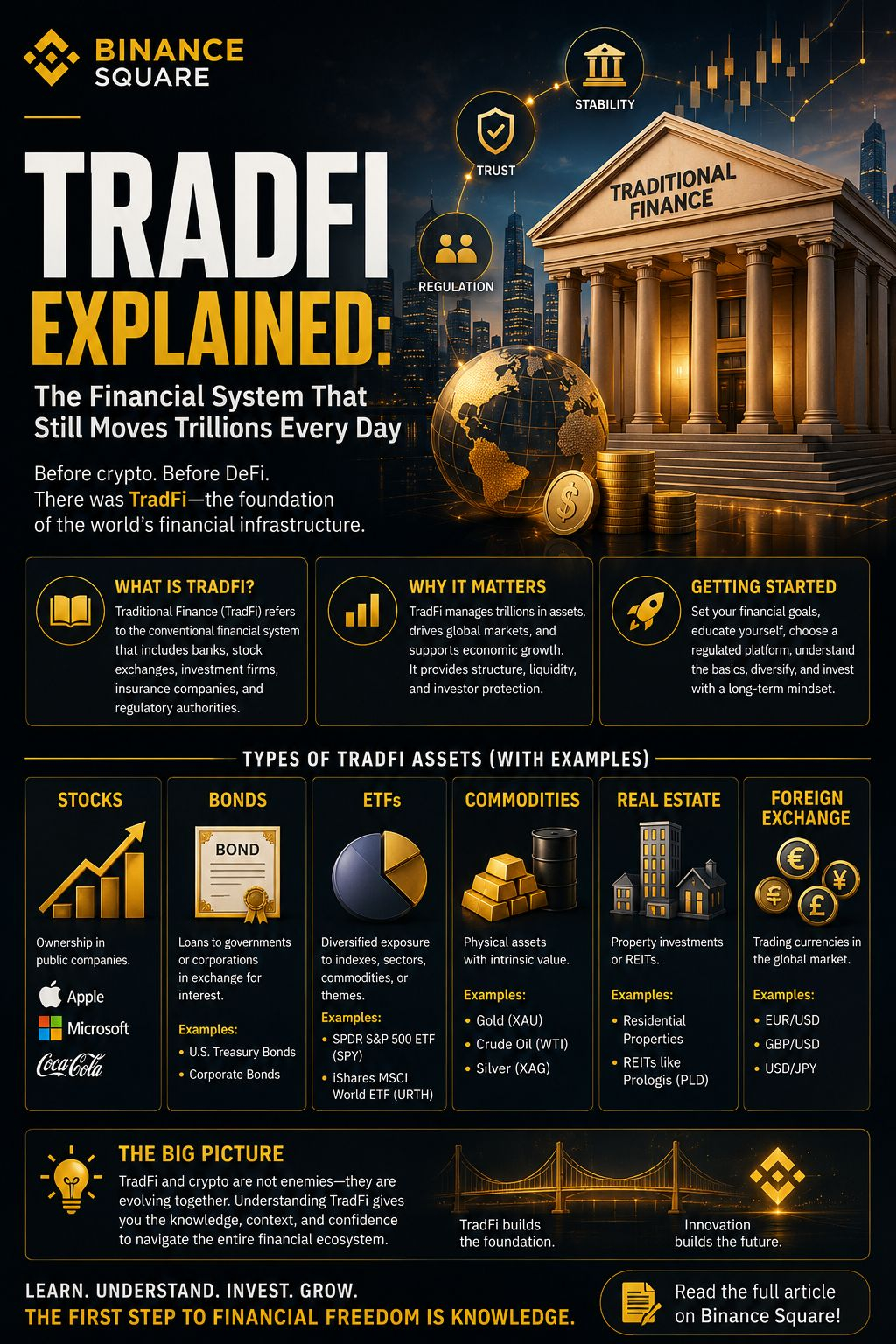
In a world increasingly dominated by blockchain innovation, cryptocurrencies, and decentralized finance (DeFi), the term "TradFi" has become one of the most frequently discussed concepts in the financial industry. Short for Traditional Finance, TradFi refers to the conventional financial system that has governed global markets for decades through institutions such as banks, stock exchanges, insurance companies, investment funds, and regulatory authorities. While crypto has introduced new ways to transfer, store, and invest value, TradFi remains the foundation of the world's financial infrastructure, managing trillions of dollars in assets and facilitating economic activity across every major country.
TradFi encompasses a wide range of financial assets that investors use to build wealth, preserve capital, and generate income. These assets include stocks, which represent ownership in publicly traded companies; bonds, which function as loans made to governments or corporations in exchange for interest payments; exchange-traded funds (ETFs), which provide diversified exposure to baskets of securities; mutual funds, commodities such as gold and oil, foreign currencies, real estate investments, and money market instruments. Each asset class serves a different purpose within a portfolio, offering varying levels of risk, return potential, and liquidity. Understanding these distinctions is essential for anyone seeking to make informed investment decisions.
One of the defining characteristics of TradFi is its reliance on intermediaries. Banks process transactions, brokers execute trades, clearinghouses settle transactions, and regulators oversee market integrity. This structure has helped create stability, investor protections, and standardized procedures, but it can also introduce inefficiencies such as higher fees, limited operating hours, and slower settlement times. These limitations are among the reasons why blockchain technology and decentralized financial systems have gained significant attention in recent years.
For beginners looking to enter the world of TradFi, the process is more straightforward than many assume. The first step is to establish clear financial goals, whether they involve long-term wealth accumulation, retirement planning, income generation, or capital preservation. Once objectives are defined, investors can open an account with a regulated brokerage platform or financial institution that provides access to financial markets. Before committing capital, it is important to understand the fundamentals of each asset class, assess personal risk tolerance, and diversify investments to reduce exposure to any single asset or market event.
Education remains one of the most valuable investments an individual can make before entering any financial market. Learning how economic indicators, interest rates, inflation, and corporate performance influence asset prices can significantly improve decision-making. Successful investing is rarely about chasing short-term trends; rather, it is built upon disciplined strategies, risk management, and a long-term perspective. Investors who focus on understanding market fundamentals often place themselves in a stronger position to navigate periods of volatility and uncertainty.
As the boundaries between TradFi and digital finance continue to blur, many financial institutions are exploring blockchain-based solutions, tokenized assets, and cryptocurrency integration. Rather than existing as competitors, TradFi and crypto increasingly appear to be complementary components of a broader financial ecosystem. Understanding both worlds provides investors with a more complete perspective on how capital flows, how markets evolve, and where future opportunities may emerge.
Whether you are a newcomer exploring investment opportunities or an experienced participant seeking a deeper understanding of financial markets, learning the foundations of TradFi is an essential step toward becoming a more informed and confident investor. The financial landscape may continue to evolve, but the principles that underpin traditional finance remain as relevant today as ever.
To better understand TradFi assets in practice, consider some common examples. Stocks may include shares of companies such as Apple Inc., Microsoft Corporation, or The Coca-Cola Company, where investors own a portion of the business and may benefit from its growth over time. Bonds can be issued by governments, such as U.S. Treasury Bonds, or by corporations seeking to raise capital. Exchange-traded funds (ETFs) include products that track broad market indices, sectors, commodities, or specific investment themes. Commodities consist of physical assets such as gold, silver, crude oil, and agricultural products, while real estate investments may involve residential properties, commercial buildings, or real estate investment trusts (REITs). Foreign exchange (Forex) markets facilitate trading between currencies such as the U.S. dollar, euro, British pound, and Japanese yen. Together, these assets form the foundation of traditional finance, providing investors with diverse opportunities to grow, protect, and manage their wealth according to their financial objectives and risk tolerance.
As financial markets continue to evolve, understanding TradFi is no longer just for finance professionals, it is becoming an essential skill for anyone looking to build long-term financial knowledge. Whether your journey begins with stocks, bonds, ETFs, or eventually expands into digital assets and blockchain technologies, a strong grasp of traditional financial principles provides a valuable foundation for making informed decisions. The most successful investors are often those who remain curious, continuously educate themselves, and adapt to changing market conditions while maintaining a disciplined and strategic approach to wealth creation. By understanding how traditional finance works today, investors can better position themselves to navigate the opportunities of tomorrow.
#BinanceSquare #TradFi #Investing" #financialeducation #CryptoKnowledge🚀