Every major technological revolution creates value long before it creates fairness.
The internet connected information but concentrated profits in a handful of platforms.
Social media gave everyone a voice but ownership remained centralized.
Artificial intelligence is now following a similar path.
Millions of people contribute data, feedback, knowledge, prompts, corrections, and specialized expertise that help train and improve AI systems every day. Yet most contributors never receive recognition for the value they create. Their work disappears into datasets, models, and training pipelines where attribution becomes difficult or impossible to track.
This is where I believe one of the most important questions in AI begins to emerge.
Who should benefit from the value AI creates?
The answer may determine how the next generation of AI infrastructure evolves.
That question is exactly why I have been paying close attention to @OpenLedger and the ecosystem being built around $OPEN.
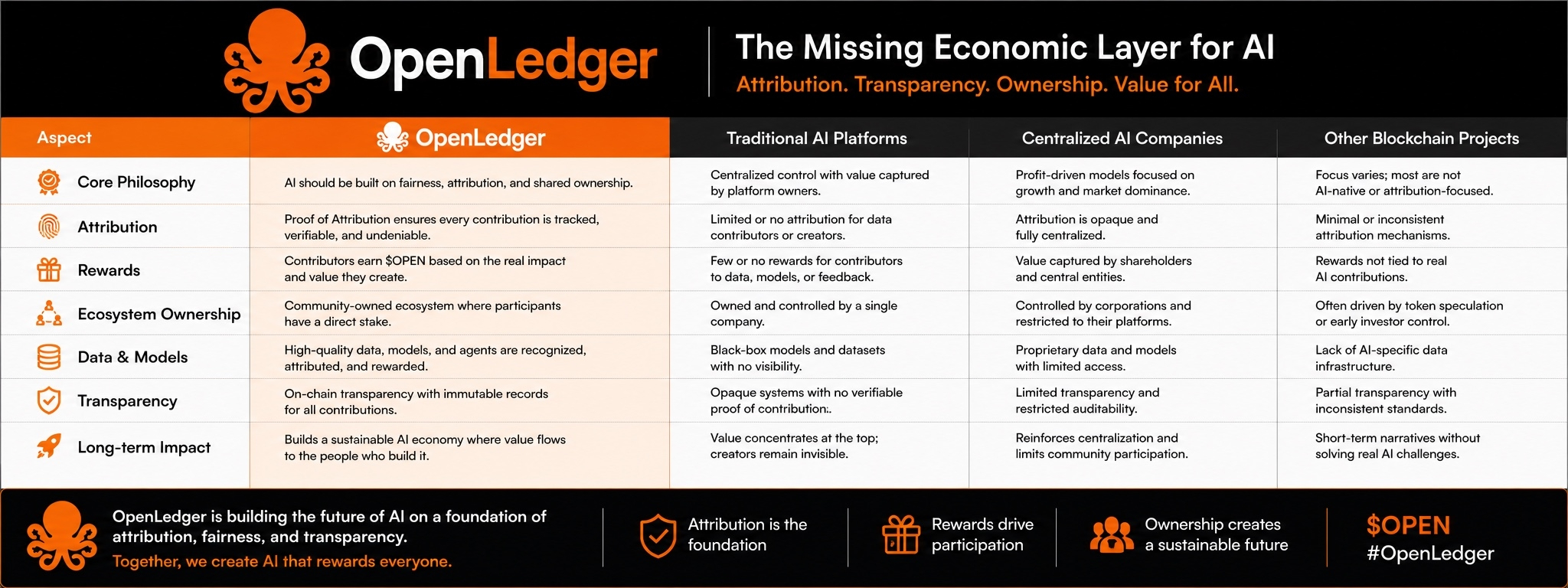
While much of the market focuses on faster models, larger datasets, and more powerful compute resources, OpenLedger is addressing something equally important: creating a transparent economic system that connects AI value back to its contributors.
In simple terms, OpenLedger is trying to solve the attribution problem.
And that problem may be bigger than most people realize.
Think about how AI systems operate today.
A model generates an answer.
That answer is based on training data.
That training data was created by people.
Those people may have contributed articles, code, research, conversations, annotations, images, feedback, or domain expertise.
But once the model produces an output, identifying who contributed value becomes extremely difficult.
The result is a system where AI creates enormous economic value while the connection between contribution and reward becomes increasingly blurred.
This is not necessarily a technical failure.
It is a structural limitation.
The more AI scales, the harder attribution becomes.
OpenLedger approaches this challenge from a completely different angle.
Instead of treating attribution as an afterthought, it places attribution at the center of the system.
The idea is straightforward but powerful.
If AI is built on contributions, then contributions should be measurable.
If contributions are measurable, they can be rewarded.
If they can be rewarded, entirely new AI economies become possible.
This is where OpenLedger’s concept of Proof of Attribution becomes particularly interesting.
Proof of Attribution is designed to track and verify contributions across AI workflows.
Rather than allowing contributions to disappear inside black-box systems, attribution remains attached to the value created.
For AI developers, researchers, data providers, and community contributors, this creates a framework where impact can potentially be recognized and rewarded rather than absorbed into centralized platforms.
What makes this concept important is that AI is no longer a single-model industry.
Modern AI increasingly operates through complex ecosystems.
Datasets interact with models.
Models interact with agents.
Agents interact with users.
Outputs become training material for future systems.
Knowledge moves continuously across layers.
As these systems become more interconnected, attribution becomes exponentially more difficult.
Yet attribution may become one of the most valuable components of the entire AI stack.
Without attribution, contributors lose incentives.
Without incentives, quality eventually suffers.
Without quality, AI systems struggle to improve sustainably.
OpenLedger attempts to create a mechanism where contribution and reward remain connected regardless of how complex AI systems become.
This creates a fascinating possibility.
Instead of AI being controlled exclusively by large organizations with access to massive resources, value creation could become more broadly distributed across participants who contribute to the ecosystem.
That shift could have significant implications for the future of AI development.
Another reason OpenLedger stands out is its focus on data.
Data is often described as the fuel of AI.
But not all data is equally valuable.
High-quality, specialized, curated datasets are becoming increasingly important as AI systems seek better accuracy and performance.
The challenge is that producing high-quality datasets requires effort, expertise, and continuous maintenance.
Traditional systems struggle to create sustainable incentives for this work.
OpenLedger’s infrastructure aims to support an environment where valuable data contributions can be recognized and rewarded.
That creates stronger incentives for quality.
And quality is ultimately what determines whether AI systems become more useful over time.
The economic implications are substantial.
Today, many AI markets are built around access.
Access to compute.
Access to models.
Access to infrastructure.
But in the future, access alone may not be enough.
Ownership of contribution could become equally important.
Imagine a world where data providers, model creators, researchers, validators, and AI operators all participate in the value generated by the systems they help build.
That is a fundamentally different economic structure from what exists today.
It shifts AI from a model where value accumulates primarily at the center toward a model where value can flow throughout the network.
This is one of the reasons blockchain technology feels particularly relevant in the AI conversation.
Blockchain excels at recording ownership, tracking activity, and creating transparent economic systems.
AI excels at generating intelligence and automation.
Combining those capabilities opens entirely new possibilities.
OpenLedger sits directly at that intersection.
Rather than viewing blockchain and AI as separate industries, it treats them as complementary technologies.
One provides intelligence.
The other provides accountability.
One generates outputs.
The other creates verifiable records.
Together they can potentially create systems that are both powerful and economically transparent.
Another aspect worth considering is how AI governance may evolve over time.
As AI systems become increasingly influential, questions surrounding ownership, participation, and value distribution will become more important.
Communities are likely to demand greater transparency.
Developers will seek sustainable incentives.
Contributors will want recognition.
Users will want accountability.
Infrastructure capable of supporting these requirements could become increasingly valuable.
OpenLedger appears positioned around that long-term thesis.
Instead of chasing short-term narratives, the project is focused on building foundational infrastructure for a future where attribution matters.
The market often rewards narratives before it rewards utility.
But eventually utility becomes difficult to ignore.
The internet needed payment systems.
Blockchain needed stablecoins.
AI may need attribution.
That possibility is what makes OpenLedger particularly interesting to follow.
The broader AI industry continues to expand at an extraordinary pace.
New models are released regularly.
Agent ecosystems are growing.
Data requirements are increasing.
Competition is accelerating.
Yet beneath all of these developments remains a simple reality.
AI does not emerge from nothing.
It is built on contributions.
The challenge is ensuring those contributions remain visible.
The opportunity is creating systems where visibility translates into value.
That is the core idea I see behind OpenLedger.
Not simply building another blockchain.
Not simply building another AI platform.
But building infrastructure that connects contribution, attribution, and economic participation.
Whether the market fully appreciates that vision today is another question entirely.
What matters is that the problem exists.
And the larger AI becomes, the more important that problem may become.
For that reason, I believe OpenLedger represents one of the more interesting long-term experiments emerging at the intersection of AI and blockchain.
As the industry continues evolving, attribution could become one of the defining themes of the next generation of AI infrastructure.
If that happens, projects focused on solving attribution today may play a much larger role tomorrow.
That is why I continue watching @OpenLedger and the evolution of the $OPEN ecosystem.
The future of AI may not only be determined by intelligence.
It may also be determined by who receives credit for creating it.