
The crypto industry loves complexity.
Every year we hear about faster blockchains, more advanced protocols, new trading tools, and increasingly sophisticated ecosystems. Innovation is moving at an incredible pace, yet one problem continues to follow the industry everywhere it goes: user experience.
I was thinking about this while exploring TradeGenius recently.
When people discuss DeFi, the conversation usually revolves around opportunities, yields, liquidity, or trading strategies. What often gets ignored is how much effort users spend simply interacting with the infrastructure itself.
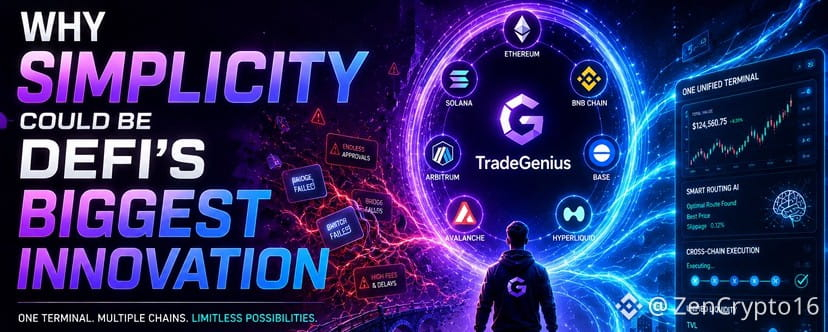
A trader might need to bridge assets, switch networks, approve transactions multiple times, move funds between wallets, and search for liquidity across different chains before even placing a trade. For experienced users, these steps become routine. For newer participants, they can feel overwhelming.
This is where I think simplicity becomes interesting.
One of the ideas behind TradeGenius is that traders should not have to think constantly about the infrastructure operating behind the scenes. Instead of focusing on which blockchain they are using, users can focus on what they actually want to accomplish.
That may sound like a small change, but I believe it represents a much larger shift in how DeFi platforms are being designed.
The most successful technologies are often the ones people barely notice. Most internet users do not think about the protocols moving data across the world when they send a message. They simply expect the experience to work. In many ways, blockchain technology is still waiting for that moment.
Features such as cross-chain execution, smart routing, and chain abstraction are attempting to move the industry in that direction. Rather than forcing users to adapt to blockchain complexity, the technology adapts to the user.
What I find particularly interesting is that this approach is not necessarily about adding more features. It is about removing friction.
In my opinion, reducing complexity can be more valuable than introducing another trading indicator, another dashboard, or another token utility. The easier a platform becomes to use, the larger the potential audience becomes.
Of course, simplicity on the front end often means significant complexity behind the scenes. Building infrastructure capable of handling multiple chains, liquidity sources, and execution routes is a difficult challenge. Security, reliability, and scalability remain critical factors.
That is why projects pursuing this vision have a lot to prove.
Still, I believe the long-term winners in DeFi may not be the platforms with the most features. They may be the platforms that make powerful technology feel effortless.
TradeGenius caught my attention because it appears to be focused on that exact goal.
If the future of DeFi is going to reach a broader audience, simplicity might not just be an advantage.
It might be the biggest innovation of all.