
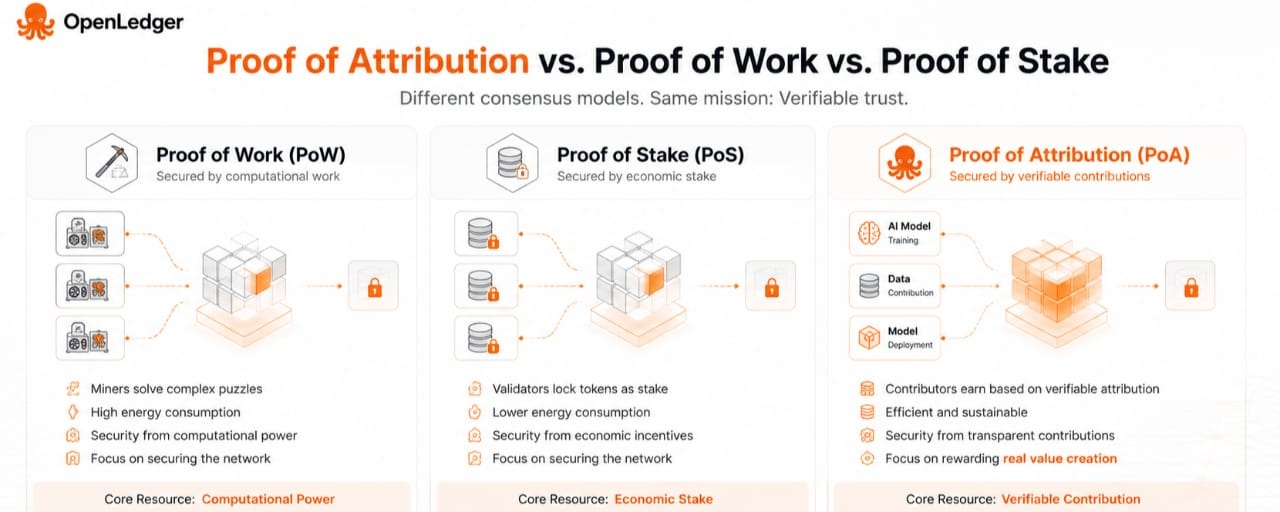
The crypto industry has a habit of introducing a new buzzword every cycle. This time it's "Proof of Attribution." It sounds innovative, but after watching countless trends rise and fall, I've learned to approach new concepts with caution. Many ideas that looked revolutionary at first eventually turned out to be little more than repackaged versions of old models. Market excitement is often the loudest signal, but not always the most reliable one.
At its core, cryptocurrency has always revolved around a simple question: how can value be verified without relying on a central authority?
Bitcoin answered that question through Proof of Work, where security comes from computational effort and energy expenditure. If you want to participate in block production, you invest in hardware and electricity. The system rewards verifiable work.
Later, networks like Ethereum adopted Proof of Stake, shifting the source of security from energy to capital. Instead of proving commitment through computation, participants prove it by locking assets at risk. Influence is tied to economic stake rather than processing power.
Both approaches work well because they align with traditional financial incentives. However, they were designed for systems focused on transactions and structured information.
The rise of AI introduces a different challenge altogether: data.
Modern AI models depend on enormous amounts of unstructured data, yet determining who contributed that data—and how much value each contribution created—is far from straightforward.
This is where the limitations of existing models become more visible.
Using Proof of Work to solve data attribution feels inefficient because computational effort doesn't necessarily measure the value of information. Meanwhile, Proof of Stake risks concentrating influence among those with the largest capital reserves, regardless of whether they contribute meaningful datasets. Neither framework seems perfectly suited to measuring the worth of data itself.
That is what makes OpenLedger's concept of Proof of Attribution interesting.
Rather than proving ownership through energy consumption or financial stake, the model attempts to prove the origin, quality, and contribution of data within AI systems. The focus shifts from "Who spent the most resources?" to "Who provided information that actually created value?"
Viewed this way, Proof of Work proves commitment through physical resources, Proof of Stake proves commitment through capital, and Proof of Attribution aims to prove contribution through data provenance and intellectual input.
Conceptually, the idea makes sense. But ideas are always easier than implementation.
The real challenge lies in execution. How can a network accurately determine the value of a dataset? How does it distinguish useful information from noise? More importantly, how can it prevent participants from generating synthetic or low-quality data solely to farm rewards?
Those are the questions that keep drawing my attention back to this model. Technology evolves, but incentives remain constant. Any system that distributes rewards will inevitably attract attempts to exploit it.
For that reason, I don't view Proof of Attribution as an automatic breakthrough. It's still early, and its long-term viability remains unproven. It could become an important building block for the AI economy, or it could end up as another ambitious experiment that struggles under real-world conditions.
Either way, it's a direction worth watching.
As AI systems increasingly depend on data as a core economic resource, mechanisms for tracking and rewarding contributions may become just as important as the models themselves. Whether OpenLedger succeeds or not, the problem it is trying to solve feels increasingly relevant.
For now, I'm staying curious and watching how the model performs.