

The first thing I look for in tokenomics is not the chart. It is the mood underneath the numbers. Every allocation tells a small confession. Who is being trusted early? Who is being asked to wait? Who gets liquidity now, and who has to earn their way into the system later?
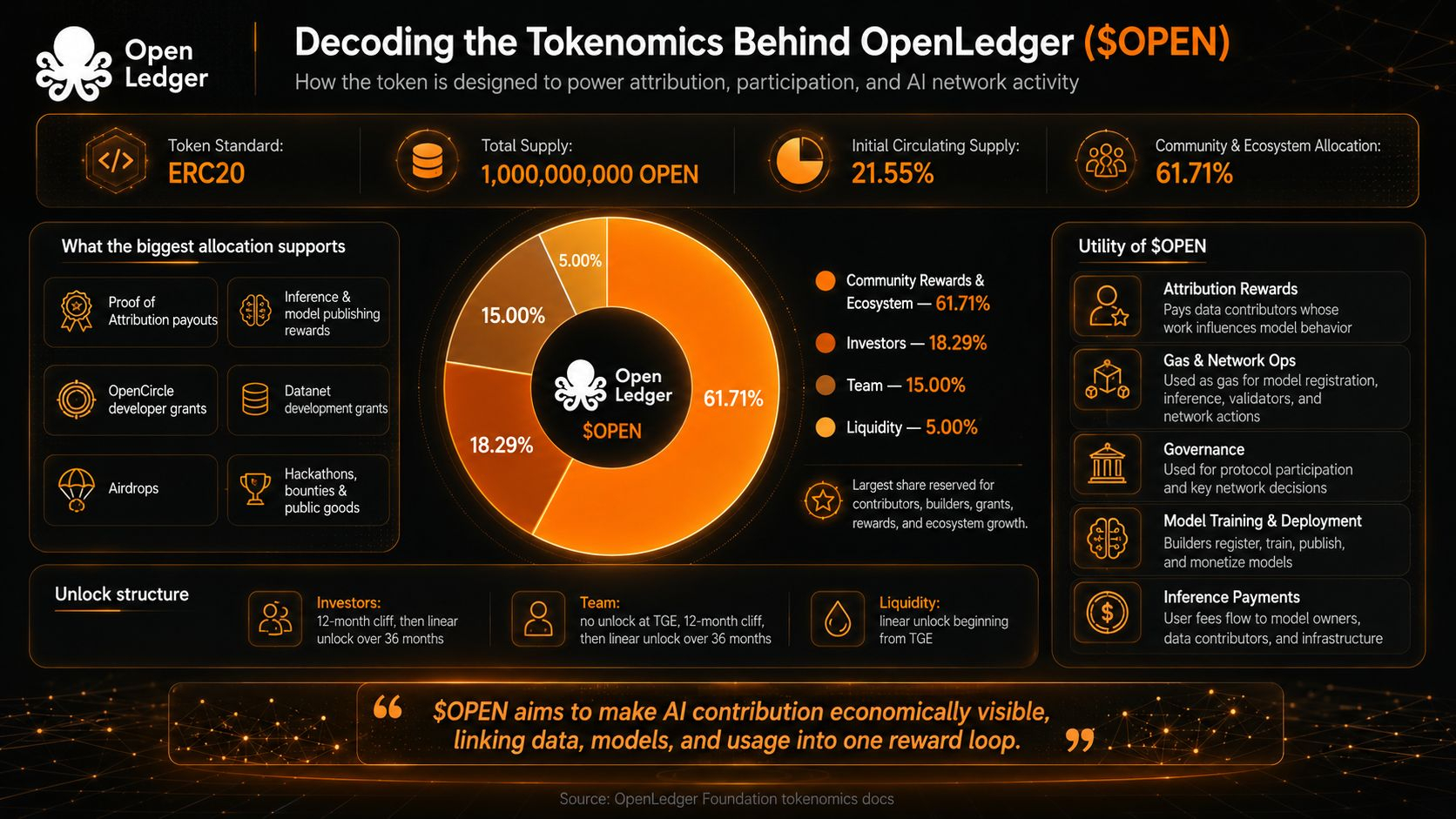
That is why $OPEN is interesting to read slowly. On the surface, the design looks clean: a fixed supply, an ERC20 launch, a large community and ecosystem share, a defined unlock path. But the real question behind OpenLedger’s tokenomics is not whether the percentages look generous. The question is whether the token can actually carry the kind of economic memory the project says it wants to build.
OpenLedger is trying to make AI less extractive. That is the larger discomfort behind $OPEN. Today, intelligence often feels detached from its origins. Data enters a model, influence disappears, and value moves toward whoever owns the interface. OpenLedger’s token design seems to push against that default by treating contribution as something that can be traced, weighted, and paid. In that sense, OPEN is not only a payment token. It is an attempt to make the invisible parts of AI economically visible.
I like that ambition, but tokenomics is where ambition becomes less comfortable. A project can say it rewards contributors, but the distribution has to prove that contributors are not decorative.OpenLedger’s biggest allocation going to the community is a positive sign. It shows the project is serious about rewarding the people who help build the network. But size alone is not enough. Rewards only matter if they are given honestly and based on real contribution.Bad incentives can turn even a generous allocation into noise farming.
The unlock schedule matters here. Immediate circulation gives the market something to work with, while longer vesting asks insiders to live with the consequences of their own design. I do not see vesting as a moral guarantee. It does not magically create patience. But it does reduce the uglier possibility of everyone selling the future before the network has had time to become useful over time, in practice.
What I find most revealing is the way OPEN is meant to sit inside actual AI activity. Gas, inference payments, model publishing, contributor rewards, governance. These are not random utilities pasted onto a token after launch. They describe a loop. A user queries a model. A developer earns from usage. Data contributors receive attribution-based rewards. Infrastructure is paid. Governance decides how the system changes. If that loop works, OPEN becomes less like a symbol and more like the accounting language of the network.
But loops are fragile. Attribution has to be accurate enough to be trusted. Inference demand has to be real enough to fund rewards. Governance has to avoid becoming a quiet room controlled by early power. Liquidity has to support access without turning the whole story into price theatre.
So I read OpenLedger’s tokenomics as a promise under pressure. The numbers suggest a system designed for participation, but the test will not happen in a document. It will happen when contributors ask whether the rewards feel fair, developers ask whether users are really paying, and the market asks whether Open represents usage or only expectation. That space between design and behavior is where the real decoding begins.
@OpenLedger #OpenLedger $PLAY $STRAX
