
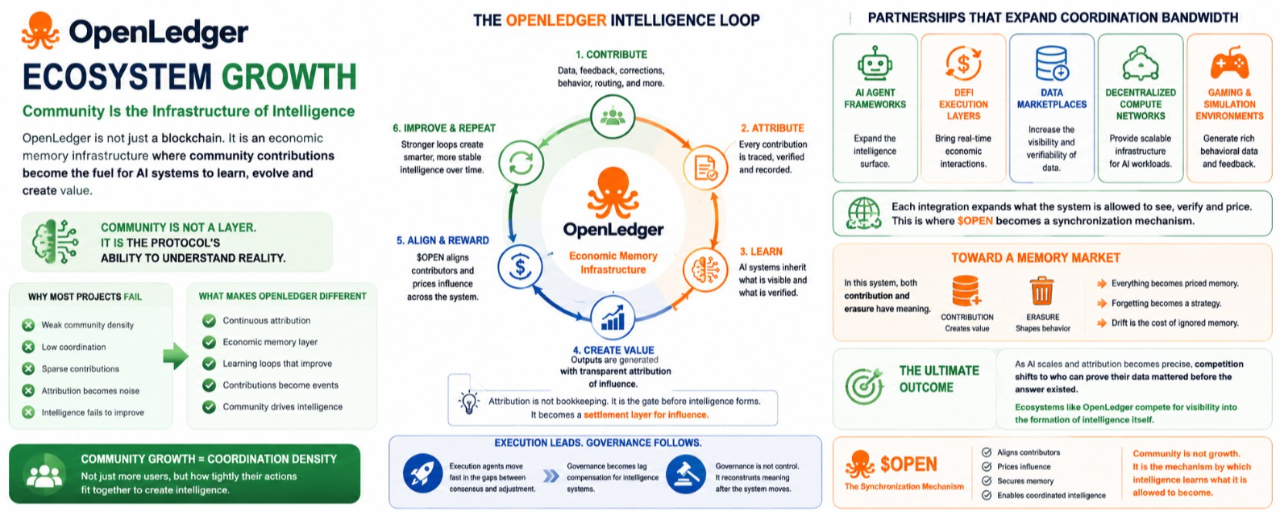

I often wonder why community growth is so important for blockchain projects like OpenLedger. What kind of partnerships could help OpenLedger grow and become successful?
I think about why most blockchain projects fail. It is not because their technology is weak. It is because their community does not become strong enough to sustain themselves.
When I hear community growth I think it sounds like marketing. You think about numbers, campaigns and incentives.. With OpenLedger it is different. The more I look at OpenLedger the more I think community looks like a part of the system. Not just any community,. An economic memory infrastructure.
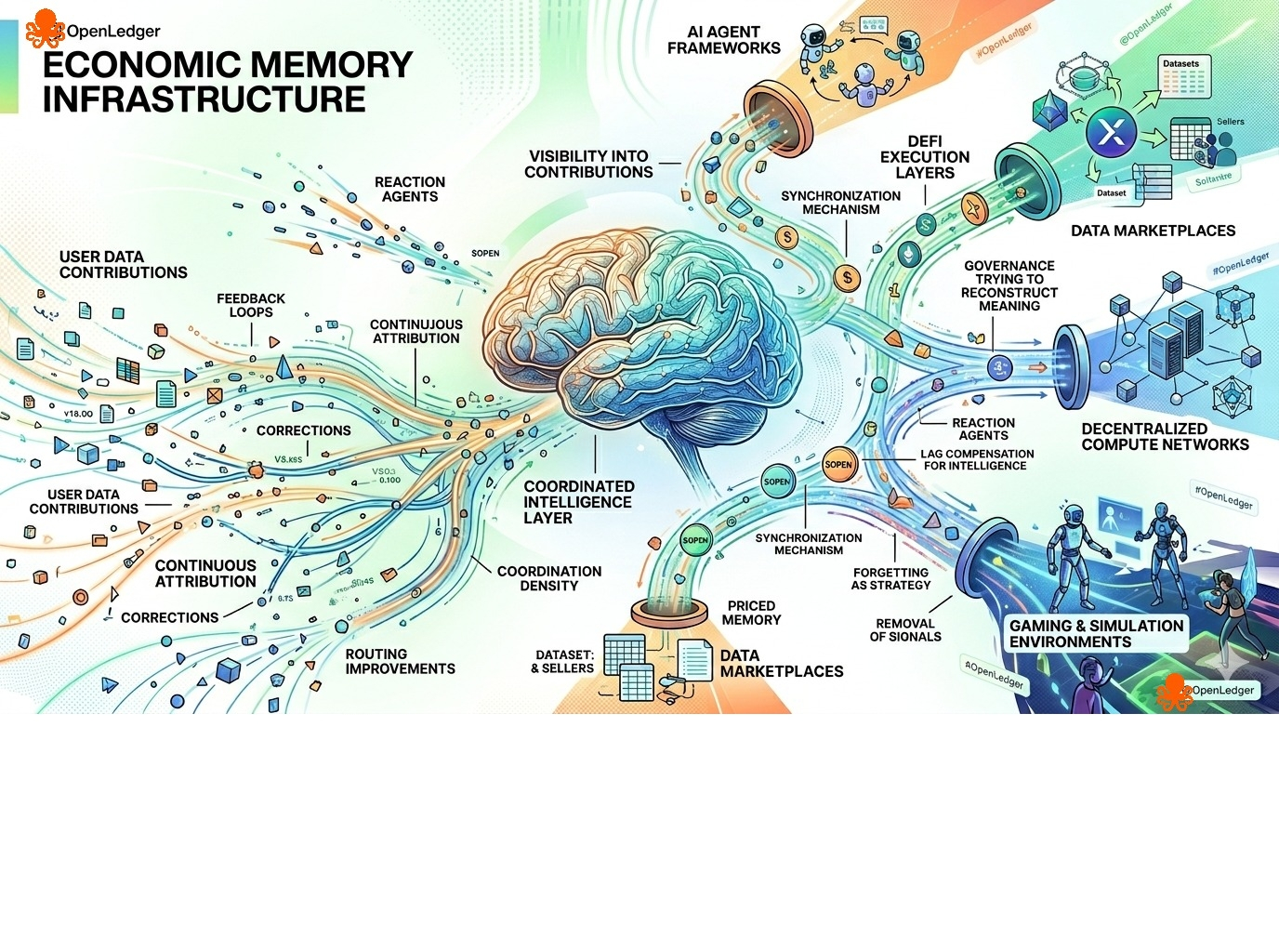
Community growth is not about being visible. It is about whether the system can keep learning. If people do not contribute data, feedback or corrections the system breaks. If few people interact intelligence does not improve it stays the same.
So the community is not around the protocol. The community is what helps the protocol keep learning. That is very different from blockchain ecosystems. There users exist around the system. Here users become part of the systems memory.
What makes OpenLedger interesting is how it attributes value. It shifts from being an event accounting layer to a pre-condition for intelligence. It starts with an idea: if data creates value then the system needs to understand who created that value.
That idea quickly becomes deeper. The system decides what it was allowed to see. That line keeps coming up when I think about AI pipelines. Models do not just consume data they inherit constraints from what's visible and what is not.
So attribution is not bookkeeping. It becomes a gate before intelligence forms. That is where OpenLedger starts to look like a settlement layer for influence. Who contributed which part of an AI output and how that contribution lasts over time?
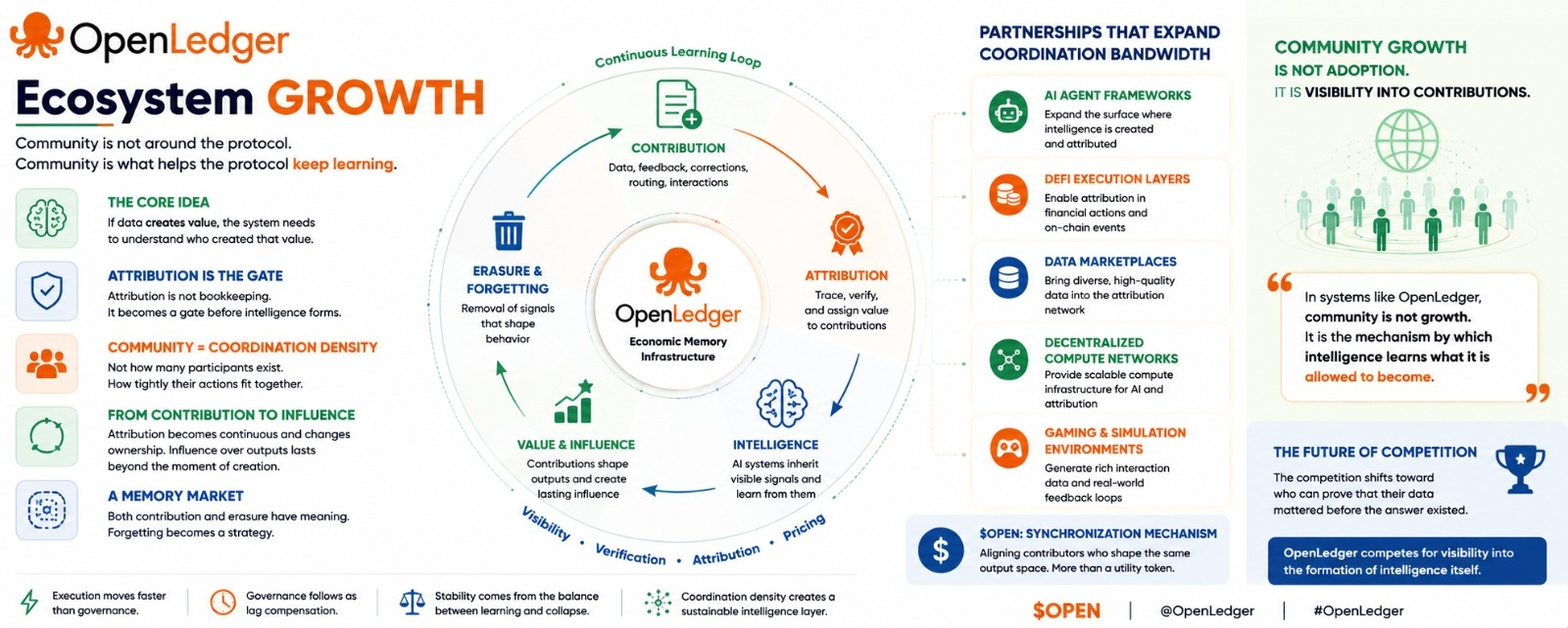
From that perspective community growth becomes coordination density. Not how many participants exist,. How tightly their actions fit together. If contributions are sparse the system cannot form intelligence. If interactions are disconnected attribution becomes noise.
If density increases something new emerges: the system starts to stabilize its learning loops. That is why ecosystem growth here is not adoption. It is visibility into contributions. Small dataset adjustments, behavioral corrections, routing improvements, feedback loops between agents. All of these become events.
Once that happens community is not a layer on top of the protocol. It is the protocols ability to understand reality. Now things become more unstable. Because once attribution becomes continuous it changes ownership. It is no longer "who owns the dataset." It becomes: who still owns influence over an output that has already changed?
That leads to a possibility: if everything becomes priced memory then forgetting becomes a strategy. Not passive decay,. Intentional removal of signals that shape behavior. In DeFi terms it looks like liquidity vanishing. In AI terms it looks like drift.
So OpenLedger starts to resemble a memory market. Both contribution and erasure have meaning. That is where partnerships stop being a distribution strategy and become necessary. Because no single ecosystem can generate coordination density alone.
What matters is not just integrating with systems. It is expanding what the system is allowed to see and verify. That means partnerships across:
AI agent frameworks
DeFi execution layers
Data marketplaces
Decentralized compute networks
Gaming and simulation environments
Each integration increases the surface where attribution can be written traced and priced. That is where $OPEN shifts from a simple usage token to a synchronization mechanism. Not just paying for access. Aligning contributors who shape the same output space.
There is also a dynamic underneath all of this. Execution tends to move than governance. Systems like reacting execution agents do not wait for coordination to stabilize. They operate in the gaps between consensus and adjustment.
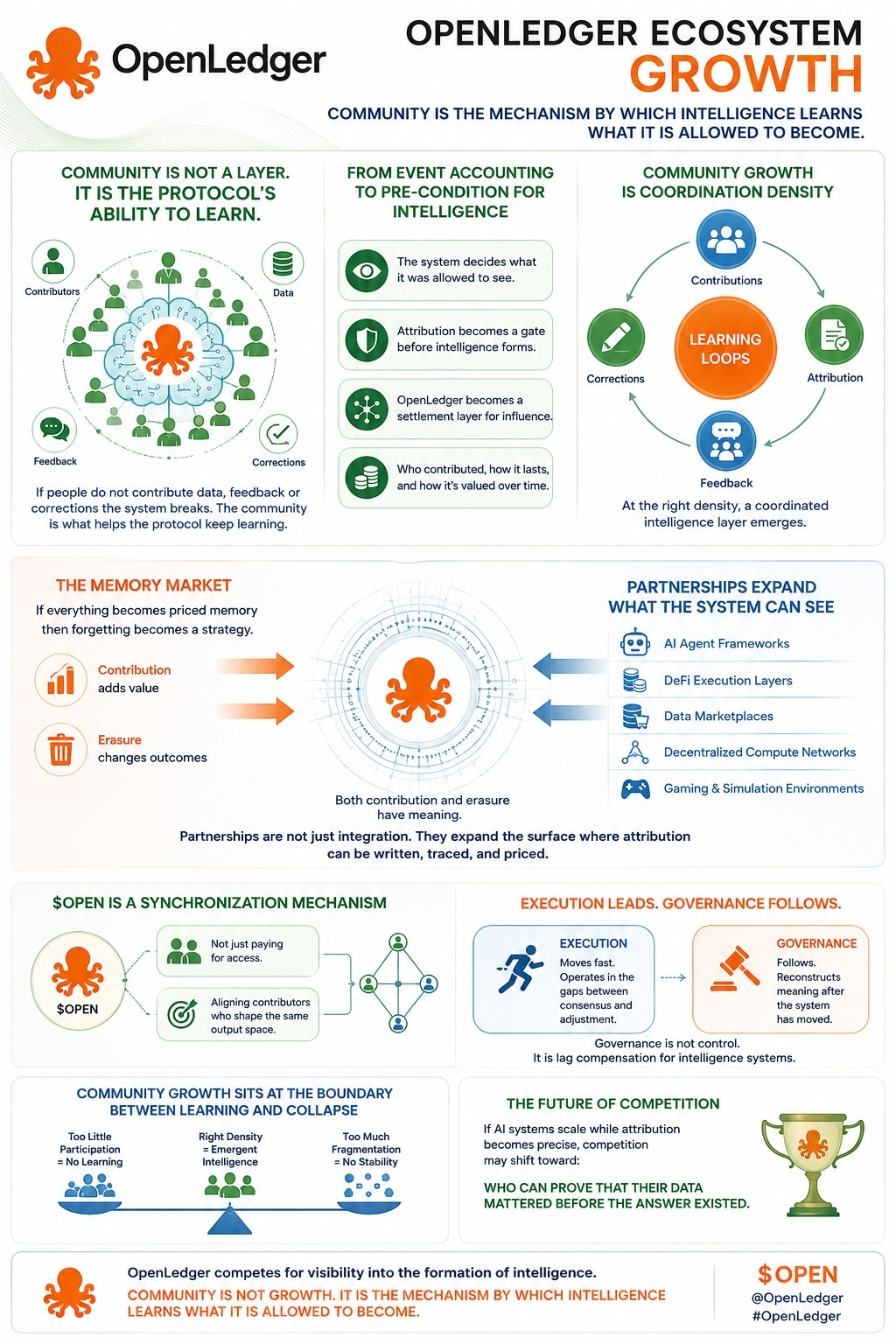
Which raises a question: if execution always leads and governance always follows then governance is not control. It becomes lag compensation for intelligence systems. In that world governance is not about deciding outcomes. It is about reconstructing meaning after the system has already moved.
So where does community growth sit in all of this? It sits at the boundary between learning and collapse. Little participation and the system cannot learn. Much fragmentation and it cannot stabilize. At the density something new emerges: a coordinated intelligence layer built from previously invisible contributions.
That is why partnerships matter more than they seem. Not because they bring users. Because they expand coordination bandwidth. The harder question is what this eventually produces. If AI systems scale while attribution becomes precise then competition may shift. It may shift toward who can prove that their data mattered before the answer existed.
If that becomes the axis of value creation then ecosystems like OpenLedger compete for visibility. They are competing for visibility into the formation of intelligence itself. Maybe that is the tension underneath all of this. Not whether OpenLedger succeeds as a product. Whether coordination can remain stable.
I still do not have an answer for that. Only the sense that in systems, like this community is not growth. It is the mechanism by which intelligence learns what it is allowed to become.