
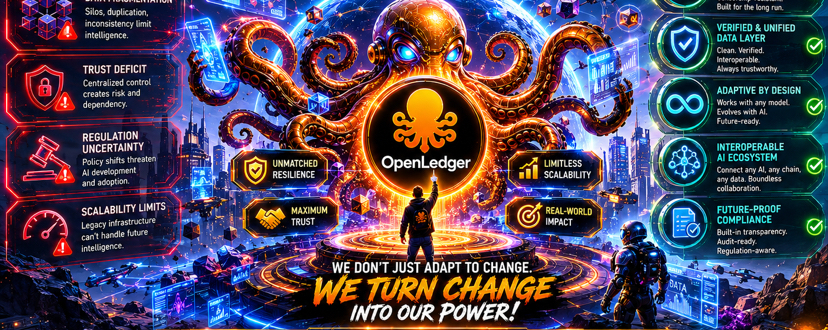
I sometimes ask myself a strange question: what would happen if AI one day stopped existing? Not just paused, but truly disappeared from the systems we rely on today.
🌟🌟🌟🌟🌟
In that imagined future, I don’t think humanity would collapse — but I do believe we would suddenly realize how much of our “intelligence layer” has been externalized. Decision-making would slow down, systems would become more fragmented, and the invisible structure that connects data, logic, and automation would be broken.
From that perspective, I start to look at @OpenLedger not as an AI-dependent project, but as something more foundational.
What I see is a system designed around structure, not just intelligence output. A framework where data, verification, and coordination become the real backbone — meaning that even if AI evolves, transforms, or even temporarily disappears, the underlying system can still function, adapt, and rebuild intelligence from trusted components.
✨✨✨✨✨
This is where my view becomes more strategic.
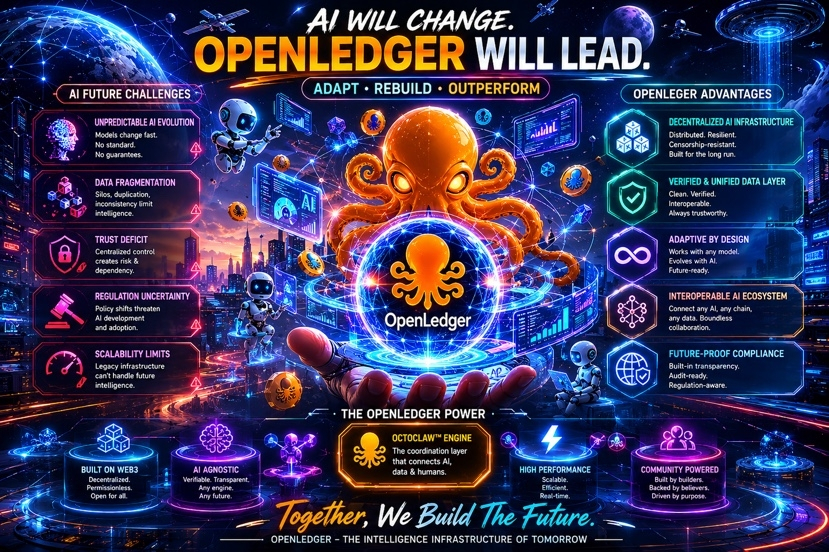
Instead of asking “how powerful is AI?”, I start asking “what survives when AI changes?”
And #OpenLedger in my interpretation, is positioned exactly in that second question.
When I look at its direction, I see a multi-layered approach. On one side, it integrates AI + Web3, allowing intelligent systems to operate within decentralized environments. On the other side, it emphasizes data structure, verification, and coordination mechanisms that can remain stable even under shifting technological conditions.
This combination is important because the future of AI is not guaranteed to be linear. It will likely go through cycles of regulation, decentralization, fragmentation, and reintegration. In such an environment, only systems that are flexible at the structural level will remain relevant.
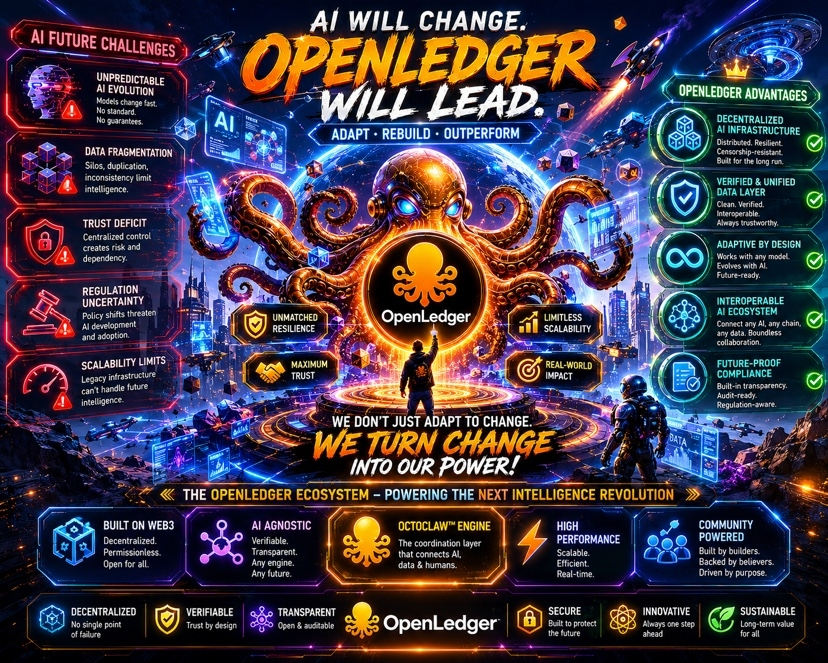
So I don’t see OpenLedger as just competing in today’s AI narrative. I see it as preparing for multiple possible futures — including ones where AI evolves beyond its current form or becomes heavily constrained.
In that sense, its value proposition becomes clearer: not dependence on AI, but adaptability across AI eras.
Of course, I remain critical and realistic. No system is immune to competition, execution risk, or adoption challenges. The real test will be whether its architecture can scale while maintaining simplicity for developers and users.
But despite these challenges, I find the direction meaningful.
Because in a world where technology is constantly shifting, the real advantage does not belong to the strongest system — it belongs to the most adaptable one.
And from my perspective, $OPEN is trying to position itself exactly there: at the intersection of intelligence, structure, and long-term resilience.