

I used to think the future of AI trading agents would be determined by who built the smartest model.
The more I watch this sector evolve, the less convinced I am. Every project seems obsessed with the same race. Better predictions. Better execution. Faster reactions. More autonomous decision making. Yet the longer I spend looking at the infrastructure beneath these systems, the more I feel we're ignoring a much bigger question. If an AI agent generates value, where does that value actually go? And who deserves a share of it?
The strange thing is that most people never ask that question. We see a profitable trade and assume the story ends there. But when I pull apart the process, the reality looks much messier. Every successful AI agent depends on datasets collected by someone else, models trained by someone else, infrastructure maintained by someone else, and execution layers built by entirely different participants. The final trade might look autonomous, but the intelligence behind it is anything but.
That's why @OpenLedger caught my attention.
Initially, I was looking at it the same way most investors do. $OPEN is trading around $0.1954 with a market capitalization of $56.84 million and approximately $22.2 million in daily volume. With 290.76 million tokens circulating out of a maximum supply of 1 billion and roughly 28.20K holders, it still sits in a part of the market where narratives are forming faster than conclusions. At first glance, it looked like another project trying to attach itself to the AI trend. Then I spent more time reading about the architecture, and the thesis started feeling very different.
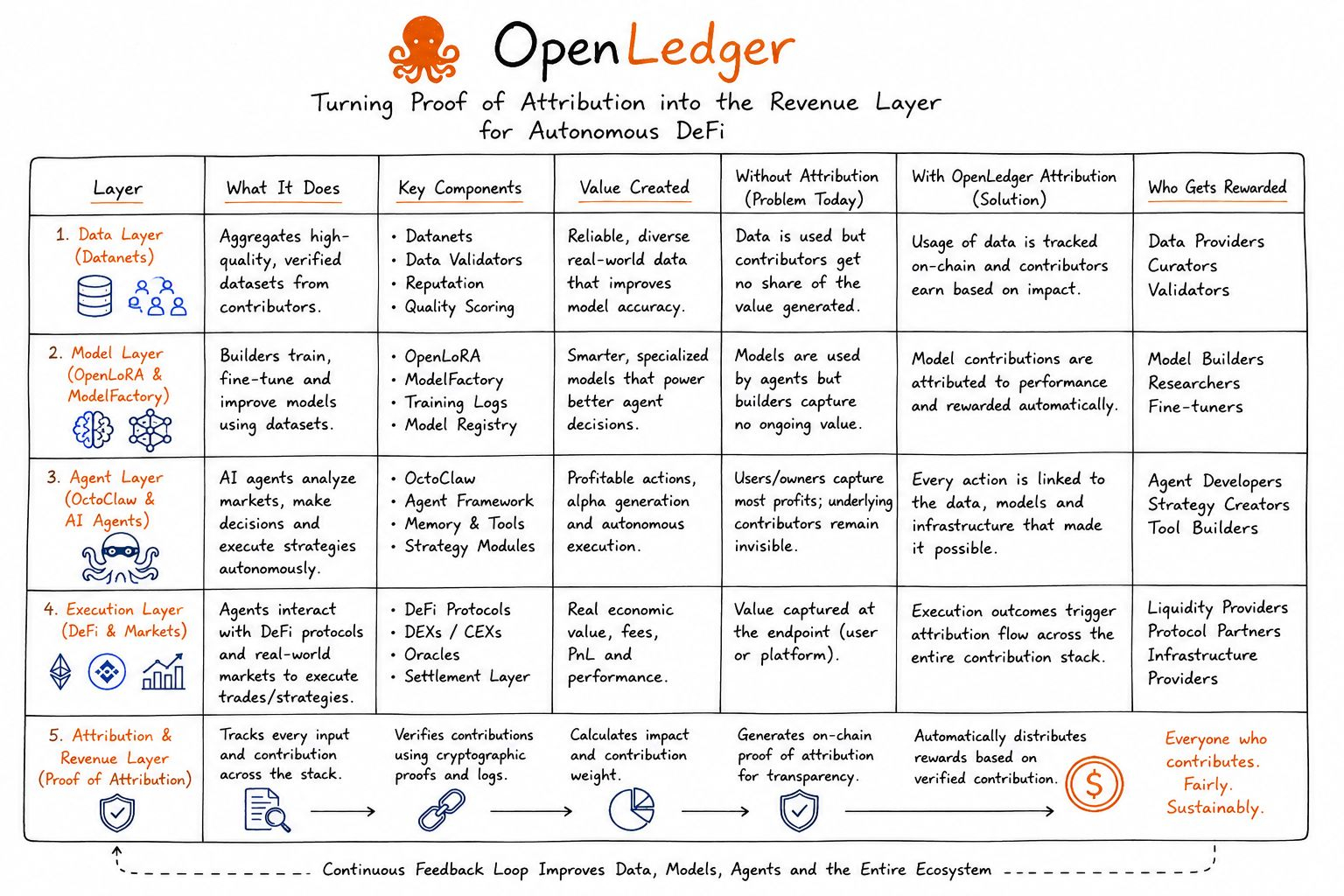
What #OpenLedger appears to be building isn't just another AI product. It's an economic system for AI.
The easiest way I can describe it is this: most AI protocols focus on intelligence, while OpenLedger seems focused on attribution. That distinction sounds small until you realize how much of the AI economy currently operates without it. Data providers contribute value. Model builders contribute value. Agent developers contribute value. Yet in most systems, the economic rewards end up concentrated around whoever controls the final application layer.
That feels increasingly unsustainable.
If $BTC introduced digital ownership and $ETH introduced programmable execution, then I think OpenLedger is trying to solve something entirely different: economic attribution. Not ownership of assets. Not execution of transactions. Attribution of value itself. The more I thought about that idea, the more it felt like a missing piece of autonomous finance.
Imagine a trading agent operating continuously across DeFi markets. One day it detects an unusual pricing inefficiency between liquidity pools, executes a series of trades, and generates profit. Most protocols would simply record the outcome and move on. But when I look at that same event through OpenLedger's lens, the picture changes. The dataset that helped identify the opportunity came from contributors in a Datanet. The predictive model was refined through OpenLoRA. The execution logic was built by an agent developer. The trade may have been autonomous, but the value creation was collective. Proof of Attribution attempts to recognize that reality and connect rewards back to the contributors who made the outcome possible.
I may be wrong, but that feels less like a feature and more like infrastructure.
What makes this interesting is that crypto has repeatedly shown how powerful incentive alignment can be. DeFi didn't explode because liquidity pools were technically impressive. It exploded because participants had a reason to contribute liquidity. Proof-of-Stake didn't succeed because validators loved securing networks. It succeeded because the economics encouraged participation. Again and again, the winning systems weren't necessarily the smartest. They were the ones that aligned incentives across the largest number of participants.
When viewed through that lens, OpenLedger's trading-agent vision starts looking different. The goal isn't simply to create autonomous agents. Plenty of projects are already attempting that. The goal is to create an environment where data providers, model creators, agent builders, and users can all participate in the value those agents generate. In other words, the agent becomes the endpoint of an economic graph rather than the sole beneficiary of it.
That's where OctoClaw becomes particularly interesting to me.
Most people see an AI agent and immediately focus on what it can do. I find myself increasingly focused on what happens after it does it. If an agent creates revenue, who gets rewarded? If a model improves performance, who captures that value? If a dataset becomes critical to future decisions, how is that contribution recognized? These questions feel boring compared to discussions about artificial intelligence, but historically, boring economic questions tend to determine which ecosystems survive.
Maybe that's why I keep coming back to OpenLedger despite the noise surrounding AI. The protocol's current fully diluted valuation sits around $195.49 million while the circulating market cap remains near $56.84 million suggesting the market is still trying to understand what category it belongs to. Is it an AI project? A data marketplace? An agent platform? The more I study it, the more I think those labels miss the point.
The real product may be attribution itself.
Of course, there are no guarantees here. The AI sector is crowded, narratives change quickly, and many ambitious ideas never achieve adoption. Healthy skepticism is necessary. I certainly don't assume that every protocol with a compelling vision will succeed. Crypto has taught me that lesson more than once.
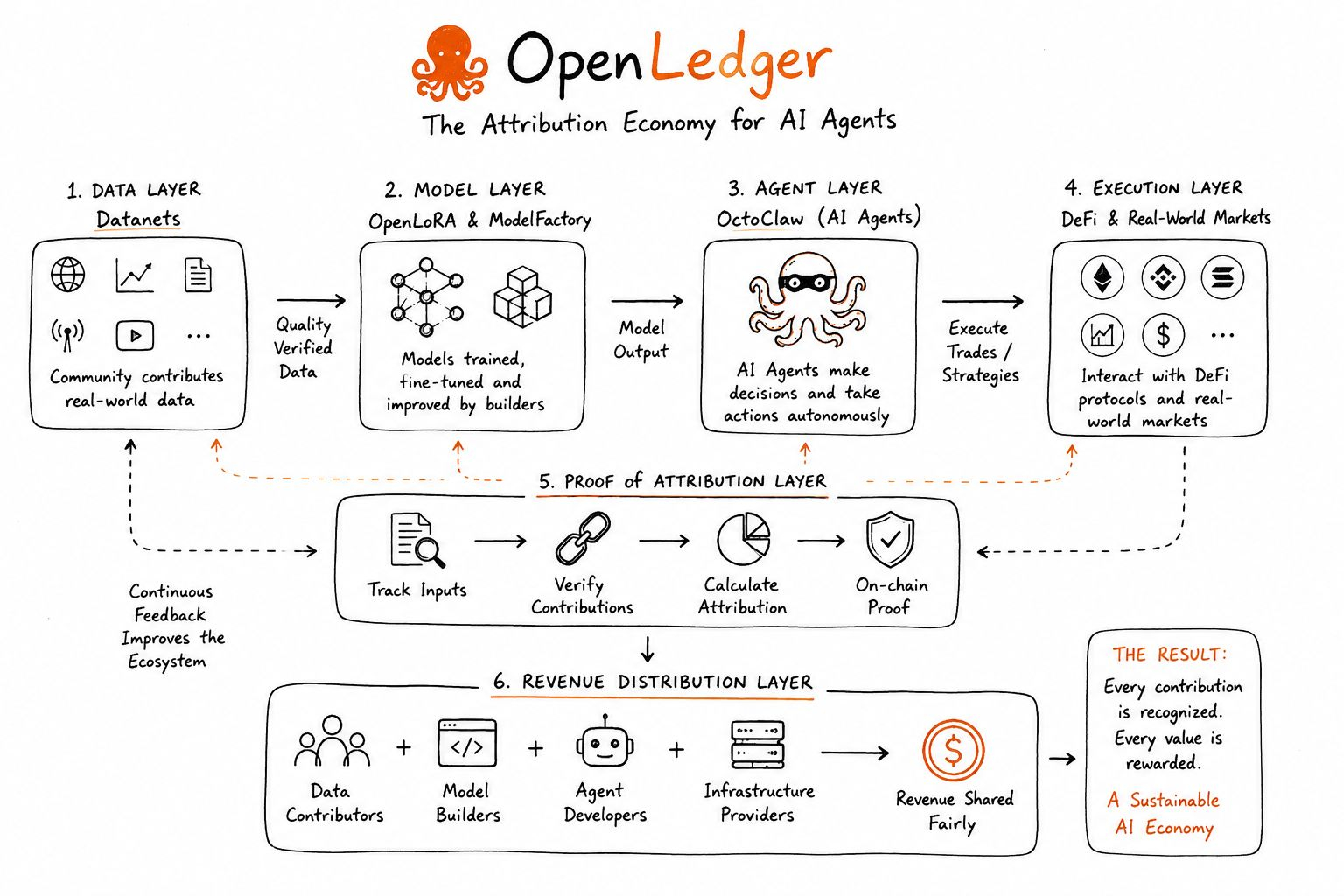
Still, I find it difficult to ignore the underlying problem OpenLedger is targeting. Autonomous agents are becoming increasingly capable. Eventually, some of them may manage billions of dollars worth of economic activity across decentralized markets. When that happens, the biggest challenge may not be intelligence. It may be distribution. Not how value is created, but how value is shared.
And that's the thought I keep returning to.
The next battle in AI may not be about who builds the smartest agent. It may be about who builds the fairest economic system around that agent. Most projects seem focused on making autonomous finance more intelligent. OpenLedger appears focused on making it economically sustainable.
If that thesis proves correct, then Proof of Attribution may end up being remembered as something far bigger than an AI feature. It could become the revenue layer that autonomous DeFi didn't realize it was missing until the entire ecosystem started depending on it. For a network with a $56.84 million market cap, 28.20K holders, and a growing ecosystem of data contributors, model builders, and AI agents, that possibility feels far more significant than the daily price chart. Sometimes the biggest opportunities emerge not from a new product, but from a new way of distributing value. And right now, that's the part of OpenLedger I find hardest to ignore.