
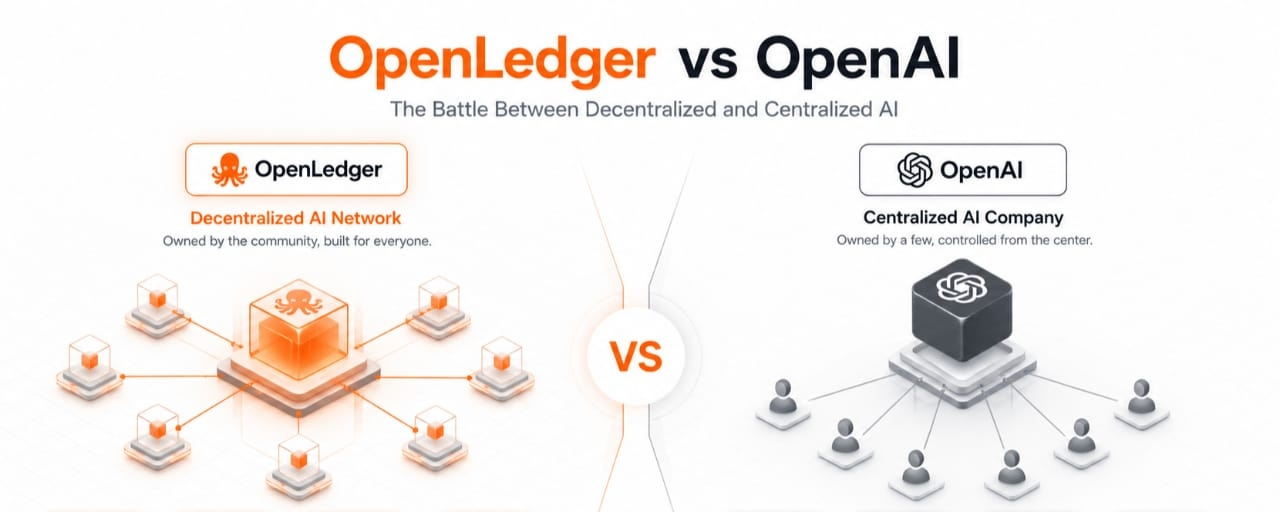
Watching the discussion around centralized and decentralized AI feels strangely familiar.
Every technology cycle seems to revive the same underlying debate. In the past it was banks versus DeFi, then cloud infrastructure versus blockchain networks. Today, the conversation has shifted toward centralized AI versus decentralized AI. There are plenty of discussions about freedom, ownership, and reducing dependence on large technology companies, but beneath all the narratives lies a much simpler question:
Who creates value, and who ultimately captures it?
That’s why I find the comparison between OpenAI and OpenLedger so interesting. Not because they are direct competitors, but because they represent two very different visions of how AI could evolve.
OpenAI follows a model that the technology industry already understands well. Data is centralized, infrastructure is centralized, training is centralized, and much of the resulting value remains centralized as well. There’s nothing inherently wrong with that approach. In many ways, it has been one of the main reasons AI has progressed so quickly. Most users simply want products that work. They rarely think about where the data comes from or how the models are trained, and OpenAI has shown that a centralized approach can deliver an exceptional user experience at scale.
Yet there is one important issue that often receives less attention than it deserves.
AI runs on data, and enormous amounts of it.
The people generating that data—whether through content, expertise, behavioral signals, or domain-specific knowledge—are often the least visible participants in the value chain. Models become more capable, companies generate more revenue, and ecosystems expand, but the contributors providing the raw material frequently remain disconnected from the value being created.
That observation has always stood out to me when looking at the AI landscape.
This is where OpenLedger becomes interesting.
Rather than competing directly with OpenAI on model performance, OpenLedger appears to be addressing a different challenge altogether. If data is the fuel powering AI systems, can the people supplying that fuel be identified, recognized, and rewarded more transparently?
The concept sounds familiar to anyone who has spent time in crypto. Markets have heard countless versions of the “ownership” narrative. What makes OpenLedger noteworthy is its attempt to make data attribution verifiable and connect rewards directly to contributors. The term they use is Proof of Attribution, but the name matters less than the underlying goal: addressing a problem that much of the current AI industry has largely left unresolved.
Of course, there is always a significant gap between an appealing concept and a functioning ecosystem.
Neither AI nor crypto suffers from a shortage of ideas. What both industries struggle with is building sustainable economic systems. For a model like this to succeed, users must find value in it, businesses must see economic incentives to participate, and developers must have reasons to build around it. If any part of that loop fails, even the most compelling vision risks becoming little more than a presentation slide.
That’s why I don’t view OpenLedger as a direct competitor to OpenAI—at least not today.
One organization operates products used by hundreds of millions of people worldwide. The other is experimenting with a new economic framework for data ownership and AI value distribution. They are pursuing different objectives and solving different problems.
Still, the broader debate they represent deserves attention.
If AI becomes foundational infrastructure for the internet over the next decade, questions around data ownership, reward distribution, and value capture will become increasingly difficult to ignore.
OpenAI demonstrates the strengths of centralization.
OpenLedger is testing the opposite assumption.
Which vision ultimately proves more effective?
The market doesn't have a clear answer yet, and neither whitepapers nor theories can provide one. Only real-world adoption, usage, and incentives will reveal what works.
For now, it's a debate worth watching closely.