
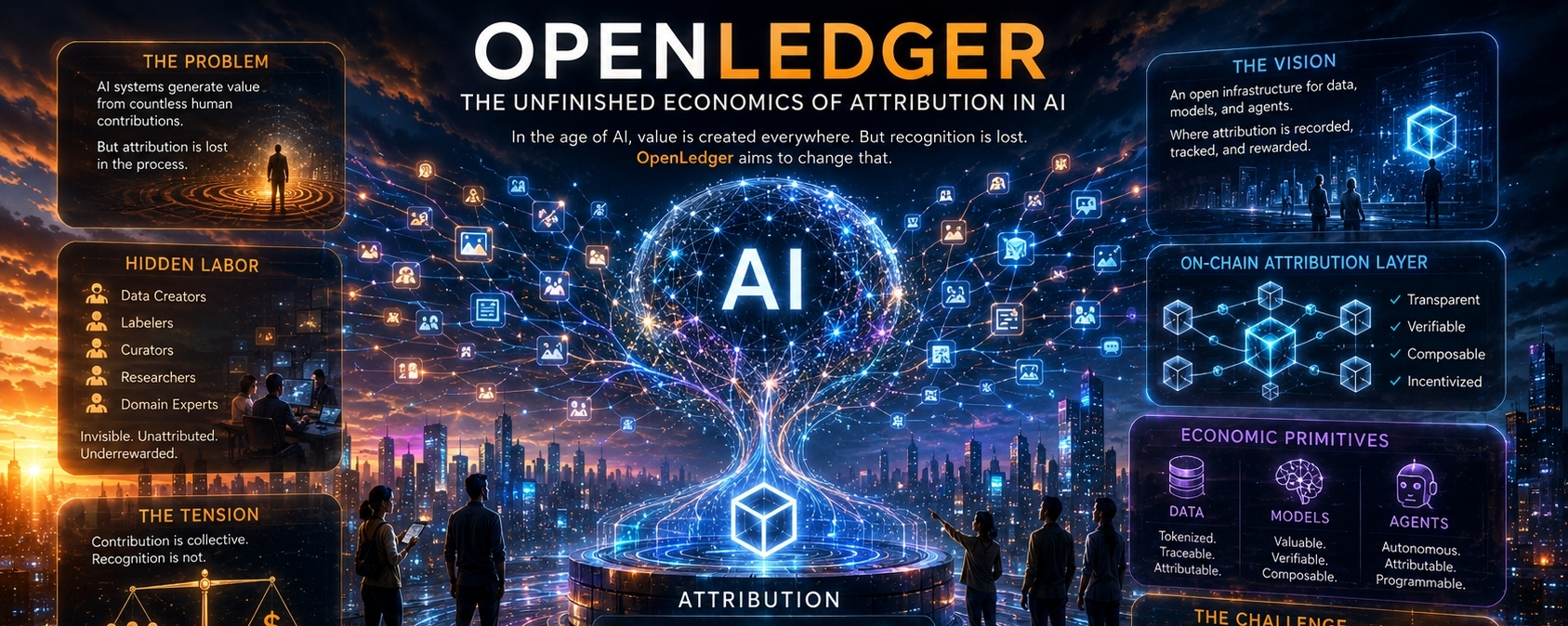

OpenLedger and the Question of Attribution in the Age of AI
One of the recurring frustrations I have with crypto is how often the industry discovers a real problem and then immediately buries it beneath a layer of narrative excess. The problem itself may be legitimate. Sometimes it is even important. Yet the conversation rarely stays there. Before long, incentives emerge, metrics appear, dashboards begin counting things, and an ecosystem forms around the measurement rather than the underlying issue. I have seen this before.
The pattern repeats across cycles. What begins as an attempt to solve coordination problems slowly transforms into a competition to manufacture participation. Activity becomes evidence. Evidence becomes value. Value becomes narrative. And narrative, for a while, becomes reality.
Until it does not.
That is partly why OpenLedger caught my attention. Not because it presents itself as an AI blockchain. Crypto has become crowded with projects attaching themselves to artificial intelligence in ways that often feel more cosmetic than structural. What interests me is the specific problem OpenLedger appears to be engaging with: attribution.
For years, much of the conversation around AI has focused on capability. Models become larger. Outputs become better. Infrastructure becomes more sophisticated. Yet beneath that visible layer sits something much less glamorous: the enormous volume of human labor, data creation, curation, labeling, refinement, and contextual knowledge that makes these systems possible in the first place.
The more I sit with it, the more I think attribution may be one of the most unresolved questions in the entire AI economy.
Not intelligence.
Ownership.
The internet has spent decades creating value from information while making it increasingly difficult to determine where that value originated. AI accelerates this tendency. Models absorb knowledge from countless sources. Outputs emerge from systems trained on contributions that become almost impossible to trace back to individual participants. The machine appears coherent. The underlying labor becomes invisible.
Appearance and reality begin to diverge.
This is where OpenLedger becomes interesting to me. At least conceptually.
The project speaks about creating liquidity around data, models, and agents. It frames these assets as economic primitives that can be attributed, tracked, and monetized. In theory, that sounds reasonable. If AI systems derive value from contributions made by many different participants, perhaps those contributions should become visible economic units rather than disappearing into a black box.
I understand the appeal.
I also understand the difficulty.
Because attribution is one of those ideas that sounds straightforward until someone attempts to implement it at scale.
Who deserves credit?
How much credit?
For how long?
Under what conditions?
These questions become remarkably complicated once real economic incentives enter the picture.
I keep coming back to a distinction that crypto often struggles with: participation versus usefulness.
A network can attract enormous participation without generating meaningful utility. People contribute because rewards exist. They optimize around reward structures because incentives encourage optimization. Eventually the system becomes highly efficient at producing the behavior it measures.
Whether that behavior creates genuine value is a separate question.
From my view, the hardest challenge for projects like OpenLedger is not building infrastructure. It is building measurement systems that cannot be easily gamed.
That sounds simple.
It rarely is.
The history of digital platforms is filled with examples where metrics become targets and targets become distortions. Once attribution acquires economic value, attribution itself becomes something participants compete to maximize. The system no longer measures contribution. It begins shaping contribution.
Sometimes in useful ways.
Sometimes not.
This is where my skepticism emerges.
Not because I think the idea is flawed.
Because I think the problem is extraordinarily difficult.
There is a tendency within both crypto and AI to assume that if something can be recorded, it can therefore be valued accurately. I do not fully trust it. Human contribution is often messy, contextual, collaborative, and dependent on factors that resist clean measurement. The most important input is not always the most visible one.
Hidden labor has always existed beneath technological systems.
The person who contributes a critical insight may receive less recognition than the person who operationalizes it. The creator of foundational data may become less visible than the model trained upon it. The infrastructure provider may disappear behind the application layer that captures public attention.
These asymmetries are not bugs. They are features of complex systems.
Which raises an uncomfortable question.
Can attribution itself ever be fully attributed?
I am not sure.
And I suspect projects operating in this space are wrestling with that uncertainty whether they acknowledge it explicitly or not.
Still, I respect the attempt more than I trust the outcome.
There is a difference.
Many crypto projects begin by inventing a token and searching for a problem. OpenLedger appears to be approaching something that feels closer to a genuine structural tension emerging from the intersection of AI and economics. That does not guarantee success. But it does make the conversation more interesting.
Because regardless of what happens to any specific network, the underlying issue remains.
AI systems require data.
Data comes from people.
Value emerges somewhere along that chain.
Yet the mechanisms connecting contribution and compensation remain remarkably unclear.
The broader technology industry has often preferred ambiguity here. Attribution introduces complexity. Complexity creates friction. Friction slows growth. The incentives have historically favored aggregation rather than precise accounting.
OpenLedger seems to be asking whether a different architecture is possible.
I think that question matters more than any short-term narrative surrounding the project.
What interests me is not whether a blockchain can tokenize data, models, or agents. We have reached a point where almost anything can be tokenized. The harder question is whether tokenization actually improves coordination. Whether it creates durable relationships between contribution and reward. Whether it reveals value that was previously hidden or simply creates another layer of abstraction around it.
Those are very different outcomes.
The crypto industry often confuses them.
The more I examine projects built around ownership and attribution, the more I find myself focusing on durability rather than innovation. New mechanisms appear constantly. New frameworks emerge every cycle. Most disappear. What survives tends to be the thing that solves a persistent problem rather than the thing that generates the most attention.
Narratives are abundant.
Durability is rare.
And attribution, despite all the complexity surrounding it, feels like a problem that is not going away.
That alone makes OpenLedger worth paying attention to.
Not because I am convinced.
Not because I think the model has already been proven.
But because the project appears to be pointing toward a tension that neither AI nor crypto has fully resolved. The visibility of contribution. The ownership of value. The economics of participation in systems where countless actors collectively produce outcomes that no single participant could create alone.
Those questions remain open.
Perhaps they will remain open for a very long time.
For now, I find myself observing rather than concluding.
Watching rather than predicting.
Because after enough cycles, certainty becomes less interesting than inquiry.
And some of the most important ideas in technology begin not with answers, but with an uncomfortable recognition that we still do not fully understand how value is created, who deserves credit for it, or how that credit should be distributed once the machines become capable of generating value of their own.