
I have sat through enough postmortems to know that nobody remembers the benchmark numbers when things go wrong.
The TPS charts disappear first.
The marketing slides disappear next.
What remains are audit trails, approval logs, screenshots from internal chats, and the uncomfortable realization that most failures were visible long before they became incidents.
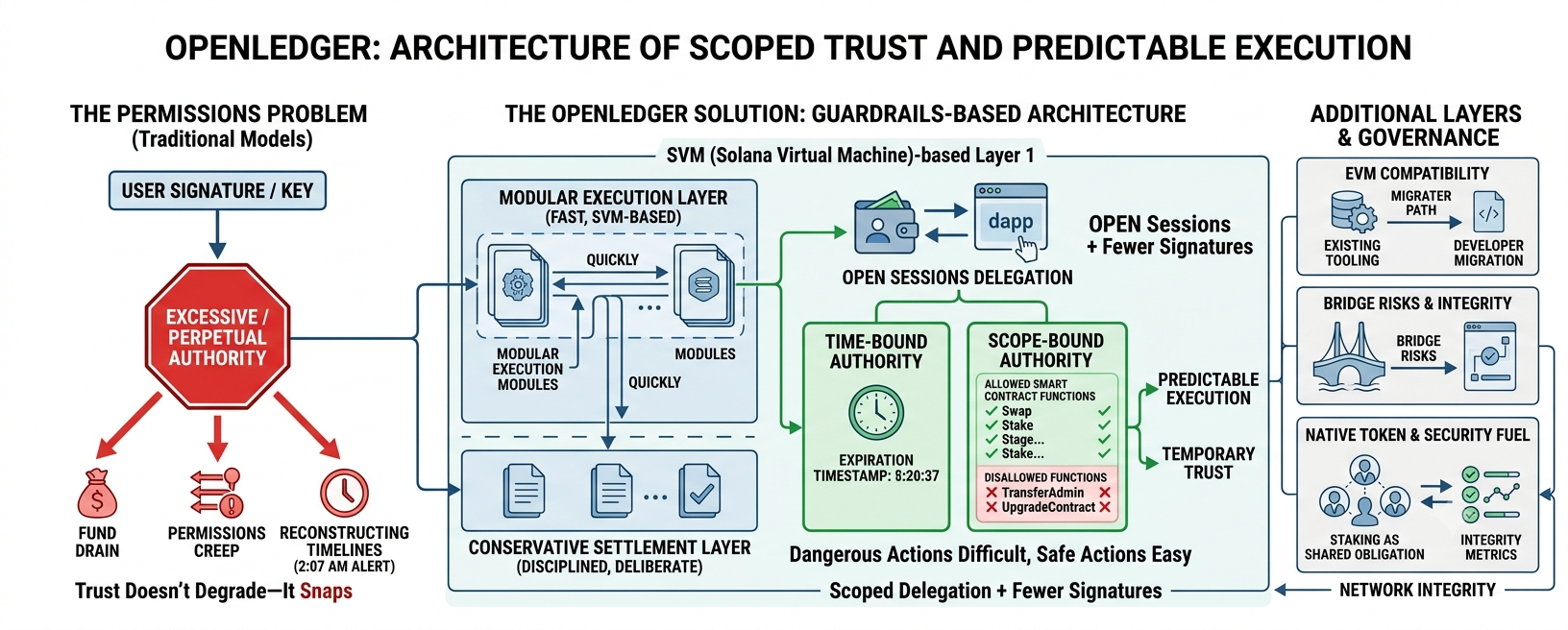
The alert arrives at 2:07 a.m.
A wallet moved funds it should not have touched.
A permission existed longer than anyone intended.
A signature was granted without understanding the scope of what it authorized.
Within minutes, risk committees are awake. Compliance teams begin reconstructing timelines. Engineers search logs. Security teams debate whether the event represents compromise, negligence, or simply the inevitable outcome of excessive trust.
Nobody asks how many thousands of transactions per second the chain could process.
That question suddenly feels irrelevant.
The industry spends enormous energy chasing speed. Faster finality. Higher throughput. Bigger numbers. Entire ecosystems are evaluated through performance metrics that fit neatly into comparison tables.
Yet most catastrophic failures do not originate from slow blocks.
They originate from permissions.
They originate from keys.
They originate from users signing things they should not sign and applications requesting authority they should never possess.
Trust doesn’t degrade politely—it snaps.
The moment a private key is exposed, the moment an approval becomes broader than intended, the moment a system grants permanent authority where temporary authority would have sufficed, performance ceases to matter.
The damage moves at network speed.
That is why the architecture matters.
OpenLedger approaches the problem from a different direction. As an SVM-based high-performance Layer 1, it provides the execution capacity modern applications demand, but speed alone is not presented as a solution. Instead, performance exists inside a framework designed around guardrails.
The distinction is subtle but important.
A system should not merely execute quickly.
It should execute predictably.
It should make dangerous actions difficult and safe actions easy.
It should reduce opportunities for human error before those errors become irreversible events.
This becomes especially visible through OPEN Sessions.
For years, users have accepted a strange compromise. Every meaningful interaction requires another signature. Another wallet prompt. Another opportunity to approve something incorrectly. Security has often been measured by how frequently users are interrupted.
But interruptions are not security.
They are friction.
OPEN Sessions introduce enforced delegation that is both time-bound and scope-bound. Authority exists only within explicitly defined limits and only for explicitly defined durations. Access expires. Permissions remain constrained. Capabilities are delegated without surrendering control indefinitely.
Scoped delegation + fewer signatures is the next wave of on-chain UX.
The significance is larger than convenience.
It represents a shift away from perpetual trust toward temporary trust.
Temporary trust is easier to monitor.
Easier to audit.
Easier to revoke.
And ultimately easier to defend.
The architecture supporting this model reflects a similar philosophy. OpenLedger separates concerns through modular execution operating above a conservative settlement layer. Execution can remain fast and adaptable while settlement remains disciplined and deliberate. The design acknowledges a reality that mature financial systems learned long ago: flexibility and restraint serve different purposes.
They should not always occupy the same layer.
This is where discussions around EVM compatibility become secondary. Compatibility matters because it reduces tooling friction. Developers can build and migrate more efficiently. Existing infrastructure becomes easier to integrate.
But compatibility is not the story.
The story is operational discipline.
The story is building systems that recognize where risk actually lives.
Even then, no architecture eliminates uncertainty entirely. Bridge risks remain. Cross-chain assumptions remain. Every connection between environments introduces new trust boundaries that require careful scrutiny. The history of digital assets has repeatedly demonstrated that complexity accumulates faster than confidence.
Security is not a destination reached through engineering.
It is a responsibility maintained through constant skepticism.
The native token exists within that framework not merely as an economic instrument but as security fuel. Staking is not passive participation. It is responsibility. It is a mechanism through which network integrity becomes a shared obligation rather than an outsourced service.
Perhaps that is the lesson hidden beneath all the throughput debates.
The future will not belong exclusively to the fastest systems.
It will belong to systems that understand why people fail.
Risk committees understand this.
Auditors understand this.
Anyone who has spent enough nights investigating incidents understands this.
The dangerous moments rarely begin with insufficient performance.
They begin with excessive authority.
A forgotten permission.
An exposed key.
An approval that lasted forever when it should have lasted minutes.
Speed matters.
But safety is something different.
And a fast ledger that can say “no” may ultimately be more valuable than one that can only say “yes” faster.
Because predictable failure is still failure.
Preventing it is the real performance metric.
