
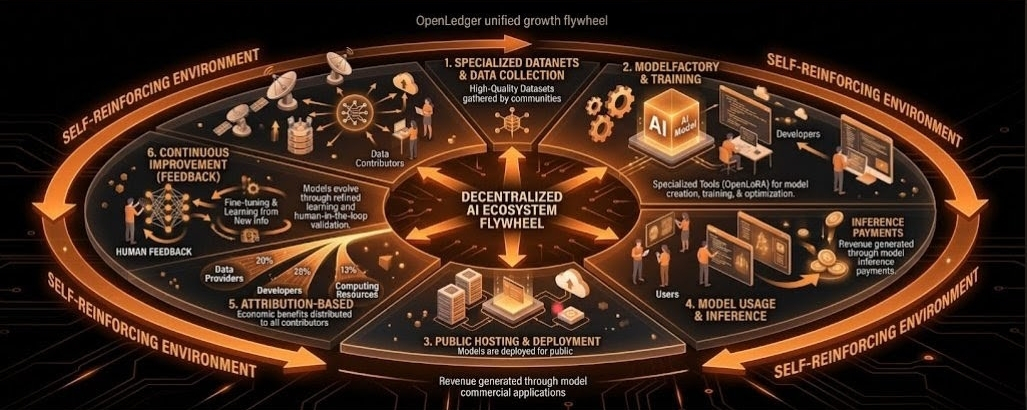
The rapid advancement of artificial intelligence has created an increasing demand for high-quality data, efficient model development processes, and fair reward systems for contributors. Traditional AI development often relies on centralized platforms where data providers, developers, and end users have limited visibility into how value is created and distributed. A decentralized approach introduces a different model, one that seeks to align incentives among all participants while encouraging continuous innovation and growth.
A key component of this framework is the process of model creation and public hosting. Rather than relying on a small group of organizations to develop and control AI systems, decentralized infrastructure allows communities to participate in building, improving, and maintaining models. This approach creates opportunities for developers, data contributors, and users to benefit from the value generated by successful AI applications.
The journey begins with the collection of specialized datasets. High-quality data serves as the foundation for any successful artificial intelligence model. Contributors provide valuable information that can be used to train systems capable of solving specific problems or serving particular industries. As more relevant and reliable data becomes available, the potential quality and performance of future models increase significantly.
Once sufficient data has been gathered and predefined requirements are satisfied, the development process moves forward. At this stage, an AI model is created, trained, and optimized using the collected information. The objective is not only to build a functional model but also to ensure that it performs efficiently and delivers meaningful results in real-world applications. Optimization techniques help improve accuracy, responsiveness, and overall effectiveness, allowing the model to meet the expectations of users and stakeholders.
After development and testing are completed, the model can be deployed for public use. Public hosting enables organizations, developers, and individuals to access the model’s capabilities through various applications and services. Deployment marks a critical milestone because it transforms the model from a development project into an active participant in the broader digital economy.
Revenue generation becomes possible once a deployed model begins serving users. Whenever businesses or individuals utilize the model’s capabilities, economic value is created. Rather than concentrating rewards in a single organization, the decentralized structure distributes benefits among multiple stakeholders. Contributors who supplied valuable data, developers who built the model, and other participants involved in the ecosystem can receive a share of the revenue generated through model usage. This approach helps create a more balanced and inclusive economic environment.
Another essential aspect of the ecosystem is model inference payments. Inference refers to the process of using a trained AI model to generate outputs, predictions, recommendations, or responses. Each inference request requires computational resources, including processing power and infrastructure support. To compensate for these resources, payments are made using ecosystem tokens.
This mechanism establishes a direct connection between model usage and economic activity. As demand for a model increases, more inference requests are processed, generating additional value within the ecosystem. The payment structure ensures that computational resources remain available while supporting the long-term sustainability of the network.
Continuous improvement remains a central objective throughout the lifecycle of an AI model. Training does not necessarily end once deployment occurs. Fine-tuning techniques allow models to evolve over time by learning from new information and feedback. Supervised learning methods help improve performance through carefully labeled datasets, while reinforcement learning with human feedback provides guidance based on real-world evaluations and preferences.
Human feedback plays a particularly important role because it enables models to adapt to practical needs and expectations. By incorporating evaluations from users and experts, AI systems can become more reliable, accurate, and useful. This ongoing refinement process helps maintain quality standards while allowing models to remain relevant in changing environments.
The broader vision behind this approach is the creation of a self-sustaining decentralized AI ecosystem. Sustainability requires more than technological innovation; it depends on establishing economic and operational structures that encourage long-term participation. OpenLedger addresses this challenge through a unified growth flywheel designed to connect the interests of developers, contributors, and users.
A flywheel model operates by creating a cycle in which each successful activity strengthens the next stage of growth. Instead of relying on constant external support, the ecosystem generates momentum through the interactions of its participants. As value is created, more contributors join the network, leading to further innovation and expansion.
The AI ecosystem flywheel begins with model creators and developers. These individuals identify opportunities, propose new ideas, and design specialized AI solutions for particular use cases. Their work serves as the starting point for innovation within the network.
To build effective models, developers require access to reliable datasets. OpenLedger’s Datanets provide an environment where specialized data can be collected, organized, and utilized efficiently. Access to quality information allows developers to train models that address real-world challenges while maintaining high performance standards.
In addition to data resources, developers can utilize specialized tools designed to simplify the training and optimization process. Technologies such as ModelFactory and OpenLoRA support efficient model development by providing secure environments for fine-tuning and customization. These tools help reduce technical barriers while enabling creators to focus on improving model quality and functionality.
As models are refined and deployed, they begin generating practical value for users. Increased adoption leads to greater demand for inference services, creating a steady flow of economic activity throughout the ecosystem. This activity forms the foundation of a self-sustaining economy where participation and contribution are directly linked to rewards.
A distinguishing feature of the system is its attribution-based reward structure. Rather than treating all contributions equally, attribution mechanisms recognize the specific role played by participants in the development process. Data contributors, model builders, and other ecosystem participants can receive compensation based on the value they help create.
This reward model encourages ongoing participation because contributors have a clear incentive to provide high-quality resources and expertise. As more individuals engage with the ecosystem, the available pool of data, knowledge, and innovation continues to expand. The result is a positive cycle in which improved models attract more users, increased usage generates additional rewards, and greater rewards encourage further contributions.
The relationship between model usage and contributor incentives is particularly important for long-term growth. Every successful deployment creates opportunities for stakeholders to benefit from the ecosystem’s expansion. This alignment of interests helps establish a stable foundation where innovation, participation, and economic value reinforce one another.
Ultimately, the decentralized AI ecosystem represents a shift toward a more collaborative model of technological development. By combining data contribution, model creation, public deployment, inference-based payments, and attribution-driven rewards, the framework creates an environment where participants can collectively build and benefit from advanced AI systems. Through its interconnected flywheel structure, the ecosystem aims to support continuous growth, encourage innovation, and ensure that value is shared among those who contribute to its success.
