
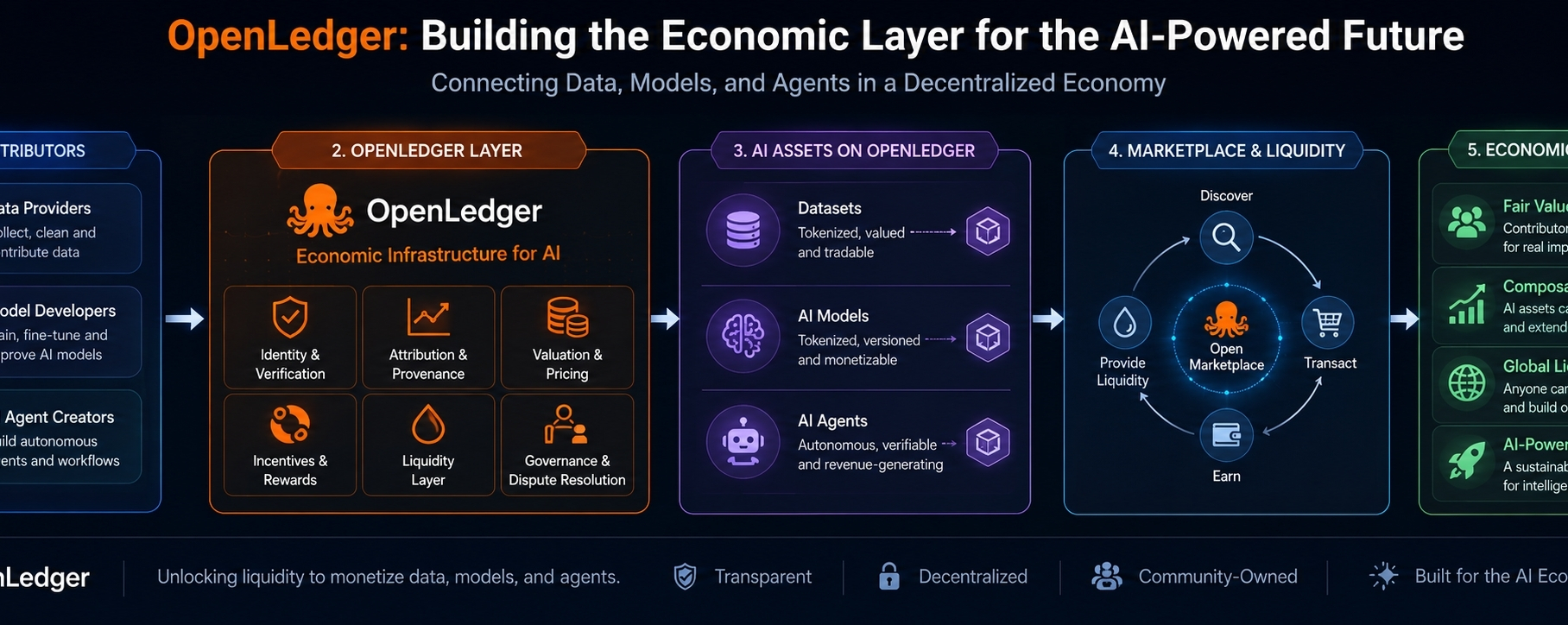
I've been following OpenLedger for some time now, and the more I look at it, the more I feel like it's trying to solve a different problem than most AI-related crypto projects. A lot of teams are focused on building faster infrastructure, larger models, or more efficient AI services. OpenLedger seems to be asking something more fundamental: if AI is becoming one of the most valuable resources in the digital world, who should actually benefit from the value it creates?
That's what initially caught my attention. Every day, enormous amounts of data are being generated, AI models are constantly learning from that data, and intelligent systems are producing outputs that businesses and users rely on. Yet when you look at where the economic value ends up, it's often concentrated among a relatively small number of platforms. The people providing the data, improving the models, or contributing to the ecosystem don't always have a clear way to participate in that value creation. OpenLedger appears to be exploring a model where those relationships become more transparent and potentially more rewarding.
What makes this interesting to me is that it feels like a continuation of a theme crypto has been pursuing from the beginning. Blockchain technology has always been about ownership, coordination, and value distribution. First it was digital money, then decentralized finance, and later on-chain ownership of assets. OpenLedger seems to be extending that idea into the AI era by treating data, models, and agents as economic resources rather than simply technical components.
The concept of liquidity is where things become especially interesting. We usually associate liquidity with tokens, markets, and financial assets, but OpenLedger is applying that same thinking to intelligence itself. The project appears to be building a framework where data contributors, model builders, and AI agents can all participate in a shared ecosystem instead of operating in isolated silos. If that works as intended, it could create entirely new economic relationships around how intelligence is created and used.
I'm also paying close attention to the role of AI agents within the ecosystem. It feels increasingly likely that future digital economies won't be powered exclusively by humans interacting with applications. Autonomous agents are becoming more capable, and over time they may be able to perform tasks, execute strategies, and generate value on their own. If that future arrives, those agents will need infrastructure for incentives, ownership, reputation, and coordination. OpenLedger seems to be positioning itself around that possibility rather than waiting for it to become obvious.
Of course, the idea comes with significant challenges. Turning data and intelligence into economic assets sounds compelling, but valuing those assets is far from straightforward. Not all data is equally useful. Not all models contribute the same amount of value. Measuring contributions fairly and creating incentives that reward quality rather than quantity will likely be one of the hardest problems to solve. The success of the entire model may depend on whether OpenLedger can build systems that participants genuinely trust.
Adoption is another area I'm watching closely. In technology, the best design doesn't always win. Ecosystems often grow because they attract developers, users, and builders who create momentum over time. OpenLedger's vision is ambitious, but like many infrastructure projects, its long-term success will probably depend less on the idea itself and more on whether it can build a network that people actually want to participate in.
What I find most fascinating is how OpenLedger reflects a broader shift happening across both AI and crypto. The industry is gradually moving beyond tokenizing financial assets and toward tokenizing productive digital resources. First it was computing power, then storage and bandwidth. Now attention is shifting toward data, intelligence, and autonomous agents. OpenLedger sits right in the middle of that transition, trying to build the economic rails for a future where intelligence becomes something that can be owned, monetized, and coordinated on-chain.
I'm still watching from the sidelines, trying to see how the thesis develops over time. There are plenty of unanswered questions, and execution will ultimately matter more than vision. But I think the reason OpenLedger keeps showing up on my radar is because it's exploring a problem that feels increasingly important. As AI becomes a larger part of the global economy, the question won't just be who builds the intelligence. It may also be who owns it, who contributes to it, and how the value it creates gets distributed. That's a conversation I expect the industry to spend a lot more time having in the years ahead.


