
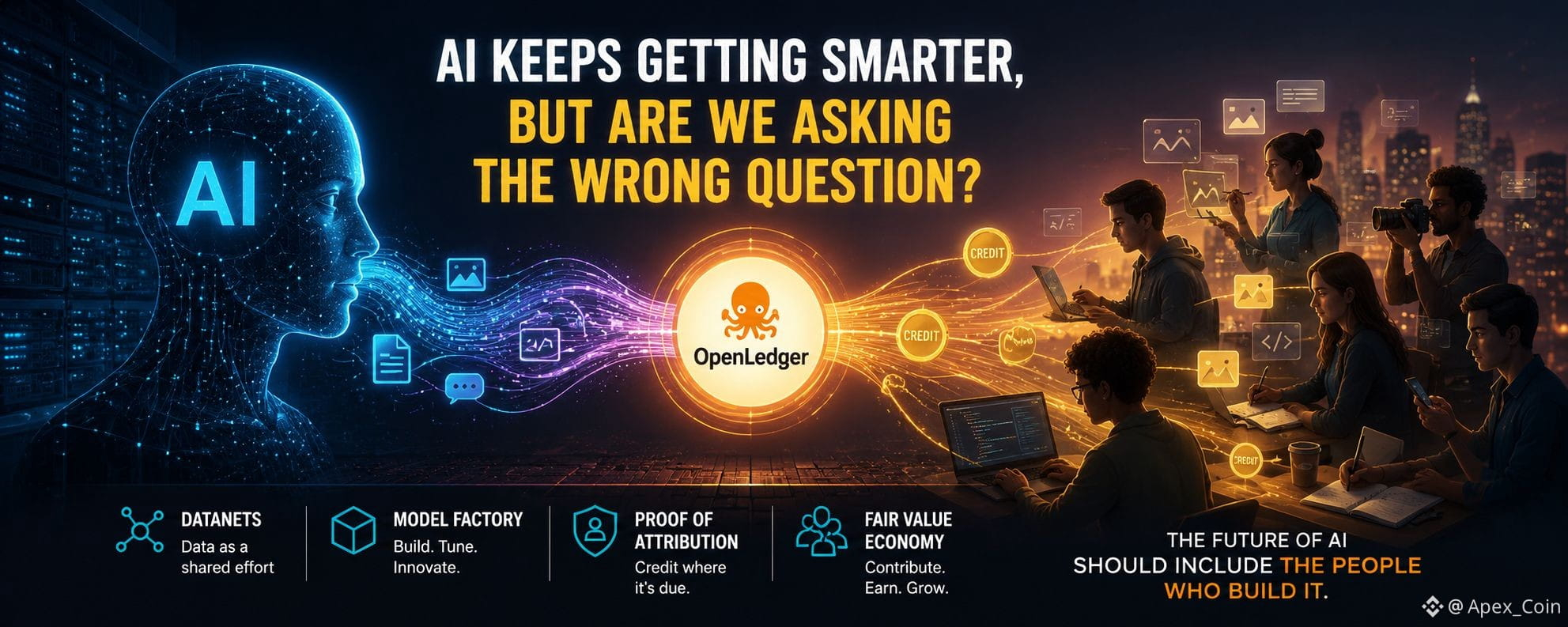
Let me admit something uncomfortable.
I watch AI get smarter every single day. Better reasoning. Faster answers. New records. It's exciting. But late atnight, I sometimes wonder… are we focusing on the wrong problem?
We keep asking: How do we build abigger model?
maybe we should ask: Who actually creates the value of this AI?
Think about it. Every conversation, every piece of writing, everyphoto, every line of code, every mistake and correction online—that's all us. Human beings. A massive, endless stream of our own work.
AI drinks from that stream. Then it produces something valuable. But here's the strange part:
almost all of that value goes straight to the model owners. The people who provided the data? They get nothing. No name. No reward.
Not even a thank you.
That stopped me cold.
So when I came across @OpenLedger I'll be honest I rolled my eyes at first.
"AI plus blockchain." You see that label everywhere. Most of them add nothing new.
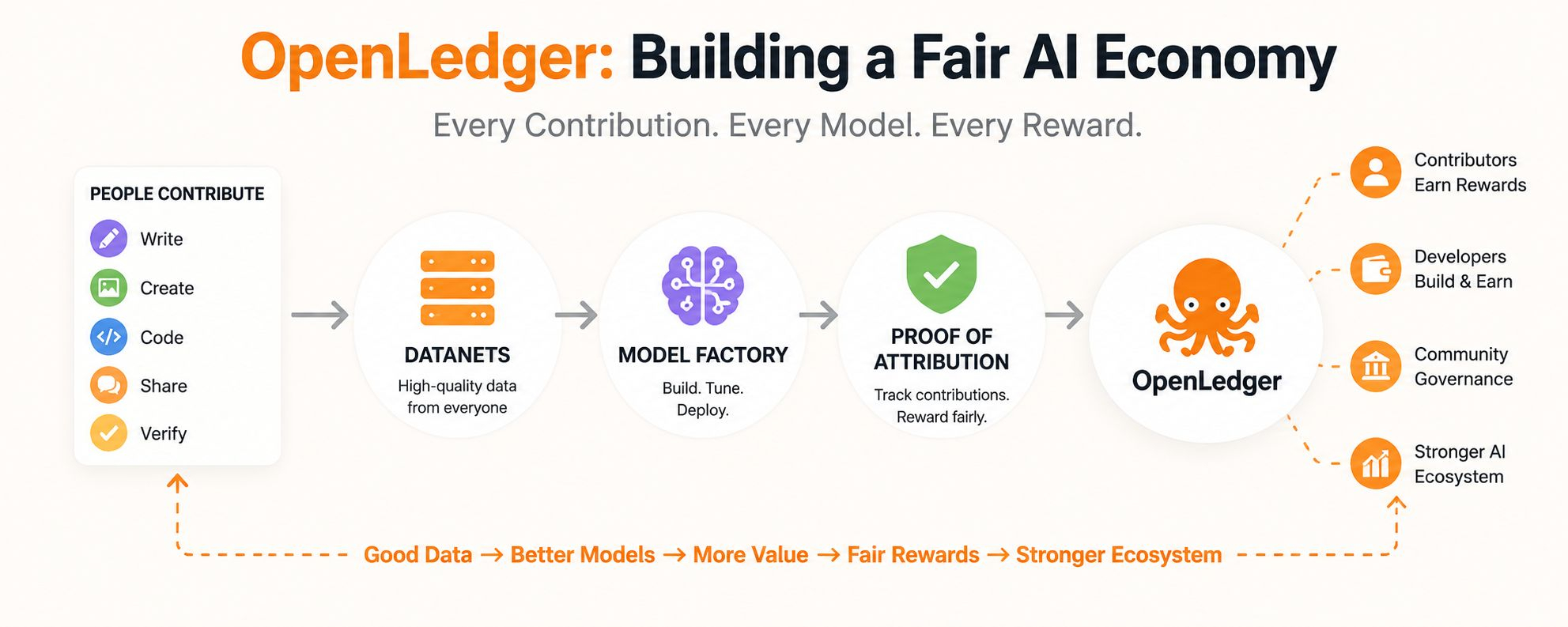
But then I dug deeper. They aren't asking the same old question. They're asking a different one: Can we build an AI economy where contributions are actually measured and rewarded?
That small shift changes everything.
Here's what caught my attention.
First,
Datanets.
Instead of treating dataas something you just take for free, it becomes a shared effort. People create, verify, and share data for specific AI needs.
Simple, but powerful.
Second,
Model Factory.
Most people have great AI ideas but hit awall because the tech istoo hard.
If building or tuning models becomes easier, innovation stops being a big-lab monopoly.
Third,
and most important:
Proof of Attribution.
Right now, when AI gives you an answer, nobody knows which data sources really mattered.
Everything gets mixed together.
This idea tries to trace it back how much did each contributor actually help? Then reward them fairly.
If that works at scale? That's areal breakthrough.
I'm not here to sell fairy tales. There are three big challenges.
One:
attribution has to be accurate.
Getit wrong, and trust is gone.
Two:
developers have to actually useit.
Good infrastructure means nothing if nobody shows up.
Three:
model quality must be high.
At the endf the day,
users donT care about philosophy.
They care if the output is useful.
Here's the beautiful part. Good data makes good models. Good models attract better data. That creates a loop not just of intelligence, but of fairness.
@OpenLedger is built on EVM, so Ethereum tools and wallets work out of the box. No need to learn everything from scratch. And the $OPEN token ties everything together: fees, rewards, governance. Itznot just a trading token. It's the engine.
No system is perfect. Designing an AI economy is way harder than it looks on paper.
but as AI keeps advancing, one thing is becoming clear. The question won't justbe "what can AI do?" It will be "who contributed, and who gets the value?"
That balance—between the machine and the people who feed it—might be the most important story of the coming years.
And maybe, just maybe, that's the future worth building.