
The crypto industry has spent more than a decade debating where value ultimately accumulates. First came the "Fat Protocol" thesis, then the "Fat Application" thesis. Both assumed one thing: the user was human.
But what happens when the next billion blockchain users aren't people at all?
What if they are AI Agents—software entities capable of making decisions, executing transactions, managing portfolios, and interacting with protocols autonomously?
This shift could fundamentally reshape how value flows across the entire crypto ecosystem.
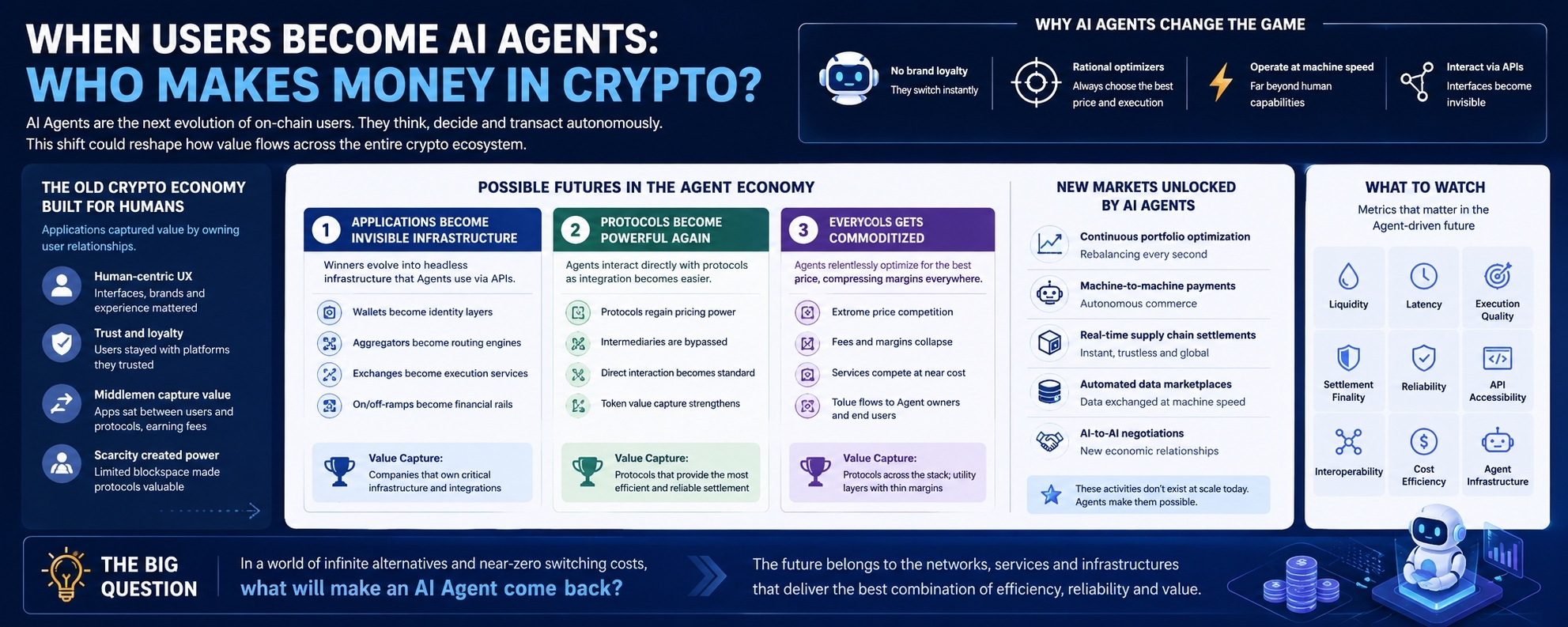
The Old Crypto Economy: Built for Humans
For years, successful crypto businesses relied on human behavior.
Humans care about:
◾ User-friendly interfaces
◾ Brand reputation
◾ Trust and security
◾ Convenience
◾ Community and network effects
This allowed applications such as wallets, exchanges, and trading platforms to capture significant value because they controlled the user relationship.
Whether users swapped tokens, staked assets, borrowed funds, or traded NFTs, applications sat between users and protocols, earning fees from every interaction.
The Rise of AI Agents Changes Everything
AI Agents operate differently.
Unlike humans, Agents:
◾ Don't care about branding
◾ Have no emotional loyalty
◾ Instantly compare prices
◾ Always seek optimal execution
◾ Can switch providers at virtually zero cost
An Agent doesn't choose a protocol because it's popular. It chooses the most efficient option available at that moment.
This seemingly small change could dramatically alter the economics of crypto.
Scenario 1: Applications Become Invisible Infrastructure
One possible future is that today's leading applications evolve into backend service providers.
Instead of serving humans through interfaces, they provide APIs that Agents can access directly.
In this world:
◾ Wallets become identity layers
◾ Aggregators become routing engines
◾ Exchanges become execution services
◾ On-ramp providers become financial infrastructure
The user interface disappears, but the underlying services remain valuable.
Companies that successfully transition from consumer products to infrastructure providers could continue capturing significant value.
Scenario 2: Protocols Become Powerful Again
Another possibility is that Agents bypass intermediaries entirely.
If blockchain protocols become easier to integrate and interact with, Agents may directly connect to them without needing aggregators or middleware.
In this scenario:
◾ Protocols regain pricing power
◾ Applications lose importance
◾ Direct interaction becomes standard
◾ Token value capture strengthens
This would resemble a revival of the original "Fat Protocol" thesis, where the underlying blockchain infrastructure captures most economic value.
Scenario 3: Everyone Gets Commoditized
The most disruptive possibility is that nobody captures significant value.
Agents are relentless optimizers.
If one provider offers slightly cheaper execution, faster settlement, or lower fees, Agents will instantly switch.
This creates extreme competition.
As a result:
◾ Trading fees collapse
◾ Infrastructure margins shrink
◾ Application premiums disappear
◾ Services compete near cost
Crypto becomes similar to electricity or internet bandwidth—a utility essential for society but difficult to monetize.
Under this model, most economic benefits flow directly to users and Agent owners rather than service providers.
The Real Opportunity: New Markets That Don't Exist Today
Many investors focus on how Agents will increase existing activity.
But the larger opportunity may be entirely new forms of economic activity.
Consider examples such as:
◾ Continuous portfolio optimization every few seconds
◾ Autonomous treasury management
◾ Machine-to-machine payments
◾ Real-time supply chain settlements
◾ Automated data marketplaces
◾ AI-to-AI commercial negotiations
Humans simply cannot operate at these speeds and frequencies.
Agents can.
These activities could generate billions of transactions that would never occur in a human-only economy.
The biggest winners may therefore be the platforms enabling these entirely new markets.
The Missing Business Model
History suggests that the biggest winners often emerge from business models nobody predicts.
When the internet was first built:
◾ Search advertising didn't exist
◾ Social media monetization didn't exist
◾ Influencer marketing didn't exist
◾ Creator economies didn't exist
Yet these became trillion-dollar opportunities.
The same could happen in the Agent economy.
Future value may flow to entirely new categories that don't fit today's definitions of protocols, applications, exchanges, or infrastructure.
The most valuable crypto company of the Agent era may not even look like a crypto company today.
Key Metrics Investors Should Watch
As the Agent economy develops, several factors may become increasingly important:
◾ Liquidity depth
◾ Transaction costs
◾ Execution quality
◾ Settlement speed
◾ Network reliability
◾ API accessibility
◾ Cross-chain interoperability
◾ Agent-specific infrastructure
Rather than asking which project has the best user experience, investors may increasingly ask:
"Which network is most attractive for autonomous AI systems?"
Final Thoughts
The Agent era isn't simply about increasing transaction volume.
It's about changing the identity of the user itself.
For years, crypto value capture revolved around human behavior. AI Agents introduce a new economic participant that thinks differently, acts differently, and optimizes differently.
The future may not belong exclusively to protocols or applications. Instead, it may belong to the networks, services, and infrastructures that can attract and retain autonomous Agents in a world where switching costs approach zero.
The biggest question facing the crypto industry is no longer:
"Where will users go?"
The new question is:
"What will make an AI Agent come back?"
#Crypto #ArtificialIntelligence #Web3 #BlockchainInnovation #ArifAlpha