
Dusk Network feels like one of those projects that makes more sense the longer you sit with it, because it isn’t trying to win attention by being louder than everything else, it’s trying to solve a real structural problem in blockchain that traditional finance has been quietly pointing at for years: public ledgers are great for transparency, but they are terrible when every position, counterparty relationship, transfer amount, and settlement pattern becomes permanently visible to everyone, especially in markets where privacy is not a luxury but a requirement.
At the center of Dusk is a very specific idea: build a Layer-1 that can support financial applications where confidentiality is default, where transactions can be verified without exposing sensitive details, and where settlement can reach finality in a way that feels closer to how serious markets operate, rather than how speculative networks behave during congestion, and that’s why Dusk doesn’t present privacy as a side feature or a special “mode,” it frames privacy as the foundation that everything else is built on, because in regulated environments you don’t just need code that runs, you need systems that can prove correctness while still protecting participants.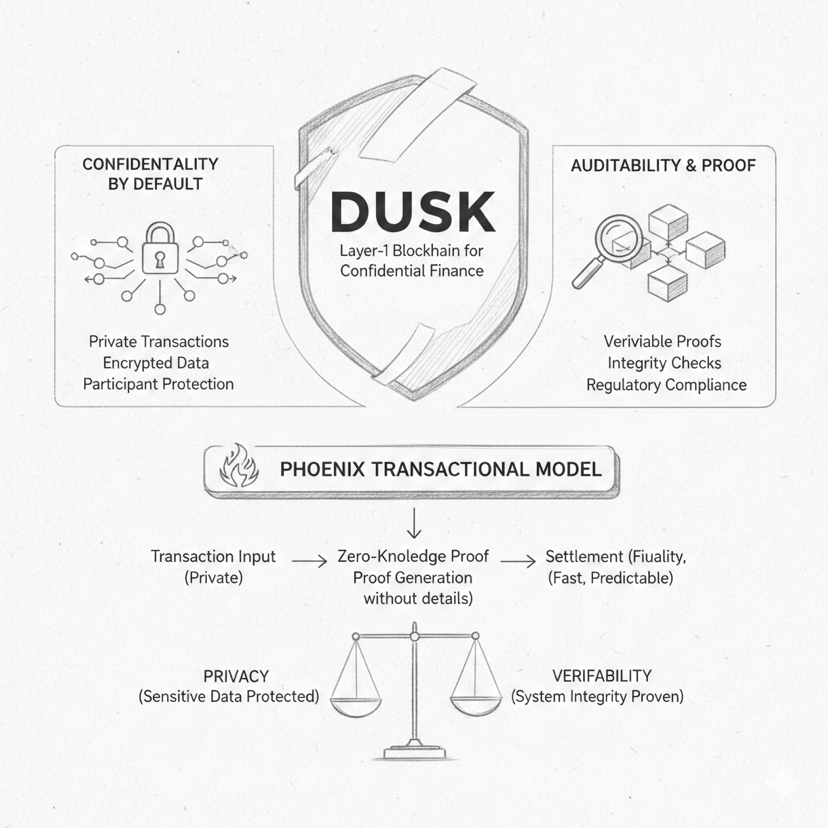
This is where the Phoenix transactional model becomes more than a technical term, because the real point behind Phoenix is not to impress anyone with cryptography, it’s to create a transaction structure where validity can be proven without broadcasting the full story of the transaction to the public, and once you understand that, you start to see why Dusk spends so much time talking about how privacy and auditability can coexist, because finance does not want a world where everything is visible, but it also cannot accept a world where nothing can be verified, so Dusk aims for a middle ground where sensitive data stays protected while verifiable proofs still exist when the system needs to demonstrate integrity.
When Dusk talks about financial markets specifically, it’s not just a branding choice, it shows up in how the project thinks about assets that come with rules, obligations, and lifecycles, and this is exactly why the conversation around security tokens and tokenized real-world assets keeps appearing around the ecosystem, because those assets aren’t meant to behave like casual transfer tokens, they often require controlled disclosures, regulated transfer logic, compliance-aware handling, and the ability to reconcile states without leaking everyone’s private activity, and in that lane Dusk’s approach with confidential contract standards and privacy-preserving models is basically a direct response to what the capital markets world actually demands.
A lot of projects fail at the practical part because they build something theoretically interesting but difficult to develop on, and this is why DuskEVM matters in a very grounded way, because it signals that the team understands the difference between an idea and an ecosystem, and ecosystems are built by developers who need familiar tooling, predictable deployment workflows, and a clear path from test to production, so supporting an EVM environment becomes less about copying what others are doing and more about removing friction, letting builders ship applications while the base layer continues to express Dusk’s privacy-first design choices.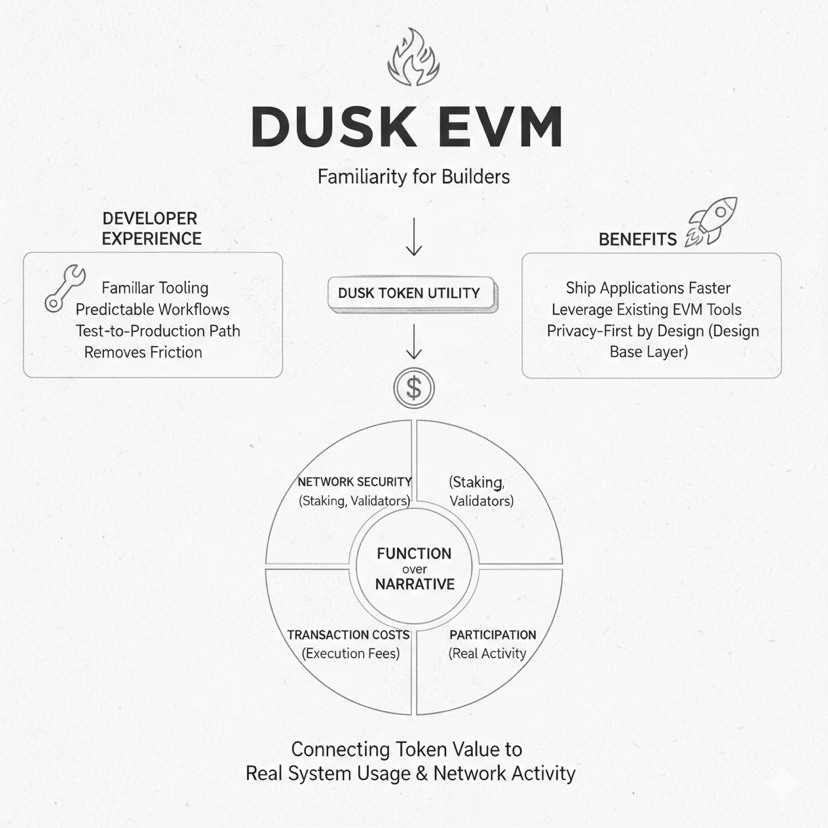
The token story fits into this in a way that’s easier to respect when you keep the focus on purpose instead of price, because DUSK is positioned as a native asset that supports the network’s mechanics, from participation and security dynamics to execution costs, and that matters because if the network grows into a real settlement layer for financial applications, the token’s relevance becomes connected to actual network activity and system usage, not only to narrative cycles, which is usually the difference between a token that lives on attention and a token that lives on function.
What I find most important about Dusk is that it’s attempting to make “private finance on public infrastructure” feel normal rather than contradictory, because the long-term market isn’t asking for more transparency for everything, it’s asking for better structure, better confidentiality, and better guarantees, and if Dusk continues to translate its privacy architecture into stable infrastructure, clean developer experience, and real-world financial workflows, it can gradually move from being a concept people debate into being a network that quietly becomes useful, and when a project becomes useful in the finance lane, the shift is always obvious in hindsight, because the conversation stops being about what it promises and starts being about what it settles.
