

The U.S. hiring rate has dropped to 3.3%, matching levels last seen during the 2020 crisis and sitting near a 13-year low. This is not just another statistic for economists. It is one of the clearest early signals that the world’s largest economy is starting to lose momentum. When companies slow down hiring, it usually means confidence is fading and caution is taking over.
According to data from the Bureau of Labor Statistics, the hiring rate measures how many new workers are added each month compared to total employment. When this number is high, businesses are optimistic and expanding. When it falls, they are protecting cash and preparing for uncertainty. At 3.3%, today’s market looks uncomfortably similar to past crisis periods.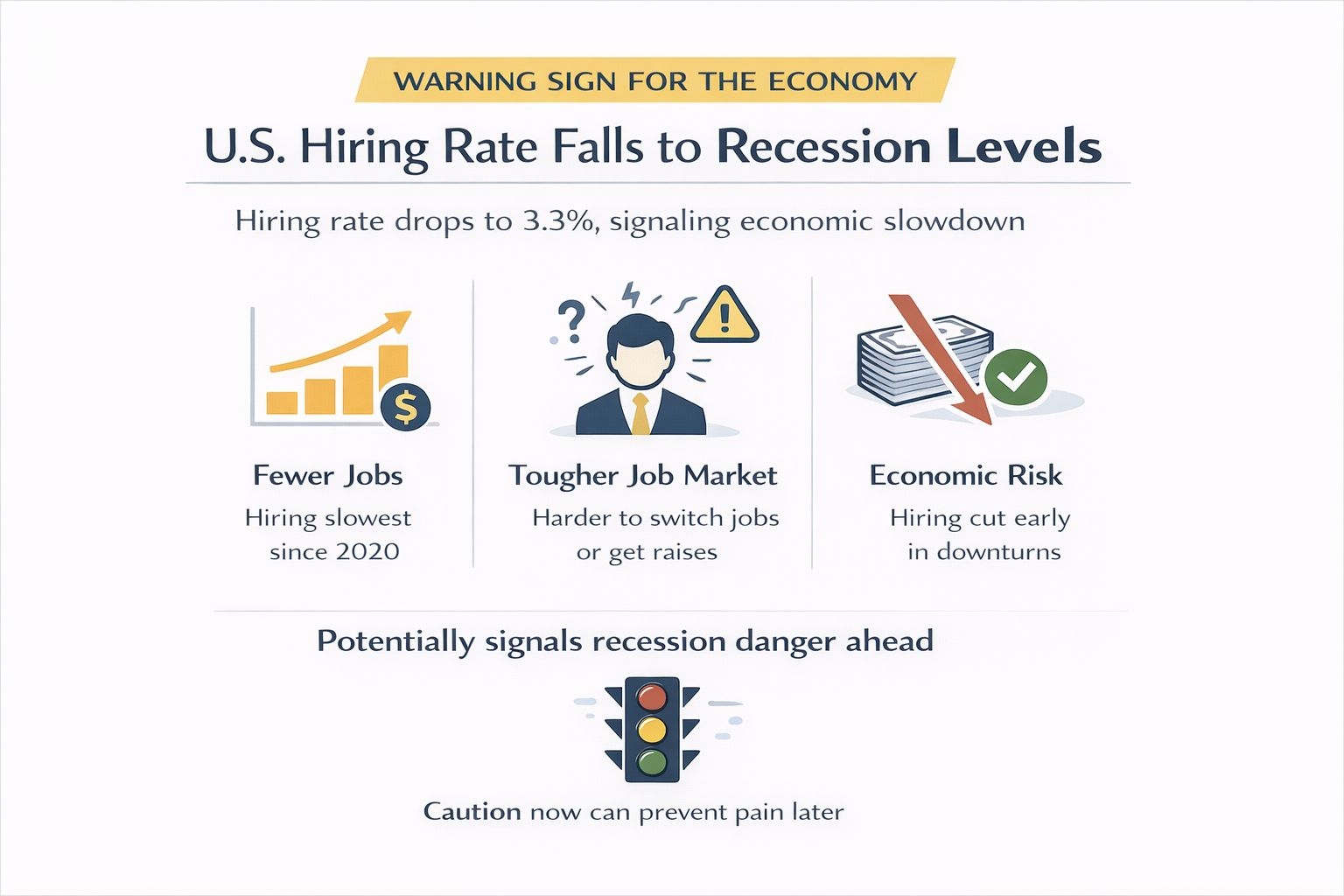
In simple terms, this means fewer job openings, tougher competition, slower promotions, and weaker bargaining power for workers. It becomes harder to switch jobs, harder to negotiate salaries, and harder for fresh graduates to enter the market. The job environment slowly shifts from being employee-friendly to employer-dominated.
One major reason behind this slowdown is high interest rates. The Federal Reserve has kept rates elevated to control inflation. While this helps stabilize prices, it also makes borrowing expensive. When loans cost more, companies delay investments, cancel expansion plans, and avoid building new teams. Growth becomes risky, so caution becomes the strategy.
Another factor is weakening consumer demand. Rising living costs, rent pressure, and household debt have reduced spending power. When people buy less, companies earn less. When profits slow, hiring is usually the first expense to be cut. Businesses prefer to pause recruitment before they even think about layoffs.
Technology is also reshaping hiring patterns. Many firms are replacing routine and entry-level roles with automation and AI tools. Instead of hiring multiple workers, they invest in software and hire fewer specialists. Productivity may rise, but job creation slows. This structural shift is quietly changing the labor market.
What makes this situation more important is that hiring is a leading indicator. Unemployment tells us what already happened. Hiring tells us what is about to happen. When companies stop recruiting today, layoffs and wage pressure often appear months later. This means the current slowdown is a warning about future economic stress.
For workers, this changes daily reality. During strong markets, people can easily switch jobs, demand raises, and receive multiple offers. During weak markets, people hold onto their positions, accept slower growth, and avoid risks. Power shifts back to employers, and job security becomes more valuable than fast career moves.
Young professionals and fresh graduates are usually hit the hardest. Low hiring means fewer trainee programs, fewer entry-level roles, and more contract or temporary work. Competition increases, rejection rates rise, and career progress slows. Entering the workforce during weak cycles often leaves long-term scars.
At the national level, weak hiring creates a dangerous loop. Slower hiring leads to weaker income growth. Weaker income reduces spending. Lower spending hurts businesses. Struggling businesses cut hiring even more. This cycle is how slowdowns quietly turn into recessions.
Does this guarantee a recession? No. But it clearly increases the risk. Strong hiring protects economies. Weak hiring weakens them over time. Right now, the U.S. labor market is not collapsing. It is freezing. And freezes are often more dangerous than sudden shocks.
For individuals, this is a moment for preparation, not panic. Building strong skills, especially in technology, data, operations, and finance, increases resilience. Maintaining savings provides flexibility. Strengthening professional networks improves access to hidden opportunities. Stability matters more in uncertain times.
It is also a period to be careful with job-hopping. The market is no longer in a post-pandemic boom. Changing jobs now carries higher risk. Reliable income and long-term positioning matter more than short-term gains.
The fall of the hiring rate to 3.3% is not just an economic headline. It is a message. Growth is slowing. Confidence is weakening. Uncertainty is rising. These shifts do not happen loudly. They happen quietly, in reports that most people ignore.
The economy rarely breaks overnight. It weakens slowly, step by step. And hiring is one of the first places where that weakness appears.
Right now, the signal is not red. It is not green.
It is yellow.
And smart people start preparing when the light turns yellow, not after it turns red.