

It was only when AI started costing real businesses real money that I finally understood what Vanar has been trying to build all along. A few days ago, over tea, a friend working in cross-border logistics vented about an uncomfortable lesson. His company had aggressively deployed AI for customer service, scheduling, and order handling. On paper, everything looked efficient. In practice, it turned into chaos. The AI processed new orders flawlessly, but it “forgot” special client instructions from previous weeks. Priority pricing was ignored. Routing notes vanished. Shipments went wrong. The damage crossed six figures in a matter of days.
What broke the system wasn’t intelligence. It was discontinuity. The AI was smart, fast, and scalable, but it had no durable memory. Every task was treated as a fresh event. In industrial environments, that kind of forgetting isn’t a bug — it’s a latent liability. And once AI starts touching logistics, payments, settlements, or inventory, the cost of forgetting compounds brutally.
That conversation suddenly reframed what I had heard recently in Dubai. At industry roundtables, Vanar Chain wasn’t pitching speed, fees, or buzzwords. The message was quieter and more unsettling: AI, if it is to run parts of the global economy, needs memory that does not quit. This wasn’t a crypto slogan. It was a productivity argument aimed directly at enterprises, policymakers, and operators who don’t care whether a chain is L1 or L2, but care deeply whether their systems make irreversible mistakes.
Most AI today operates in sessions. It responds, completes a task, and moves on. Memory is fragmented across centralized databases, logs, or private clouds. When systems fail, no one can fully reconstruct what the AI knew, when it knew it, or why it acted the way it did. Vanar’s bet is that this model breaks down once AI stops being a tool and starts becoming an economic actor. In that future, memory is not optional. It is infrastructure.
Vanar’s persistent on-chain memory reframes AI experience as something that compounds. Every interaction, transaction, decision, and outcome can become a verifiable record. Not just for audits, but for learning. An AI agent that has handled ten thousand verified logistics interactions, payment flows, or commerce decisions is not the same as a fresh model with zero history. Experience becomes an asset. Memory becomes reputation. Reputation becomes economic leverage.
This is where the market may be mispricing the entire effort. Many still evaluate Vanar through a narrow crypto lens: price action, hype cycles, short-term narratives. But Vanar is quietly expanding its total addressable market from the hundreds of billions in crypto to the trillions in global AI-driven services. That is a far riskier path. It is also the only one that avoids becoming another forgotten altcoin.
There is another layer most discussions miss. Once AI agents begin transacting autonomously — opening positions, sending payments, distributing rewards — the weakest link is no longer speed. It is trust. Autonomous systems exploit loopholes endlessly. Humans get tired; bots do not. Any profitable gap will be hit tens of thousands of times before lunch. This is why AI-native finance without identity and uniqueness rails is a recipe for automated exploitation.
Vanar’s direction here is telling. Instead of pushing heavy KYC everywhere, the ecosystem has leaned into proof-of-uniqueness and human-centric safeguards. The integration of Humanode Biomapper brings Sybil resistance without destroying user experience. One human, one participant, without forcing every interaction to feel like a passport checkpoint. For marketplaces, PayFi flows, and AI-assisted commerce, this is not a cosmetic feature. It is plumbing.
Then there is the naming layer, which sounds trivial until money moves at machine speed. Long hexadecimal addresses are not just bad UX; they are systemic risk. When AI agents send value to other agents, an address typo is not an inconvenience — it is permanent loss. Human-readable naming via wallet extensions and tools like MetaMask Snaps changes the safety model. Names reduce transmission errors. They make routing understandable to humans and machines alike. In an agent economy, clarity is a form of security.
This is why the amusement-park analogy resonates. Most public chains still operate like pay-per-ride carnivals. Every action triggers friction. Every click demands gas. Vanar’s “pass” model, where developers absorb complexity so users can simply play, transact, or interact, aligns with how mainstream systems actually scale. Users shouldn’t need to think about wallets to enjoy experiences. AI systems shouldn’t need to guess context that was already known yesterday.
Put together, a clearer picture emerges. Vanar is not trying to be loud. It is trying to be reliable. Persistent memory, identity guardrails, human-readable routing, and extensibility bridges are not hype features. They are the minimum requirements for AI systems that operate when no one is watching. When mistakes are irreversible. When forgetting costs money.
The real question going forward won’t be which chain has the highest TPS. It will be which systems can be trusted when AI agents act autonomously, repeatedly, and at scale. Speed fades. Experience compounds. Infrastructure that remembers quietly outlives infrastructure that shouts.
That is the deeper vision behind Vanar and $VANRY. Not celebrity status in crypto, but credibility in the AI economy. Not being the fastest voice in the room, but the ledger that doesn’t forget.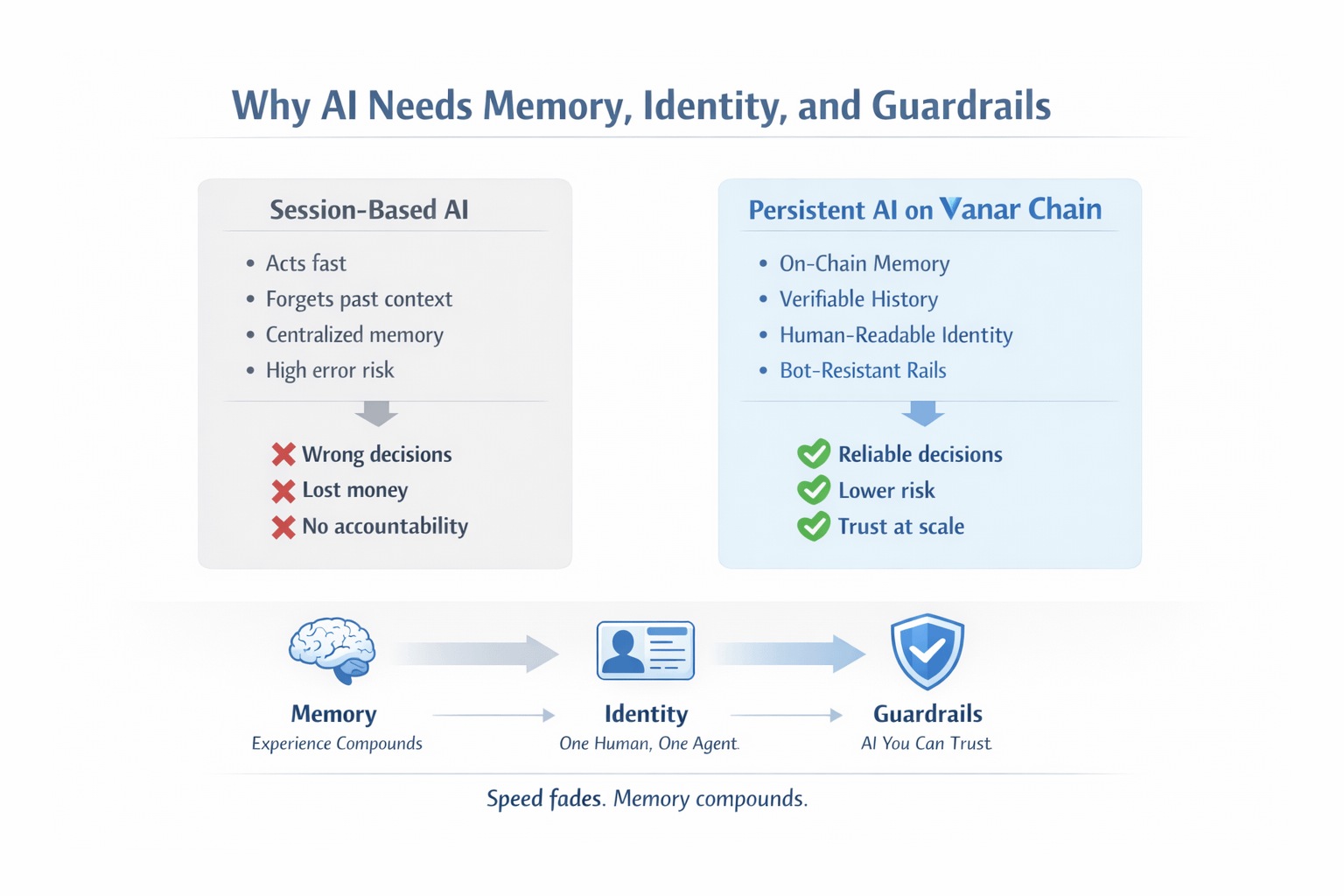
If AI truly becomes a global growth engine, memory will decide who survives.
I’m curious how others see this shift. Do you think persistent memory and identity guardrails will become non-negotiable for AI-driven systems, or will markets continue to prioritize speed and hype?