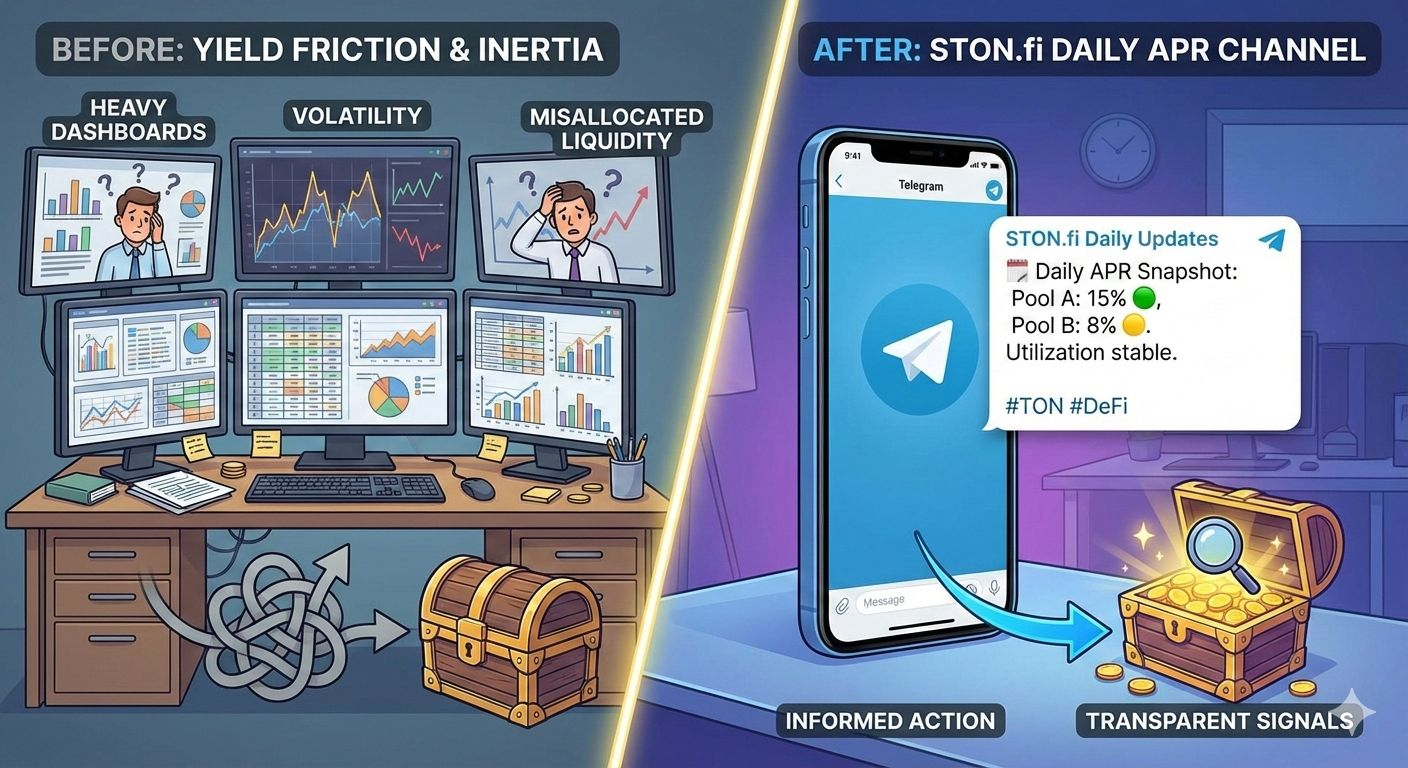
How STON.fi's Daily APR Channel on Telegram Is Fixing Yield Friction
Yield farming and liquidity provision are powerful engines for decentralized finance — but they run on information. APRs move constantly: pool utilization, swap volumes, reward schedules, and token incentives all push returns up and down. For many users, that volatility is less a feature than a burden. People who want to chase good yields face a practical problem: they don’t have time to watch dozens of pools, and dashboards feel heavy, technical, and detached from where their conversations already happen.
Enter a deceptively simple idea: bring the numbers to the user. Instead of building another dashboard that users must remember to check, STON.fi delivers daily APR updates directly into the chat app many TON users already live in. That small UX decision — light, regular reports inside an existing social environment — changes behavior in ways that matter.
From inertia to informed action
Behavioral friction is the unseen tax of DeFi. When yield information is hard to access or interpret, the rational response for many participants is inertia: stay put rather than pay the cognitive and operational costs to move capital. That conservatism isn’t always bad, but it does mean liquidity can become misallocated; high-performing pools go underfunded because people simply don’t know or can’t act quickly.
Automated reporting attacks that inertia at the source. A short, daily snapshot of APRs and incentive shifts reduces the informational cost of monitoring pools. Because the updates arrive in the same place users already check messages, the additional attention required is minimal. Over time, this small reduction in friction changes the calculus: monitoring becomes habitual, comparative thinking becomes easier, and reallocations become more targeted and less emotional.
Teaching users to compare, not chase
One-off alerts and flashy APY figures can encourage frantic migration — liquidity hopping from pool to pool whenever a headline number spikes. By contrast, a consistent daily cadence builds a dataset users can learn from. When users see how pools behave across days and market regimes, they start to distinguish between noise and structural trends. Is a pool’s APR spiking because of a temporary reward boost? Is utilization steady or volatile? Which pools deliver persistent, risk-adjusted returns?
This comparative thinking improves individual decisions — and the health of the protocol. Rather than reactive migrations that amplify volatility, liquidity flows become more thoughtful. Users make moves based on observed patterns and risk trade-offs instead of chasing headline numbers.
Lower operational cost, higher participation
Operational costs — the time, gas, and attention required to move capital — are real. Streamlining the “monitoring” step lowers the psychological and practical barriers to active participation. A daily digest that highlights utilization, recent trading activity, and the net effect of incentive schedules makes it far easier to detect when an action is worth the transaction fees and effort.
Because the format is lightweight and focused, it also invites newcomers. Instead of an intimidating dashboard, a simple update can act as a primer: here’s what to watch, here’s why it changed, and here’s the sensible response. That lowers onboarding friction and broadens the base of participants who can contribute to deep, resilient liquidity.
Transparency as social proof
Transparent, regular communication performs another function: it builds trust. When performance metrics aren’t tucked behind complex interfaces or selectively showcased, users feel more confident that the protocol isn’t hiding inconvenient truths. Regular, predictable reporting signals that the project values clarity over hype — and clarity breeds longer-term participation.
Moreover, delivering that transparency in a communal channel creates social proof. Peers see the same updates, discuss them, and collectively develop norms about acceptable risk and reasonable responses. That social layer helps stabilize behavior and reduces the herd mentality that can accompany one-off, sensational APR announcements.
Design choices that matter
Two design principles make the daily APR channel effective:
Proximity — Put data where users already spend time. Integrating updates into an app that’s part of users’ daily routines reduces the activation energy required to engage with yield data.
Simplicity — Deliver the essentials: current APR, utilization, recent incentive changes, and a one-line interpretation. Too many numbers overwhelm; a concise digest invites action.
Combined, these principles turn reporting from a luxury feature into a core utility that changes how capital is allocated.
What this means for the TON DeFi ecosystem
As DeFi on TON scales, institutions and retail users alike will favor systems that respect time and attention. Protocols that centralize critical signals in accessible formats strengthen not only their own liquidity but the broader ecosystem. Predictable, transparent reporting helps allocate capital more efficiently, encourages prudent risk management, and fosters sustained user engagement.
If you care about yield that’s both accessible and responsibly allocated, following pool updates is a simple, high-leverage habit. Want to try it? Join the daily updates channel at t.me/stonfi_updates and see how small, consistent signals can transform your yield decisions.
#Telegram #BTCMiningDifficultyIncrease