
Introduction
Every emerging blockchain promises disruption, but only a few attempt to align vision with disciplined execution. Long-term success depends on thoughtful token design, incentive alignment, risk transparency, and sustainable governance. Fogo positions itself as an ambitious entrant with high-performance goals, yet like any early-stage network, it must earn trust over time. This review explores Fogo’s governance model, token distribution, incentive programs, and operational risks—highlighting both strengths and open questions.
Token Allocation: Vesting, Lockups, and Long-Term Alignment
Token structure is foundational to any network’s incentive framework. According to published tokenomics, Fogo distributes its supply as follows:
34% to core contributors
21.76% to the ecosystem fund
16.68% to community allocations (sales and airdrops)
12.06% to institutional investors
7% to advisors
6.5% to launch liquidity
2% permanently burned
What matters more than percentages, however, is timing. Core contributor tokens are locked at launch, with vesting beginning after September 2025 following a one-year cliff. Institutional allocations unlock in September 2026, while most community tokens vest over extended periods. Approximately 63.74% of the supply remains restricted at launch, with distribution phased over four years.
This structure reflects caution. Long vesting periods encourage long-term commitment from insiders while limiting sudden sell pressure. The 2% burn signals scarcity intent, though its practical impact is modest. In a market often disrupted by aggressive unlock schedules, Fogo’s pacing appears conservative and strategically aligned.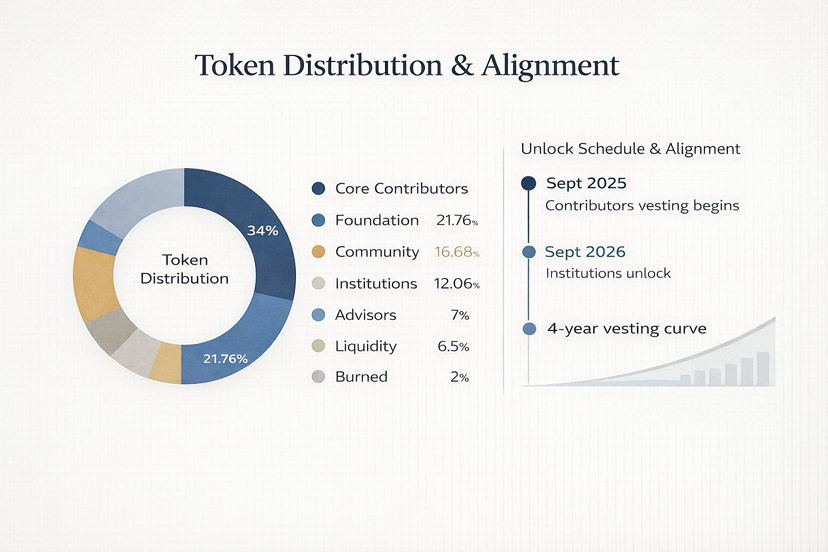
Airdrop Design: Participation Over Exploitation
Fogo’s airdrop framework stands out for its transparency. The distribution is segmented into six categories, rewarding:
Early bridgers (before December 19, 2025)
DEX traders and contest participants
Open-source contributors
Translators
Active Discord participants
The team explicitly addressed Sybil attack mitigation, reducing allocations for wallets linked across Fogo and Ethereum that suggested farming behavior. An appeal process allows users to contest misclassifications, reinforcing procedural fairness.
Many token launches suffer from vague criteria and post-launch disappointment. Fogo’s structured categories and open communication signal an effort to prioritize genuine engagement over opportunistic farming. By publicly addressing Sybil filtering, the team acknowledges abuse risks instead of ignoring them.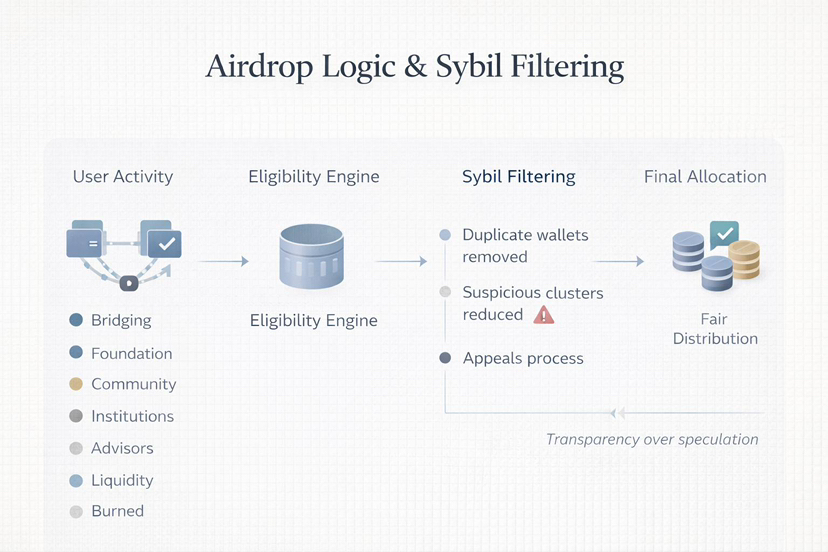
Flames and Flywheel: Incentivizing Engagement
Fogo introduced “Flames,” a points-based participation program launched in late 2025. Season 1 rewarded trading, staking, and bridging. Season 1.5 expanded activities, including bridging WETH or stETH and supplying liquidity to specific pairs.
Importantly, Flames points are not direct token claims. They may influence future allocations but remain separate from monetary guarantees. This distinction reduces regulatory exposure while encouraging ecosystem exploration. The program motivates usage rather than passive speculation.
Complementing Flames is the “Flywheel” initiative. Under this structure, the Fogo Foundation funds promising ecosystem projects, which in turn contribute part of their revenue back to the network. This creates a cyclical value model—similar to venture capital mechanics, but executed on-chain. Although early-stage, the Flywheel aligns builders, users, and the foundation around shared economic growth.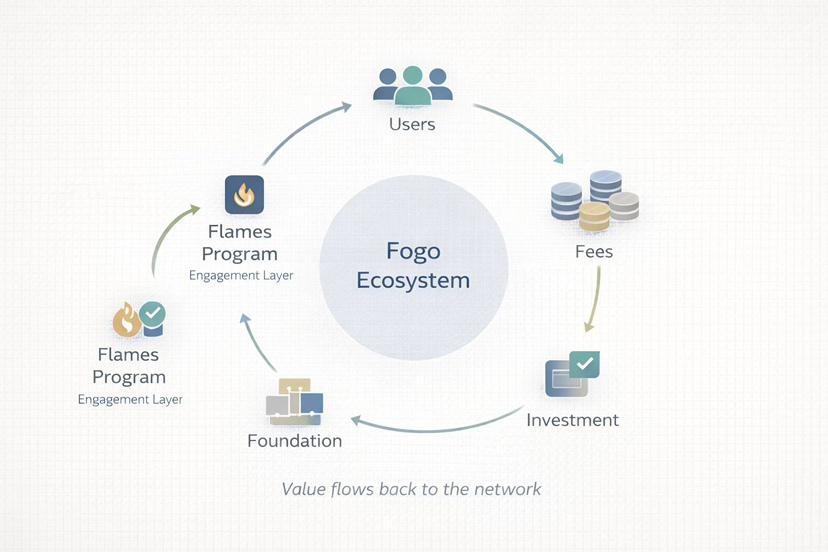
Reliability and Operational Risk
No incentive model is complete without addressing technical risk.
In mid-2025, Fogo’s testnet experienced downtime during geographic zone rotations. Validators temporarily failed to detect the next leader due to rotation logic issues. Although no funds were lost, the incident exposed coordination challenges in a zone-based architecture.
The team responded with improvements to edge caching, RPC routing, and rotation scheduling. Transparency during the incident strengthened credibility, though it underscored the complexity of high-performance distributed systems.
Bridging introduces additional exposure. Fogo integrates with the cross-chain protocol Wormhole, which historically has been targeted across the industry. Users are advised to verify addresses on Fogoscan and bridge cautiously. While selected validators enhance performance, they introduce partial centralization risk. A limited validator set can increase efficiency but may reduce resilience if a subset fails or misbehaves.
These risks are not fatal flaws, but they warrant consideration for developers and traders building on the network.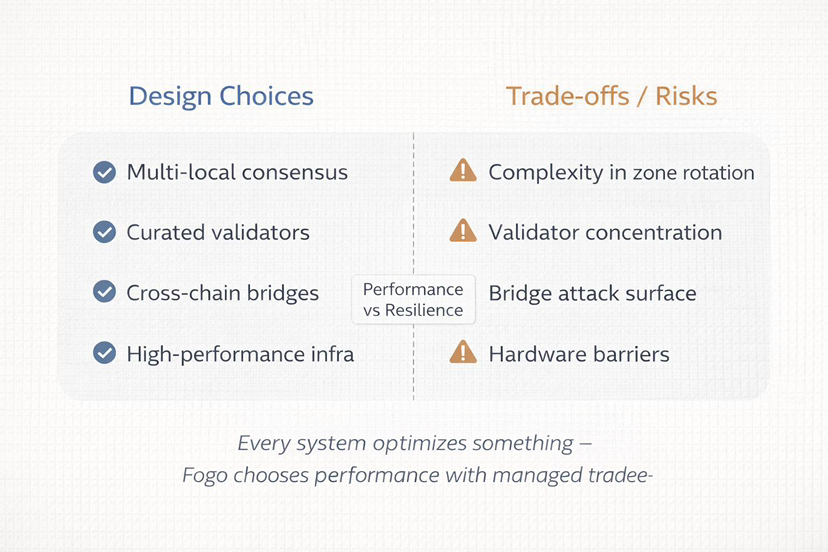
Governance and Philosophy
Fogo currently operates under team-led governance with community engagement. Tokens unlock gradually rather than remaining permanently restricted. Incentives reward active participation, not merely token holding.
The validator selection model is a debated design choice. While it prioritizes execution efficiency, it inevitably reduces decentralization compared to fully permissionless systems. However, the team communicates openly about this trade-off, which is notable in an industry where governance structures are often opaque.
Fogo’s incentive ecosystem encourages usage: staking, bridging, liquidity provision, and application building. Programs like Flames and Flywheel reward contribution and ecosystem growth rather than passive speculation. This fosters a user base invested in network success beyond short-term price movements.
Conclusion: Weighing Ambition Against Risk
Fogo attempts to integrate performance, cross-chain interoperability, usability, and structured incentives within a single framework. Its token distribution model promotes gradual alignment. Its airdrop system rewards authentic participation. Its incentive programs encourage real engagement. Its team addresses technical setbacks publicly.
Challenges remain. Zone-based coordination adds complexity. Bridges inherently carry security risk. Validator selection may limit decentralization. Scalability under increasing cross-chain volume remains unproven.
Yet Fogo demonstrates awareness of these trade-offs. By combining ambitious technical goals with structured incentives and transparent communication, the project positions itself as a serious contender in an increasingly mature DeFi landscape.
It is not a perfect solution to every systemic issue in decentralized finance. However, its deliberate balance between innovation and realism gives it a distinct identity in a crowded field.