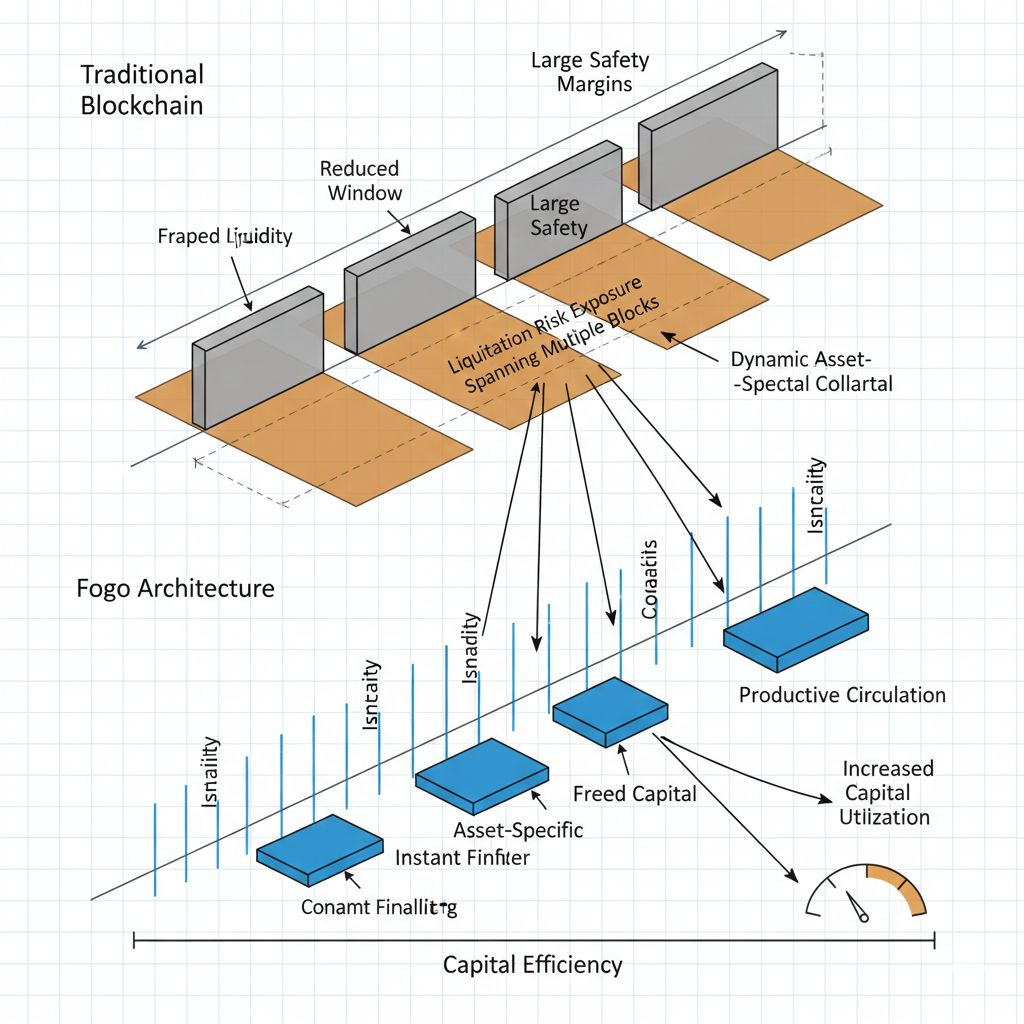
The DeFi evaluation playbook is broken. Analysts still default to Total Value Locked as the primary health indicator, a metric that rewards hoarding over productivity. This framework made sense in the era of Ethereum-mainnet lending, where block times measured in seconds demanded conservative collateralization ratios to absorb volatility between confirmation windows. But Fogo's 40-millisecond finality changes the underlying physics of risk management so fundamentally that applying old evaluation lenses produces active misjudgment.
Consider the hidden cost of reliability. Aave's risk framework deserves its reputation—it's battle-tested, mathematically rigorous, and predictably boring. But that reliability is purchased through capital inefficiency. When liquidation events take multiple blocks to resolve, protocols must mandate over-collateralization buffers that sit dormant, earning nothing, waiting for black swan events that statistically never arrive for most asset classes. It's insurance pricing without actuarial precision, a blanket premium extracted from every participant to cover worst-case scenarios that specific assets may never present.
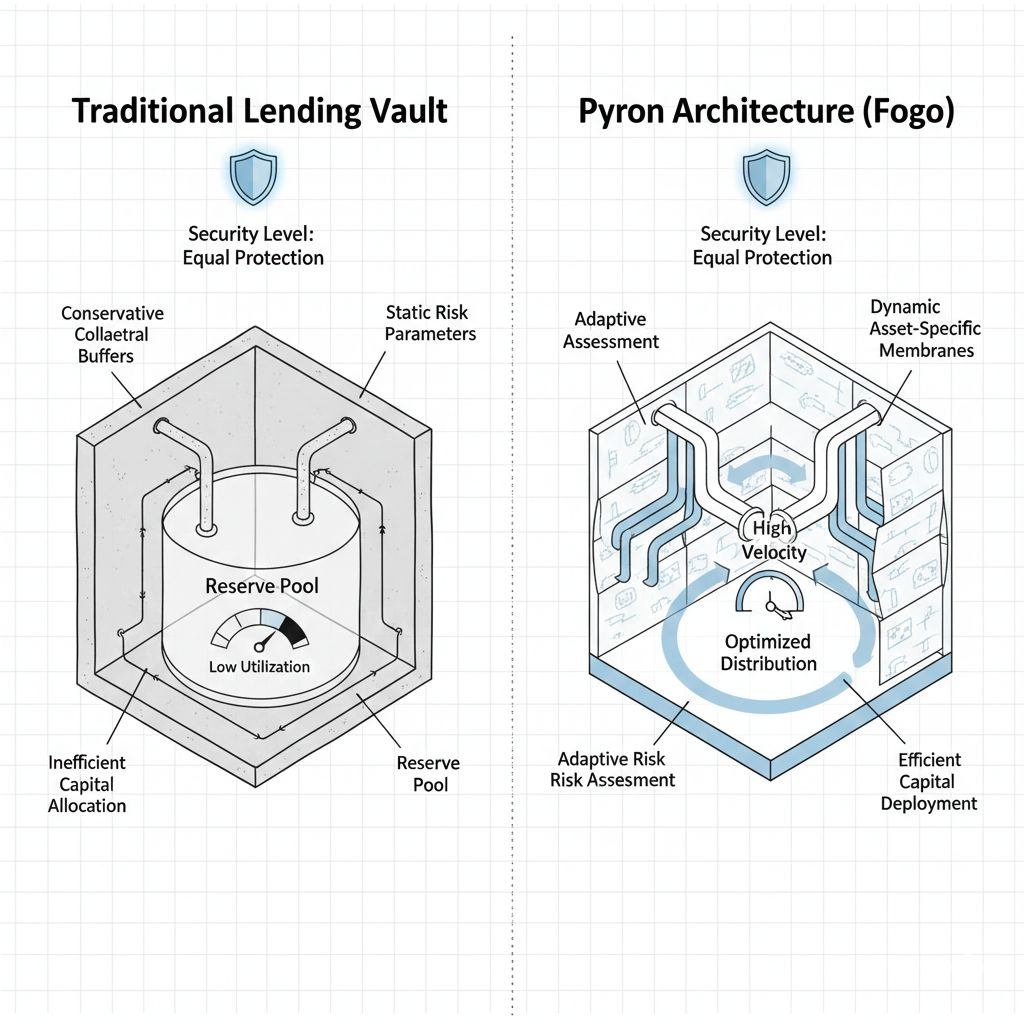
Fogo's architecture enables a different approach entirely. Pyron's asset-specific risk parameters aren't merely a feature—they're a temporal arbitrage on the cost of safety. When blocks finalize in 40 milliseconds, the liquidation window compresses from a probabilistic exposure spanning multiple confirmations to a deterministic event with near-instant execution. This doesn't eliminate risk; it localizes it. Protocols can tune collateral requirements to actual asset volatility profiles rather than network latency constraints. Stablecoins need not subsidize the risk management of speculative tokens. Blue-chip collateral doesn't carry the buffer costs of exotic assets.
The implications for capital efficiency are systematically underappreciated. Traditional metrics compare TVL across protocols as if a dollar locked in Aave equals a dollar locked in Pyron. But utilization rates tell the real story: capital in slow-finality environments must remain underleveraged to survive volatility windows, while Fogo's speed permits higher deployment ratios without proportional security degradation. The relevant metric isn't dollars locked—it's dollars productive per unit of risk assumed. This reframes competitive analysis entirely. A protocol with lower TVL but higher velocity may represent superior economic infrastructure, much as a lean supply chain outperforms a bloated inventory system.
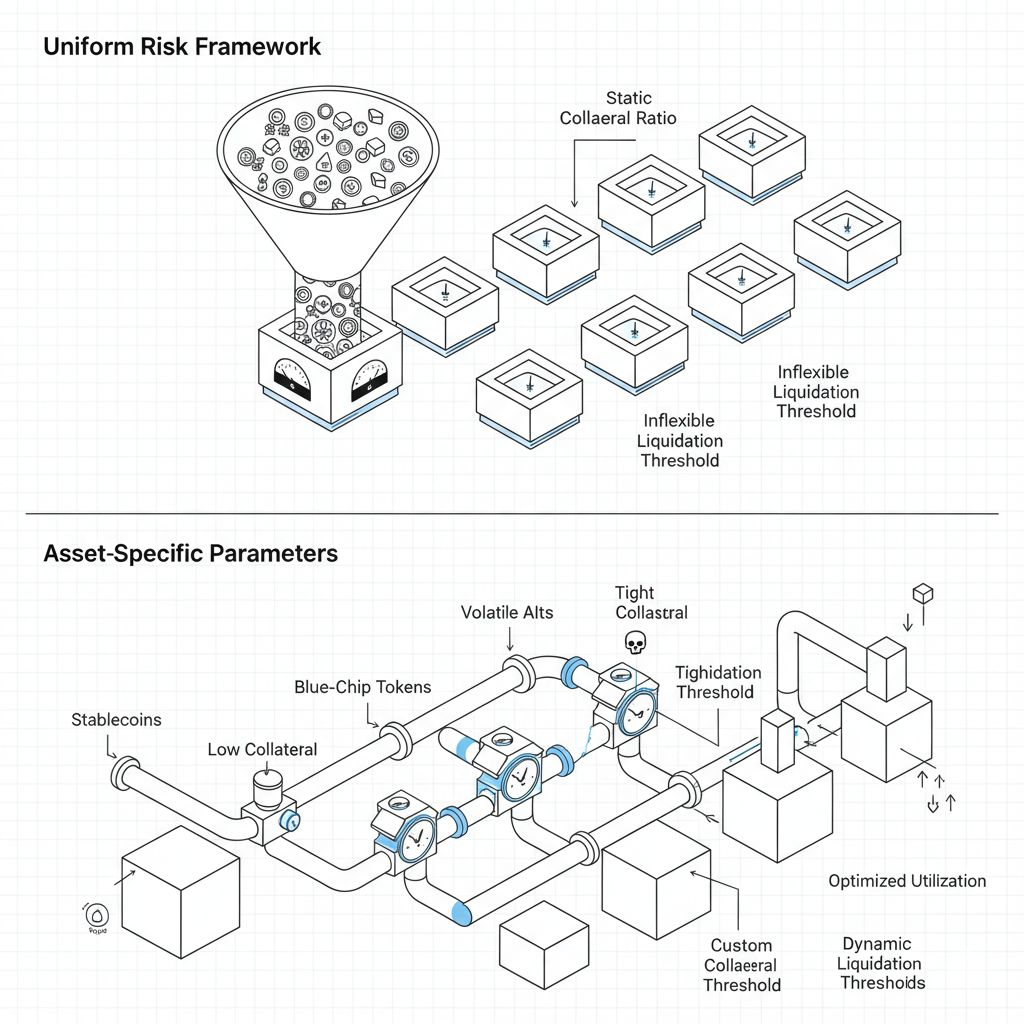
Fogolend extends this logic further, suggesting the model scales beyond single-protocol implementations. When an entire ecosystem shares sub-second finality, risk parameters become composable across money markets rather than siloed within them. The evaluation framework shifts from "how much is locked" to "how fast can safety be re-established"—a dynamic metric that rewards architectural sophistication over conservative stagnation. This isn't an attack on Aave's model; it's an observation that different physical constraints demand different economic optimizations. As institutional capital enters DeFi, the sophisticated allocators won't chase the highest TVL—they'll chase the highest risk-adjusted capital velocity. Fogo's architecture positions its money markets to capture that discerning capital not through marketing, but through measurable structural advantages that only become visible when you stop looking at locked value and start measuring how efficiently it moves.