

In the hyper-competitive world of DeFi, we’ve been conditioned to worship at the altar of raw speed. We celebrate million-TPS throughput and sub-second block times as the ultimate metrics of success. But after spending a week breaking things in the Fogo ecosystem, I’ve realized we’ve been asking the wrong questions. It’s not just about how fast a transaction hits the ledger; it’s about what happens to your capital in the milliseconds before and after that trade.
Fogo isn't just building a faster "highway" for DeFi; they are redesigning the vehicles and the traffic laws themselves. While other Layer 1s are busy trying to replicate the traditional centralized exchange (CEX) experience on-chain, Fogo is pioneering a philosophy centered on Liquidity Efficiency. They are moving away from the era of "Lazy Capital" and into a model where every dollar works harder, stays safer, and yields more for the actual trader.
The Death of the Passive AMM: Why I’m Over "Pools"
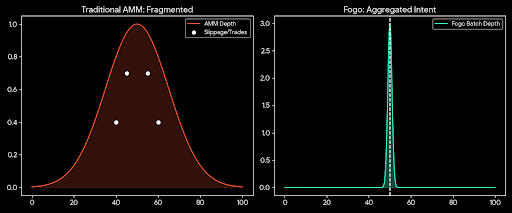
The standard Automated Market Maker (AMM) model the one we've used since the early Uniswap days—is fundamentally broken. It’s inefficient. It spreads liquidity across an infinite price curve, meaning the vast majority of deposited capital is "lazy." It just sits there, collecting dust, waiting for a price swing that may never come. Concentrated liquidity was a band-aid that offloaded the headache to the user, forcing us to babysit positions or get wrecked by impermanent loss.
Fogo takes a radical departure with its Dual Flow Batch Auction (DFBA) model. Instead of continuous, fragmented trading that lets bots pick you apart, Fogo groups orders into discrete batches.
Aggregated Intent: By settling trades in batches, Fogo concentrates all buying and selling power at a specific point in time. This ensures that even with lower gross TVL, the effective liquidity at the execution price is significantly higher than a standard AMM.
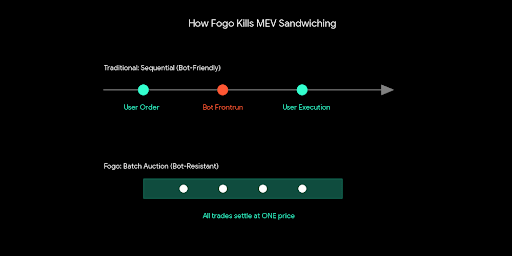
Fair Price Discovery: In a batch auction, everyone in that batch gets the same price. Period. This kills the "first-in-line" advantage that high-frequency bots use to exploit retail traders.
The War on MEV: It’s Not a Bug, It’s a Design Flaw
Most chains treat Maximal Extractable Value (MEV) as an externality—a "tax" you just have to pay to the dark forest. They try to manage it with flashbots or complex off-chain auctions. Fogo treats it as a design flaw to be engineered out of existence. By using the DFBA model, the "ordering" of transactions within a block loses its predatory value. You can't sandwich a trade if the entry and exit prices are determined by the batch's aggregate volume rather than individual sequential hits.
This structural honesty is what caught my attention. It’s not just about the 40ms finality though that feels like trading on a local machine it’s about the fact that those 40ms aren't being weaponized against you.
The Architecture of Expertise: Looking at the Pedigree
When you look at Fogo’s genesis, the involvement of figures from Jump Crypto, Citadel, and Gauntlet starts to make sense. This isn't a project built by "crypto-native" hobbyists experimenting with code in a vacuum; it’s built by people who have spent decades in the plumbing of global high-frequency trading.
Gauntlet’s expertise in risk modeling is particularly visible here. In traditional lending protocols, liquidations are often clunky and "lumpy," leading to bad debt and protocol insolvency. On Fogo, the high-performance base layer allows for more granular, real-time risk adjustments. This means lower collateral requirements for users without increasing the systemic risk to the protocol. It’s a delicate balance that requires a deep understanding of market micro-structures.
The Honest Limitation: Speed Without Depth is Just a Fast Car in a Small Garage
For all its technical brilliance, Fogo faces the same "cold start" problem as every new ecosystem: Depth. Currently, with a price hovering around $0.027 and daily volumes near $26 million, Fogo is in its "early adopter" phase. The architecture is built for billions in volume, but the current reality is still catching up.
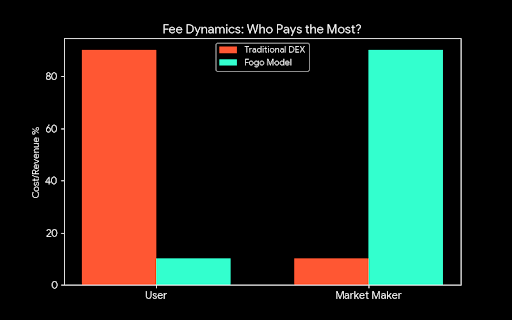
However, the incentive structure is what will likely bridge this gap. Because market makers on Fogo pay for "access" to batches rather than users paying exorbitant fees to market makers, the cost-to-trade is fundamentally lower. As liquidity deepens, this virtuous cycle should accelerate.
Redefining the User Experience: Session Keys and Seamless Flow
One of the most immediate "quality of life" upgrades I experienced on Fogo was the implementation of Session Keys. In the old world of DeFi, every single action approving a token, swapping, adding collateral required a manual wallet confirmation. This "click-and-wait" fatigue is the silent killer of active trading.
Fogo’s session keys allow you to grant temporary, scoped permissions for a specific window of time. You set the parameters, and for that session, the chain keeps up with your intent without the friction of constant pop-ups. It transforms the feeling of "interacting with a blockchain" into the feeling of "using a high-end trading terminal." When combined with that 40ms finality, the psychological barrier to complex, multi-leg trades simply evaporates.
The Institutional Pivot: Built for the Next Wave
The next trillion dollars entering crypto won't come from retail traders chasing 100x memes; it will come from institutional desks looking for capital efficiency and regulatory-friendly execution. Fogo’s model is tailor-made for this. By eliminating the dark-forest risks of MEV and providing a predictable, batch-based settlement, they are offering an environment that looks much more like the sophisticated markets of Wall Street—but with the transparency and permissionless nature of Web3.
The team's background at JPMorgan and State Street isn't just a marketing line; it's a roadmap. They aren't trying to build a playground; they are building a clearinghouse. This institutional-grade focus on "Risk-Adjusted Speed" is the unique differentiator.
The Market's Verdict
Fogo is a bet on the idea that DeFi users will eventually value fairness and efficiency over raw, unoptimized speed. It’s a bet that the future of finance isn't just "on-chain," but "re-engineered on-chain."
The tech is ready. The team is elite. The architecture is a masterclass in market design. Now, the mission is simple: attract the developers and the volume to prove that this "Liquidity Thesis" holds water under the pressure of a global bull run. If the ecosystem scales, Fogo won't just be another L1 it will be the blueprint for the next generation of financial infrastructure.