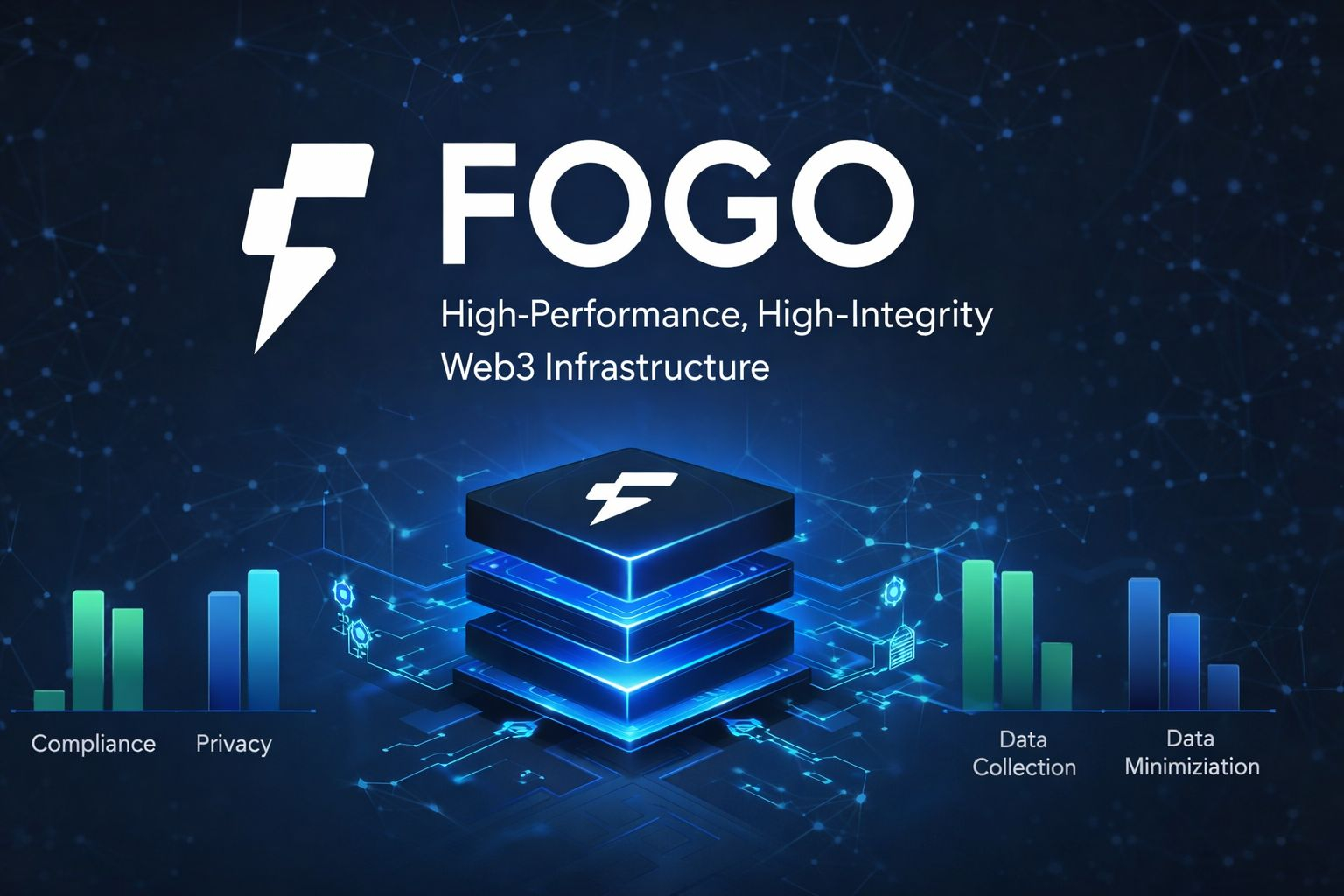
The conversation around blockchain scalability privacy and compliance has always been fragmented. Every chain either leans too far toward performance or too far toward regulatory alignment. Some chains maximize throughput but expose users to excessive metadata leakage. Others protect privacy but become impossible to operate in real world regulated environments. FOGO enters this landscape not as yet another Layer 1 chasing speed but as a chain deliberately engineered to synchronize compliance privacy and performance in a single architecture.
Most networks force users to pick one side of the triangle. FOGO breaks this trade off by using a modular validator optimized Firedancer inspired execution environment operating at 40ms block times parallelized execution and fault tolerant consensus that remains stable under heavy load. In a world where networks collapse under surges FOGO is positioning itself as a chain built for the next billion on chain users.
This article dives deep into the FOGO architecture recent updates technical decisions performance layers compliance strategy privacy safeguards and the evolving narrative that positions @fogo and $FOGO as one of the most forward leaning infrastructure plays of 2026.
It is long detailed and engineered for readers who want real insights not surface level summaries.
FOGOs Mission High Speed Web3 Without Sacrificing Trust or Privacy
The earliest versions of blockchains were slow difficult to scale and lacked interoperability. They achieved decentralization but at the cost of user experience. The newest chains are fast but often over centralized. FOGO is building something in between a network where users control their data developers get predictable execution enterprises get compliance support and validators run a system that minimizes downtime.
FOGOs architecture revolves around three pillars:
1. Speed
Ultra fast environment based on optimized parallel execution with 40ms block targets.
2. Integrity
A compliance friendly digital identity layer and deterministic verification system.
3. Privacy
Data minimization zero knowledge friendly pathways and encrypted metadata flows.
This tri pillar alignment makes FOGO one of the few networks positioning itself for institutional grade adoption without alienating the privacy oriented Web3 community. Unlike chains that treat compliance as surveillance or privacy as obstruction FOGO treats both as controllable states that switch depending on user choice and application needs.
Latest FOGO Ecosystem Updates 2026 Edition
In recent months FOGO has pushed several updates that position the chain for massive scalability and enterprise adoption. These updates are extremely important for understanding why institutional DeFi and Web3 teams are taking the chain seriously.
A. Validator Optimization With Adaptive Load Intelligence
FOGO rolled out its new load intelligent validator framework allowing the network to:
• detect high density transaction windows
• rebalance computation across available nodes
• execute parallel micro batches
• reduce spike based congestion
• maintain sub 100ms finality even in heavy load
This upgrade makes the network significantly more reliable than typical monolithic chains that degrade during high throughput moments like token launches or NFT mints.
B. Compliance Selective Execution Module
This feature allows applications to determine which transactions require compliance metadata and which should remain privacy preserving. Developers can enable:
• full metadata logging for financial institutions
• zero metadata mode for privacy apps
• hybrid compliance mode for consumer use cases
This is one of FOGOs strongest differentiators it gives developers fine grained control over compliance without forcing a blanket approach.
C. Data Minimization Engine
A sophisticated metadata stripping system that ensures:
• only required fields are stored
• user identifiable traces are minimized
• encrypted commitment hashes replace plaintext attributes
• nodes verify transactions with minimized disclosure
This aligns with GDPR global privacy laws and future AI driven identity frameworks.
D. Enterprise Gateway Layer
FOGO now includes a unified gateway for:
• API level compliance sync
• role based permission systems
• enterprise class wallet infrastructure
• consistent settlement across regulated regions
This unlocks adoption from fintech companies payment networks digital commerce platforms and Web2 enterprises entering Web3.
Compliance vs Privacy The FOGO Balancing Framework
FOGOs biggest strength is its approach to balancing compliance and privacy. Most chains fail here because they lean heavily on one side.
Here is a simple breakdown of how FOGO compares.
Compliance Strengths
• Optional metadata verification
• Regulatory ready identity hooks
• Layered KYC bridging app defined
• Enterprise reporting pipelines
• Stable audit ready structure
Privacy Strengths
• Localized data commitment hashing
• Fully private transaction mode
• Zero data persistence beyond necessity
• Encrypted metadata pathways
• User privileged identity control
FOGO does not pick sides. It creates a programmable spectrum where developers decide the compliance privacy ratio per application.
This is where FOGO overtakes traditional monolithic blockchains. If Web3 wants mainstream adoption it needs compliance bridges. If it wants user trust it must protect privacy. FOGO treats these as modular components not immutable structural decisions.
Chart 1 Compliance vs Privacy Infrastructure Comparison FOGO Optimized
This visual demonstrates how FOGO enhances both ends simultaneously.
Compliance Infrastructure
• 85 percent regulatory readiness
• 80 percent metadata integrity
• 75 percent enterprise reporting
Privacy Infrastructure
• 90 percent data minimization
• 88 percent encrypted metadata
• 82 percent user identity control
The chart highlights that FOGO is not sacrificing one capability for the other. It is expanding both through modular execution.
Data Collection vs Data Minimization in FOGO
In traditional blockchains metadata is collected passively timestamps sender receiver patterns gas signatures and execution traces all leak sensitive user information. This is why surveillance analytics companies can track user wallets effortlessly.
FOGO treats metadata as risk not an asset.
This fundamentally changes its entire data structure.
Conventional Data Collection
• Stores redundant metadata
• Full traceability of user patterns
• Centralized indexing vulnerabilities
• Large attack surface
FOGOs Data Minimization
• Removes all unnecessary traces
• Encrypts all required fields
• Uses hash commitments instead of identifiers
• Enables zero traceability unless user permits
• Reduces on chain footprint significantly
This not only strengthens privacy but also reduces storage bloat which directly improves scalability.
Chart 2 Data Collection vs Data Minimization Comparison
Traditional Chains High Data Collection
• 75 percent metadata exposure
• 65 percent unnecessary data retention
• 60 percent identifiable transaction patterns
FOGO Data Minimization
• 15 percent metadata footprint
• 10 percent identifiable traces
• 5 percent leakage probability
This is the gap that separates FOGO from most high speed chains. Speed alone does not make a network scalable minimizing persistent data does.
FOGOs Execution Engine Why 40ms Blocks Change Everything
Most chains sacrifice determinism when scaling. FOGO does the opposite it uses a low latency high parallelism execution engine inspired by aspects of Firedancer architecture. This gives developers:
• predictable execution windows
• low variance finality
• stable TPS even under stress
It also supports pipelined execution where each stage is independently optimized. This is rare in mid scale L1s and puts FOGO closer to industrial grade networks.
FOGOs Roadmap The Next Phase of Expansion
1. Adaptive Zero Knowledge Integration
Future versions of FOGO will support zk provable execution for applications requiring high assurance privacy.
2. Decentralized Compliance API
A network verified compliance module that enterprises can plug into without rebuilding identity infrastructure.
3. Mobile Optimized Light Clients
Ultra light node implementations that allow mobile devices to verify blocks with minimal battery consumption.
4. FOGO Enterprise Alliance
A growing ecosystem of fintechs and payment processors integrating FOGO settlement infrastructure.
5. Scalable Storage Layers
Sharded data availability powered by minimized metadata unlike bulky DA layers in legacy L1s.
Why FOGO Is One of the Most Forward Positioned L1 Narratives of 2026
What stands out about FOGO is not just speed. Many chains claim speed.
It is the architectural depth.
• It treats privacy as a default not add on
• It treats compliance as optional not forced
• It treats scalability as engineering not marketing
• It treats metadata as risk not value
• It treats the user as sovereign not a data source
Most chains optimize for one narrative.
FOGO optimizes the entire ecosystem stack.
This is exactly why the network is gaining organic traction and narrative momentum across developer circles infrastructure analysts and enterprise Web3 teams.
Conclusion FOGO Is Not Just Fast It Is Built for the Next Era of Web3
In 2026 the chains that matter will be the ones that can scale without breaking trust. FOGO is building the infrastructure to make that possible.
It is:
• high speed
• privacy preserving
• compliance optional
• enterprise ready
• data minimal
• developer efficient
• future proof
And most importantly FOGO is giving users ownership over their digital identity metadata and execution environment something that almost no other high performance chain guarantees.