We keep saying Web3 is about coordination. Decentralized coordination. Trustless systems. Shared ownership.
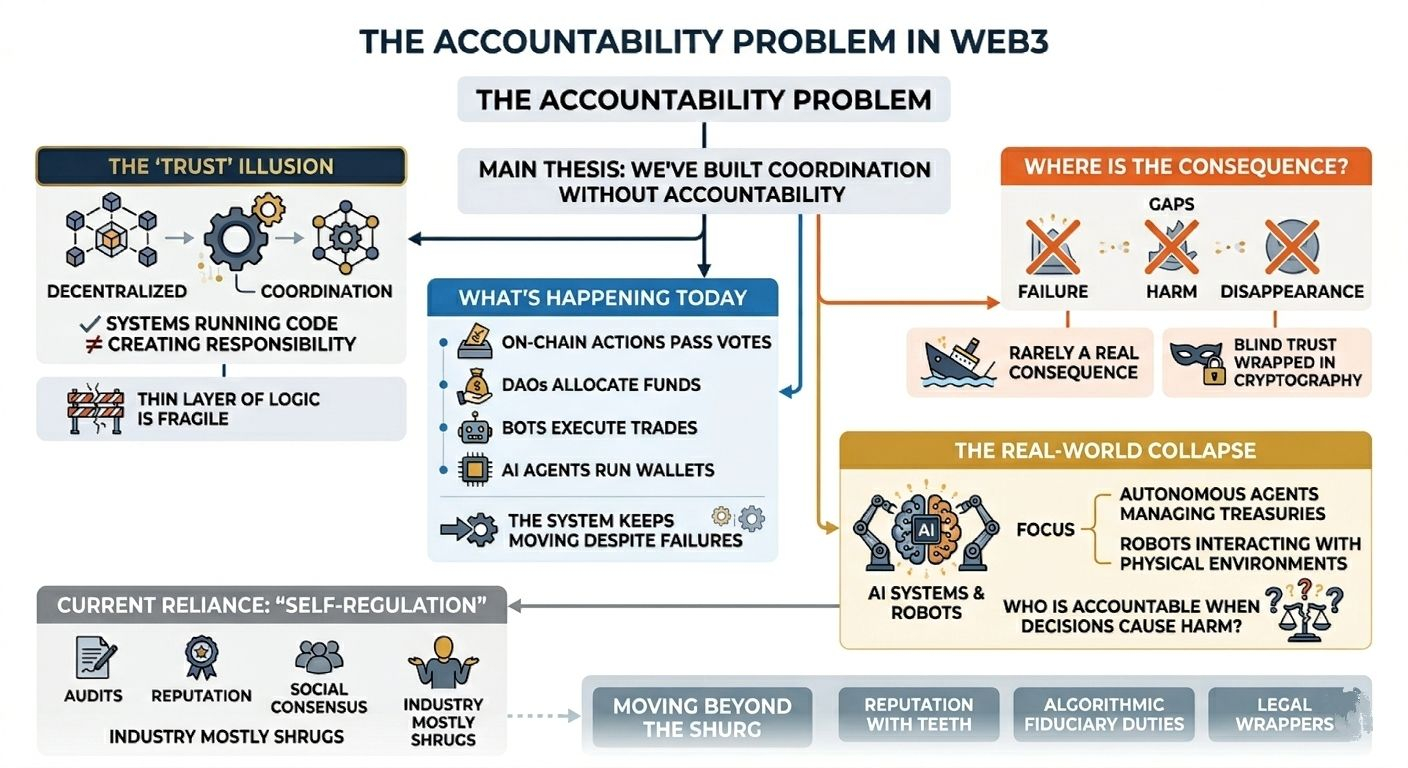
But if we’re honest, what we’ve really built is coordination without accountability.
Things happen on-chain. Votes pass. DAOs allocate funds. Bots execute trades. NFTs promise access. AI agents now run wallets and interact with contracts. And when something breaks, disappears, or quietly fails, there’s rarely a real consequence. The system keeps moving. The dashboard still shows activity. The narrative doesn’t pause.
We talk about decentralization like it automatically creates responsibility. It doesn’t.
Most of the infrastructure assumes that if code runs, that’s enough. If a proposal passes, that’s governance. If an agent signs a transaction, that’s consent. But once AI systems and robots start interacting with these networks, that thin layer of logic starts to look fragile.
Coordination without accountability works fine in speculation cycles. It falls apart in the real world.
Imagine autonomous agents managing treasuries. Or robots interacting with physical environments based on on-chain instructions. Or AI systems collaborating across DAOs. Who is accountable when decisions cause harm? When incentives misalign? When data is manipulated? When something acts unpredictably?
Right now, the industry mostly shrugs. We rely on audits, reputation, or vague social consensus. We call it “self-regulation.” In reality, it’s blind trust wrapped in cryptography.
This is where projects like Fabric Protocol and $ROBO feel less flashy and more necessary.
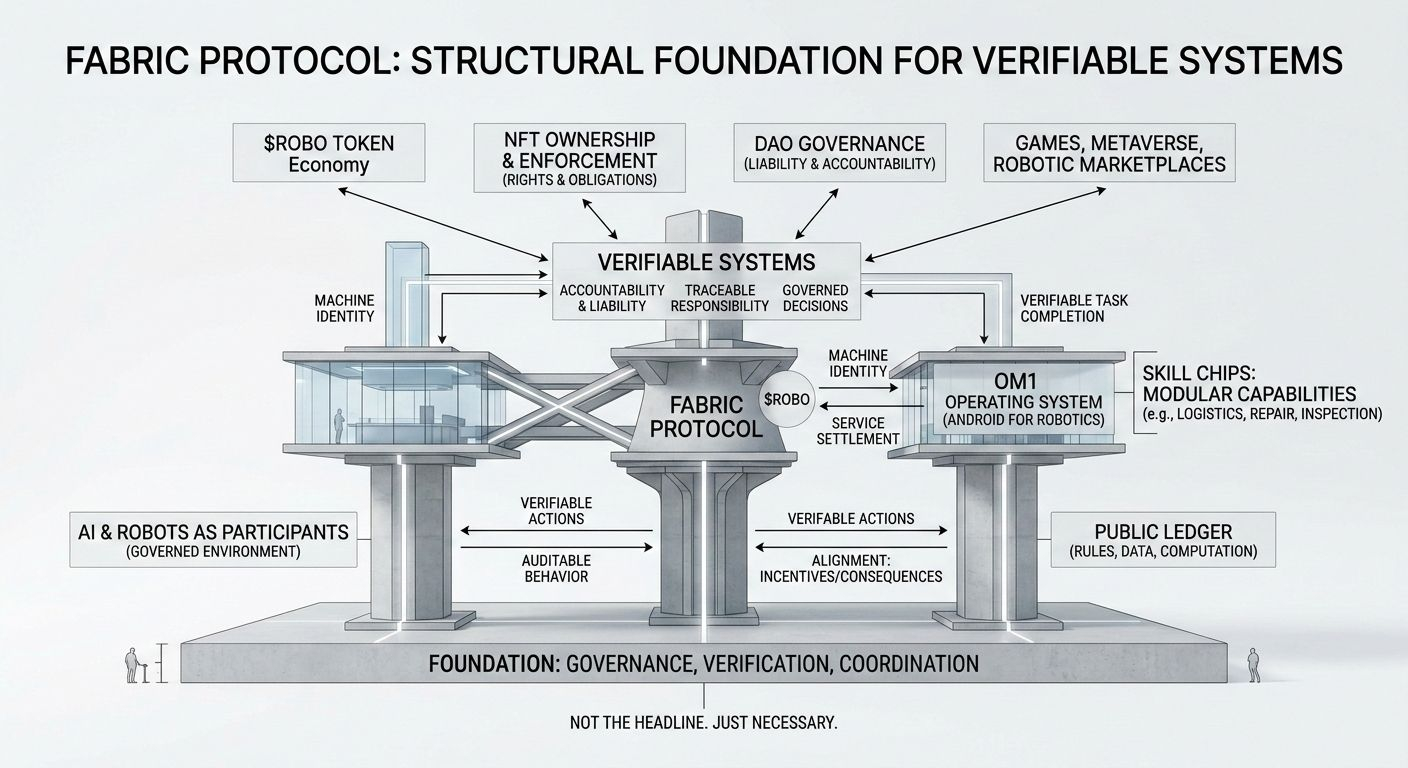
Fabric Protocol, supported by the Fabric Foundation, is trying to build an open network where robots and AI agents aren’t just connected to blockchains, but governed through verifiable systems. Not just execution, but accountability. Not just coordination, but traceable responsibility.
The idea isn’t glamorous. It’s structural.
If machines are going to operate in shared digital and physical spaces, there needs to be a public layer that records what was computed, why it was computed, and under what rules. Not just transactions, but decisions. Not just ownership, but obligations.
Fabric coordinates data, computation, and regulation through a public ledger. It treats robots and AI agents as participants in a governed environment, not as isolated tools. That means actions can be verified. Behavior can be audited. Incentives can be aligned with consequences.
It’s less about speed and more about structure.
And that matters more than we like to admit.
NFTs, for example, are often framed as ownership primitives. But ownership without enforcement is just a database entry. If AI agents start licensing content, generating derivative works, or interacting with tokenized assets, we need systems that define rights and responsibilities clearly.
DAOs talk about collective governance, but most still rely on informal trust and patchwork tooling. If autonomous agents begin voting, executing strategies, or coordinating capital, the governance layer can’t remain loose and symbolic. It needs mechanisms that define liability and accountability.
Games, metaverse platforms, robotic marketplaces. All of it becomes more fragile when intelligent systems act at scale without verifiable constraints.
Fabric doesn’t solve everything. It’s not pretending to. But it acknowledges something most of Web3 avoids: decentralization doesn’t remove responsibility. It redistributes it. And redistribution requires structure.
We don’t just need more throughput or better UX. We need systems where actions have context, where incentives are tied to consequences, and where machines operating on-chain are accountable in ways humans can understand.
Web3 doesn’t grow up by getting louder. It grows up by getting stricter about responsibility.
If AI and robotics are going to merge with crypto infrastructure, the quiet work of governance, verification, and coordination under rules becomes the foundation. Not the headline.
Fabric Protocol feels like an attempt to build that foundation. Not exciting. Not noisy. Just necessary.
$ROBO @Fabric Foundation #ROBO