
In the quiet labs of Silicon Valley and the buzzing server farms of decentralized networks, a revolution is brewing—not in the code of a single AI model, but in the very fabric of how machines will live, work, and interact with us. This is the story of the Fabric Foundation, a nonprofit born from the minds at OpenMind, that's quietly laying the groundwork for what they call the "Robot Economy." It's a world where robots aren't just tools in a factory or curiosities in a tech demo; they're autonomous agents with identities, wallets, and a stake in the global economy. But why build this now? And why decentralize it? To understand, we have to step back and trace the threads of innovation, risk, and human ambition that weave this vision together.
Picture this: It's 2030, and your morning coffee isn't delivered by a drone from a mega-corp like Amazon, but by a fleet of humanoid robots coordinated through an open network. These bots don't report to a central HQ in Seattle; they negotiate tasks, share data, and even pay each other for energy or repairs using cryptocurrency. No single company owns the system—it's governed by a global community of developers, users, and even the machines themselves. This isn't science fiction; it's the long-term bet of Fabric Foundation, and their native token is the fuel making it possible. But to grasp the "why," we need to contrast it with the world we're hurtling toward without such a system: a centralized robot landscape dominated by a few giants, where innovation stalls, privacy erodes, and power concentrates in fewer hands.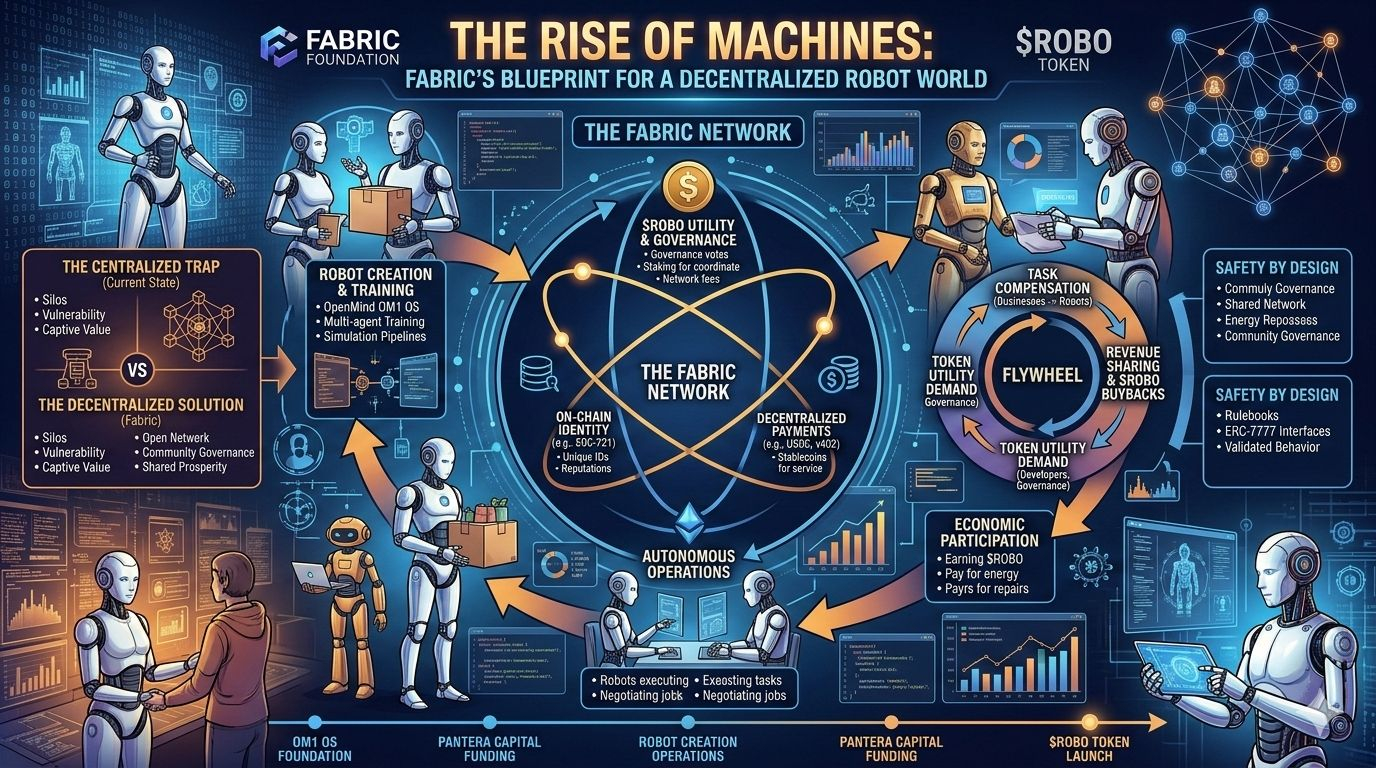
The Centralized Trap: Lessons from the Past
Today's robots—from Boston Dynamics' acrobatic Spot to Tesla's Optimus—are marvels of engineering, but they're silos. Each is locked into its maker's ecosystem: proprietary software, closed data sets, and hardware-specific controls. Imagine if the internet worked like that—every website only accessible through one browser, owned by one company. We'd still be in the AOL days, not the open web era. Centralized robot platforms promise efficiency, but they deliver dependency. Companies like Google or SoftBank pour billions into robotics, yet their bots can't easily "talk" to each other across brands. A Spot dog might excel at warehouse navigation, but integrating it with an Optimus for a collaborative task? That's a coding nightmare, requiring custom bridges and endless permissions.
This centralization breeds vulnerabilities. Remember the 2021 Colonial Pipeline hack? A single point of failure shut down fuel supplies across the U.S. East Coast. Now scale that to robots: a cyberattack on a centralized fleet could paralyze hospitals, factories, or entire cities. And then there's the economic angle. In a closed system, profits flow upward to shareholders, not outward to creators or users. Robots generate value—through labor, data collection, or even creativity—but that value gets captured by the platform owners. Workers displaced by automation? They're left out. Innovators wanting to build on top? They pay hefty fees or get shut out entirely.
Fabric Foundation sees this as a dead end. Founded by the team behind OpenMind—an AI collective pushing open-source robotics—the nonprofit isn't just critiquing; it's building an alternative. Drawing from blockchain's playbook, Fabric envisions a decentralized network where robots operate as peers in an open economy. No gatekeepers, no single points of failure. Instead, a "fabric" of interconnected protocols that anyone can contribute to, verify, and benefit from. It's like Linux for robots: hardware-agnostic, community-driven, and infinitely extensible.
Why Robots Need Their Own Economy: Payments, Identity, and Governance
Robots aren't static machines; as AI advances, they're becoming autonomous agents capable of decision-making in the real world. They navigate traffic, handle delicate surgeries, or explore disaster zones. To do this effectively, they need three pillars: payments, identity, and governance—things humans take for granted but machines lack.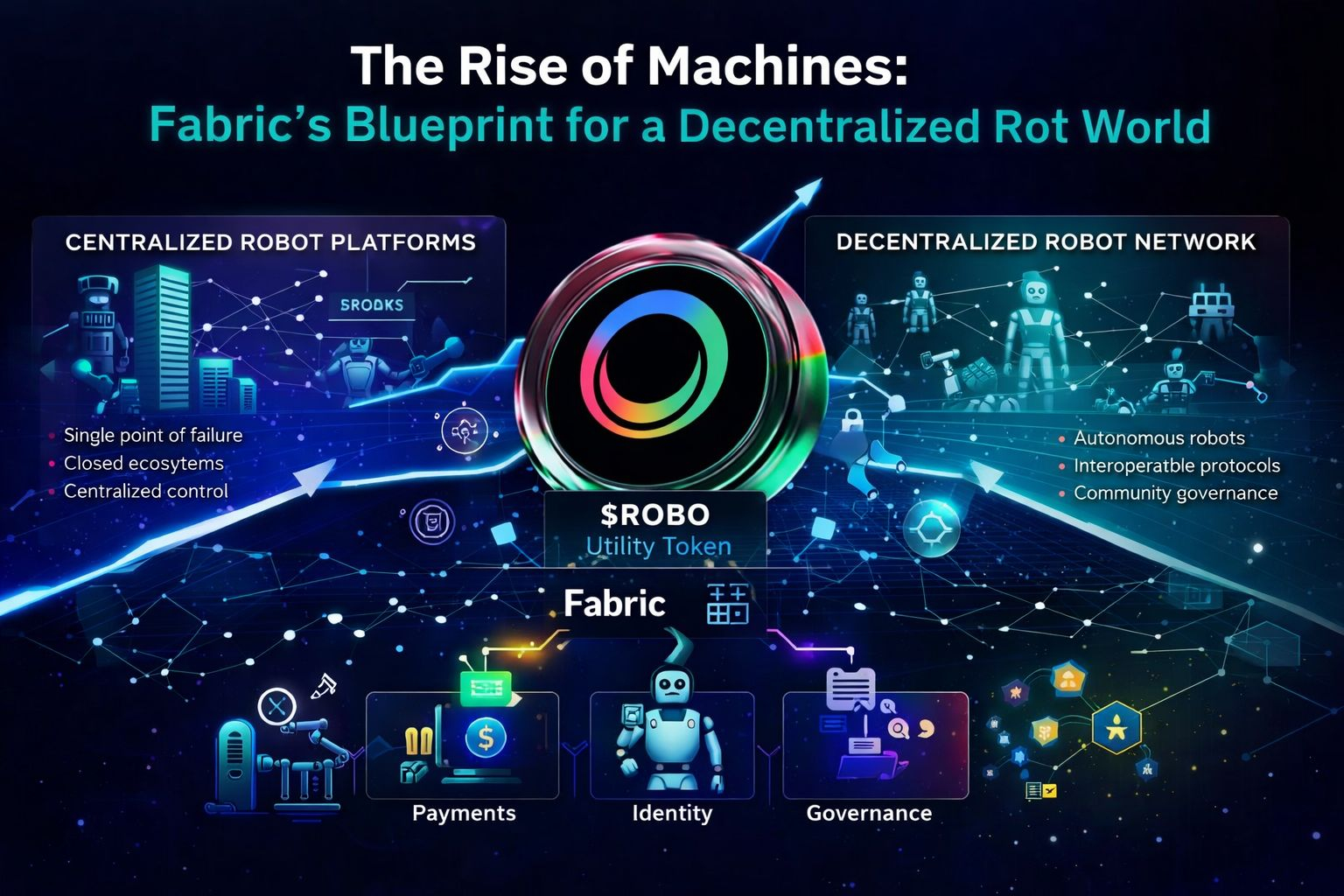
First, payments. In a robot economy, bots won't just consume resources; they'll trade them. A delivery robot might pay a charging station for electricity, or compensate a data provider for real-time traffic updates. Traditional finance won't cut it—robots can't open bank accounts or swipe credit cards. Enter cryptocurrency: fast, borderless, and programmable. Fabric integrates stablecoins like USDC via protocols like x402, allowing machines to transact seamlessly. Network fees and incentives flow through the native token, funding development and rewarding contributors.
Identity is the second pillar. Every bot gets an on-chain identity—a cryptographic passport tied to verifiable logs of actions, locations, and interactions. This trust-minimization approach, built initially on Base (an Ethereum layer-2 chain) and eventually its own L1, ensures identities are tamper-proof and interoperable. A robot built by one company can join a fleet from another, sharing skills without friction.
Governance ties it all together. Who decides the rules? Centralized platforms leave it to CEOs and boards. Fabric flips the script: token holders vote on policies, from fee structures to safety protocols. It's DAO meets robotics. Early contributors stake to coordinate robot "genesis," gaining priority in task allocation. As the network grows, developers stake to build apps, aligning incentives around shared success.
The Fuel Layer Powering It All
At the heart of this system is the native token—more than just a coin, it's the economic engine. Launched with a 10 billion supply, it's utility-first. Network fees are paid in it. Staking for coordination uses it. Governance votes require it. This creates a flywheel: as robot adoption ramps up, transaction volume surges, driving demand. 40% of initial allocations went to communities like KaitoAI, Virtuals, and Surf, rewarding early believers. The rest funds ecosystem growth, with vesting for core teams.
Combined with OpenMind's OM1 OS—already hardware-agnostic—the coordination layer enables multi-agent fleets that learn together and adapt on-edge. Pantera Capital's $20M raise in 2025 signals serious belief in the shift from closed labs to open infrastructure.
The Long-Term Vision: A Machine Economy for Humanity
Zoom out, and Fabric's ambition crystallizes: a world where machines augment humanity, not replace it. Robots handle the mundane, freeing us for creativity. Safety-by-design is core—rulebooks interleave constraints into AI loops, ERC-7777 interfaces make governance verifiable, and decentralization democratizes access: anyone can contribute data, compute, or skills and earn rewards.
Challenges remain: regulation, ethics, scalability. Fabric addresses them with an eventual dedicated L1, Circle partnerships for payments, and simulation-to-real pipelines for safe testing.
As we stand on the cusp of this era, Fabric Foundation reminds us that technology's path isn't inevitable. Centralized giants might dominate if we let them, but decentralization offers a choice: an open, equitable robot world. Whether you're a developer, a business hiring bot labor, or an investor, the Robot Economy is emerging—and Fabric is weaving its foundations.
In the end, this isn't just about robots—it's about us. Will we build a world where machines serve all, or a few? Fabric bets on the former, and their decentralized network might just make it reality. As one early contributor put it: "The autonomous future should benefit all of humanity." Time will tell, but the blueprint is compelling.