
In a world where artificial intelligence and robotics are no longer the stuff of science fiction but integral parts of our daily lives, the Fabric Foundation stands out as a beacon of innovation and inclusivity. Founded with the mission to advance open robotics and artificial general intelligence for the benefit of all humanity, this non profit organization is paving the way for a decentralized robot economy. At the heart of this ecosystem lies the $ROBO token, a utility and governance asset that’s capturing the attention of crypto enthusiasts and tech visionaries alike. Follow @FabricFND for the latest updates on this groundbreaking project.
The Vision Behind Fabric Foundation
Imagine a global network where anyone can contribute to building, governing, and evolving general-purpose robots. That’s the core idea driving the Fabric Foundation. By leveraging blockchain technology, the foundation creates a platform that coordinates data, computation, and oversight through public ledgers. This ensures verifiable contributions and broad participation, making robotics accessible beyond big corporations.
As robots become more capable handling tasks from household chores to complex industrial operations society needs infrastructure for safe, verifiable human machine interactions. Fabric addresses this by initially deploying on the Base network, with plans to evolve into its own Layer 1 chain. This shift will capture economic value from robot activities, fostering a truly open ecosystem.

The image above illustrates a futuristic robot seamlessly integrating into everyday life, vacuuming a bedroom a glimpse into the practical applications Fabric aims to enable.
Introducing $ROBO: The Fuel of the Robot Economy
$ROBO isn’t just another cryptocurrency; it’s the linchpin of the Fabric network. As the core utility token, it aligns incentives across participants, from developers to robot operators. Here’s how it works:
• Network Fees and Payments: All transactions, including payments for robotic labor, identity verification, and on-chain activities, are settled in $ROBO. Since robots can’t hold traditional bank accounts, crypto wallets become essential.
• Crowdsourced Coordination: Participants stake $ROBO to coordinate robot hardware activation and genesis, gaining priority access to tasks. This creates buy pressure as protocol revenue acquires more tokens.
• Ecosystem Entry: Builders and businesses must stake $ ROBO to develop applications on the network, ensuring alignment with long-term success.
• Governance: Token holders influence key decisions, like fee structures and policies, democratizing the direction of robotics advancement.
Launched recently on major exchanges like Coinbase and Binance, $ROBO has seen impressive traction, with a current price hovering around $0.038 and a market cap exceeding $83 million. The ongoing airdrop claim portal, open until March 13, 2026, allows eligible users to secure their share, further boosting community engagement.
Tokenomics: A Balanced Approach for Sustainable Growth
Fabric’s token allocation is thoughtfully designed to prioritize ecosystem growth while rewarding contributors. With a total supply of 10 billion $ROBO, the breakdown ensures long-term viability:
• Investors (24.3%): Vested over 36 months after a 12-month cliff.
• Team and Advisors (20%): Similar vesting to align with project success.
• Foundation Reserve (18%): 30% unlocked at token generation event (TGE), remainder over 40 months.
• Ecosystem and Community (29.7%): Partially unlocked at TGE, with mechanisms like Proof of Robotic Work to incentivize participation.
• Community Airdrops (5%): Fully unlocked at TGE to kickstart adoption.
This structure funds development, reserves resources for the foundation, and aligns stakeholders through vesting periods.
Building a Decentralized Robotics Network
At its core, Fabric promotes composable intelligence and trust-minimized execution. Developers can build interoperable agents that share infrastructure, unlocking new possibilities in AI-robotics integration. As adoption grows, the network will handle everything from skill development to task validation, all rewarded in $ROBO.
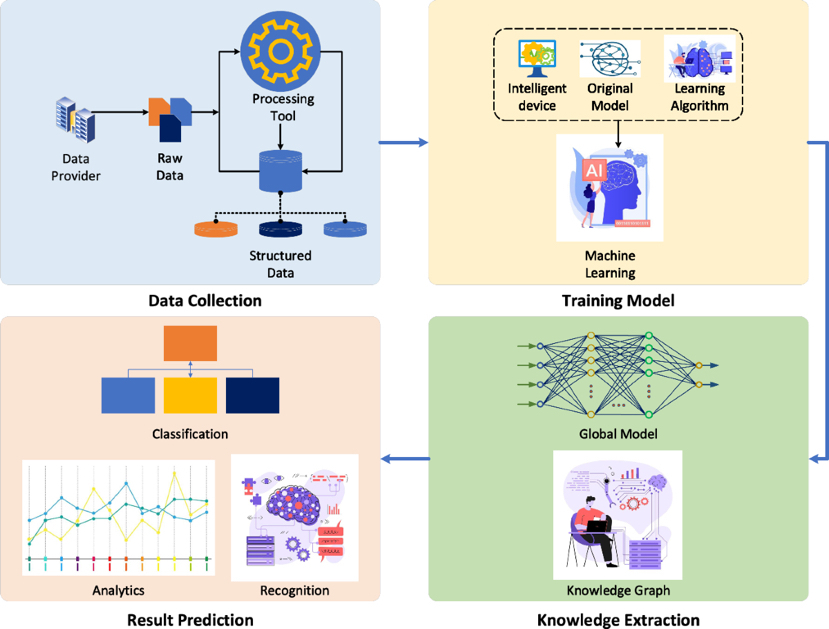
Consider the diagram below, which outlines a decentralized AI network mirroring Fabric’s approach to data collection, model training, and knowledge extraction. This ensures transparency and scalability in robotic operations.
Why $ROBO Matters in 2026 and Beyond
2026 is shaping up to be a pivotal year for robotics, with converging standards and increasing capital investment. Fabric Foundation is at the forefront, ensuring that advancements benefit humanity broadly rather than a select few. By owning a piece of the robot economy through $ROBO, participants aren’t just investing they’re contributing to a future where robots enhance lives globally.
Whether you’re a developer staking for access, a business integrating robotic solutions, or an investor eyeing growth potential, $ROBO offers a gateway to this transformative space. With strong partnerships like @openmind_agi and recent listings on top platforms, the momentum is undeniable.
In conclusion, the Fabric Foundation and $ROBO represent more than a tech project; they’re a movement toward an open, equitable robotic future. Dive in, stake your claim, and be part of the revolution.
