
If $ROBO standardized robot skill NFTs across manufacturers, would factories become composable liquidity pools of machine capability?
When Machine Skills Become Liquid
Last week I tried to book a small fabrication job through an online manufacturing platform. I uploaded a CAD file, watched the loading spinner hesitate for two seconds longer than usual, and then the quoted price jumped 14%. No explanation. No visible constraint change. Just a backend recalculation I didn’t authorize. The UI refreshed. A new delivery estimate appeared. Somewhere, a machine schedule shifted. Somewhere, a pricing model reprioritized me.
It wasn’t a failure. The part still got made.
But I felt the quiet asymmetry. The factory floor was dynamic. I was static. The algorithm knew capacity, maintenance cycles, margin thresholds, queue depth. I saw a number. I clicked accept.
That small moment exposed something structural: industrial capability today is fluid internally, but rigid externally. Factories dynamically optimize tasks across machines, yet buyers interact with them like fixed storefronts. Behind every “instant quote” button sits a black box deciding which robot arm gets my job, at what cost, under which contractual boundary. The capability is programmable. Access to it is not.
We talk a lot about digital liquidity in finance. But industrial capacity remains siloed in corporate balance sheets and proprietary scheduling systems. A five-axis CNC in Pune and a collaborative welding robot in Shenzhen might both be underutilized for six hours a day. There is no native way to compose them into a shared market of skills. Only bilateral contracts and opaque platforms.
Here’s the mental model that clarified this for me:
Factories today are like swimming pools filled with highly skilled swimmers. Each swimmer can do butterfly, freestyle, backstroke. But you can only rent the entire pool by the hour. You don’t hire the butterfly stroke. You hire the building.
Skill is bundled with ownership.
The more I thought about it, the more it felt economically inefficient. If machine capabilities were separable from the physical asset — if “precision drilling to ±5 microns” could exist as a tradable primitive — then manufacturing stops being venue-based and starts becoming skill-based.
That shift is subtle but foundational.
Ethereum normalized programmable logic as a first-class object. Solana optimized execution throughput and reduced latency. Avalanche experimented with subnet isolation for custom application environments. Each ecosystem, in its own way, treated computation as modular infrastructure.
But none of them solved industrial capability standardization. They optimized digital transactions, not robotic skill abstraction. Factories remain off-chain scheduling fortresses. The liquidity of computation does not translate into liquidity of machine capability.
Now imagine ROBO standardized robot skill NFTs across manufacturers.
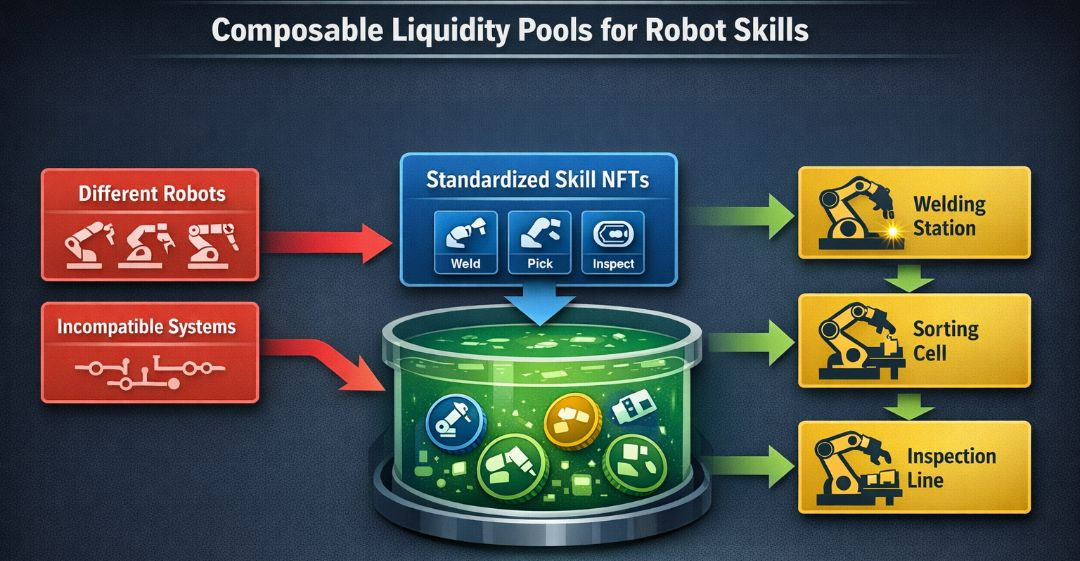
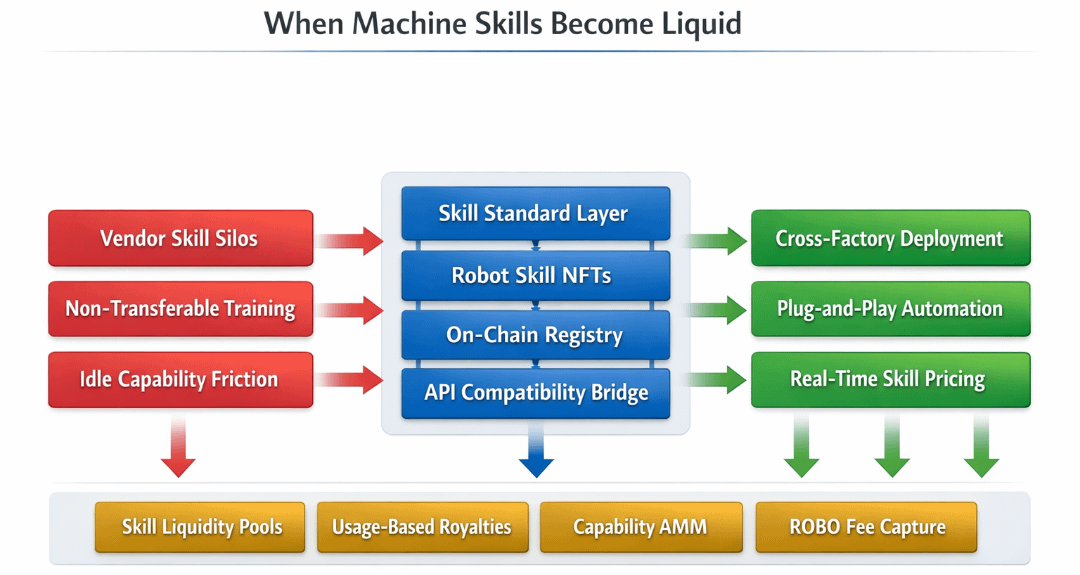
Not NFTs as collectibles. Not speculative artifacts. But standardized, machine-verified capability tokens — “Arc Welding Level 3,” “Laser Cutting 10mm Steel,” “High-Speed Pick-and-Place 0.2mm Accuracy.” Each minted only after hardware calibration proof, performance benchmarking, and periodic audit.
Suddenly, the unit of exchange shifts.
Instead of hiring Factory A, you lease 400 units of “High-Torque Assembly Skill” across a distributed network of machines that satisfy the NFT specification. Factories become liquidity providers of machine skills. The floor becomes a composable capability pool.
Mechanically, this requires several design principles:
1. Verifiable Skill Encoding
Each robot’s performance data — error rate, throughput, downtime, calibration logs — must be cryptographically anchored. Not raw telemetry on-chain, but hashed attestations. Oracles validate performance thresholds before a skill NFT can be issued or renewed.
2. Skill Fragmentation
Capabilities must be divisible. A factory holding 10 robotic arms could tokenize partial daily capacity as fractional skill units. These NFTs represent time-bound rights to execute a defined task under measurable parameters.
3. Dynamic Pricing Layer
Instead of opaque algorithmic repricing, skill NFTs trade in an open marketplace. Price discovery reflects real-time demand for specific capabilities, not bundled factory margins. Idle machines naturally lower skill prices to attract flow.
4. Settlement and Escrow Logic ($MIRA)
$MIRA functions as the coordination token. It handles staking for skill providers, collateral for performance guarantees, and fee capture for protocol-level verification services. If a machine underperforms relative to its NFT spec, staked $MIRA is slashed and redistributed to affected buyers.
This is not abstract decentralization rhetoric. It’s mechanism design.
Factories stake $MIRA to mint skill NFTs. Buyers lock $MIRA when reserving capability. Upon successful task completion — verified via post-execution performance attestations — funds settle automatically. If deviation exceeds tolerance, dispute resolution triggers arbitration logic tied to objective performance metrics.
The incentive loop looks like this:
Factory stakes $MIRA → Mints skill NFT → Lists fractional capacity → Buyer acquires NFT → Task executed → Performance attested → Settlement + fees → Reputation updated → Future pricing adjusts.
A visual that clarifies this would be a flow diagram of the incentive loop, showing:
Left column: Factory actions (stake, mint, execute)
Middle: Verification layer (oracle attestations, performance thresholds)
Right column: Buyer actions (acquire, deploy job, confirm receipt)
Bottom layer: $MIRA token flows (stake lock, fee distribution, slashing events)
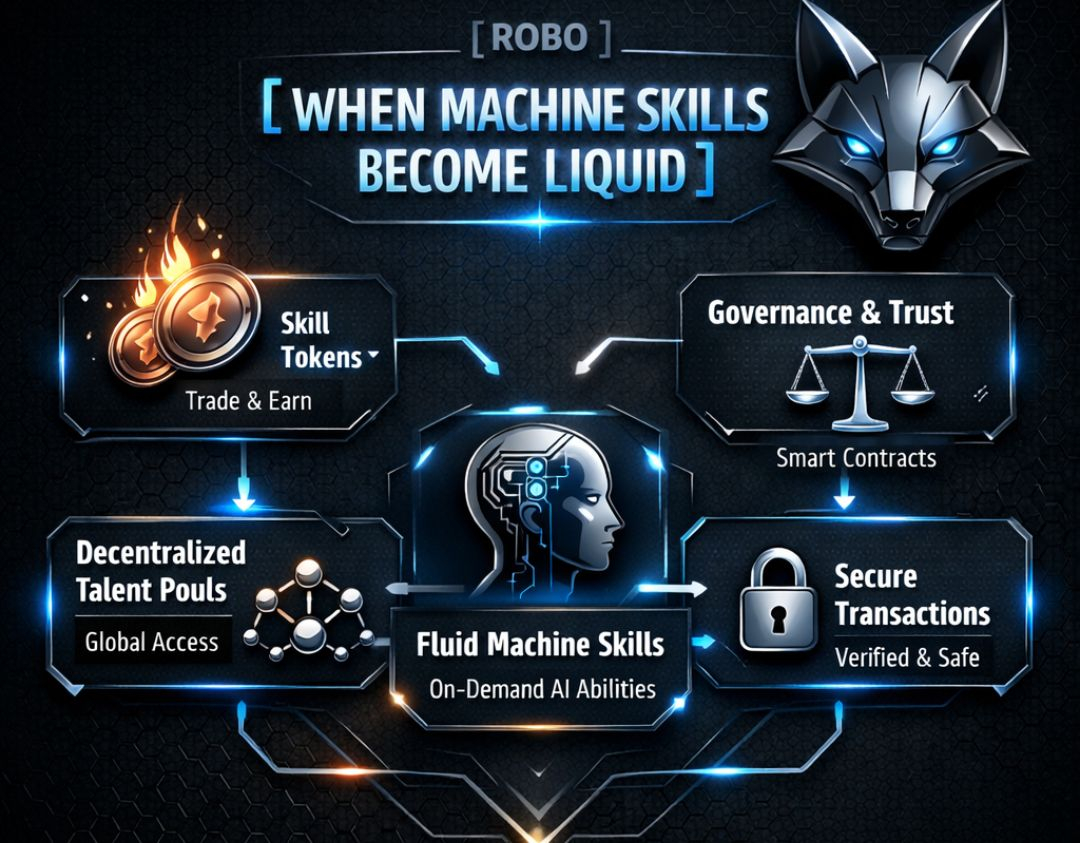
This matters because it reveals that $MIRA isn’t just a payment rail. It’s the enforcement substrate aligning machine performance with market trust.
Value capture emerges from three layers:
Minting and renewal fees for skill NFTs.
Transaction fees on skill leasing.
Slashing penalties redistributed through governance-controlled pools.
Governance becomes less about parameter votes and more about specification evolution. What qualifies as “Level 3 Welding”? How often must calibration proofs be refreshed? What oracle providers are trusted? These decisions shape the integrity of the capability pool.
Second-order effects are where it gets interesting.
Developers stop building monolithic factory platforms and start building skill routers — algorithms that optimize job distribution across skill NFTs globally. Instead of negotiating contracts, they optimize liquidity across capability pools.
Manufacturers shift behavior too. Idle capacity becomes a visible liability. The market punishes underutilization through lower NFT pricing. Capital allocation decisions become transparent signals: invest in higher-precision robotics, mint higher-tier skill NFTs, capture better margins.
But there are risks.
Standardization might compress differentiation. If every “10mm Laser Cutting” NFT is equivalent, premium branding erodes. Smaller factories could struggle to meet staking requirements. Oracle manipulation or falsified telemetry could corrupt trust in the system.
And there’s a deeper question: does tokenizing skill reduce manufacturing to a commodity layer, stripping away contextual craftsmanship that doesn’t fit into clean specifications?
Liquidity improves efficiency. It can also flatten nuance.
Still, the architectural shift is hard to ignore. If robot skills become standardized digital primitives, factories stop being destinations and start being nodes in a global capability mesh. Capital no longer buys buildings alone; it buys programmable skill bandwidth.
That moment when my fabrication quote jumped 14% without explanation wasn’t dramatic. It was structural. It exposed that machine capability is dynamically allocated but statically monetized.
If ROBO and $MIRA succeed in abstracting skill into liquid units, the factory floor stops being a closed optimization engine and becomes an open liquidity pool of machine competence.
And once skill is liquid, industrial power migrates from ownership of machines to orchestration of capability.