
@Mira - Trust Layer of AI $MIRA #mira

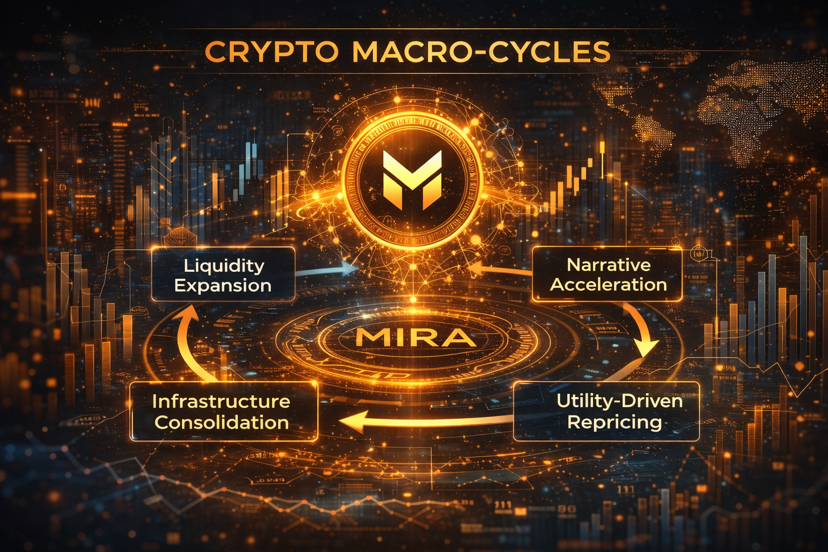
Crypto markets historically rotate through identifiable macro phases: liquidity expansion, narrative acceleration, infrastructure consolidation, and finally utility-driven repricing. Understanding where MIRA Coin fits within this framework requires zooming out beyond short-term volatility and examining structural capital flows.
The previous cycle was largely dominated by DeFi primitives, Layer-1 competition, and NFT-driven liquidity expansion. The current emerging macro theme appears centered around artificial intelligence and modular infrastructure. However, narrative adoption typically precedes infrastructure maturity. Early in a cycle, capital flows into thematic tokens; later, it consolidates around protocols that provide measurable utility.
MIRA Coin’s positioning within verifiable AI infrastructure suggests it may belong to the second phase of the AI-crypto convergence rather than the first. While speculative AI tokens may capture early momentum, sustainable valuation tends to accrue to projects solving foundational problems — scalability, interoperability, and verification.
From a liquidity perspective, infrastructure tokens often lag during narrative-driven surges but outperform during consolidation phases when market participants shift from storytelling to due diligence. If AI agents become embedded into DeFi, DAO governance, and automated trading systems, the demand for verifiable computation transitions from optional to systemic.
Macro conditions also matter. In high-liquidity environments, risk appetite expands and capital tolerates experimental models. In tightening conditions, markets reward efficiency and provable utility. If the broader crypto market enters a phase emphasizing real revenue, integration depth, and defensible tokenomics, $MIRA’s thesis strengthens.
Another macro variable is regulatory posture. As AI-driven financial automation increases, oversight bodies may demand greater transparency in algorithmic decision-making. Protocols that embed validation and auditable computation could benefit from this shift, indirectly reinforcing infrastructure-layer demand.
In cycle theory terms, MIRA Coin represents exposure to a convergence trade: AI + blockchain + verification standards. Its valuation trajectory will likely depend less on immediate hype and more on whether decentralized AI transitions from experimental deployment to economic necessity.
If the next major crypto cycle is defined by intelligent automation operating at scale, then verification infrastructure becomes mission-critical. Under that macro scenario, MIRA is not simply an AI token — it becomes a structural bet on the maturation of decentralized intelligence systems.